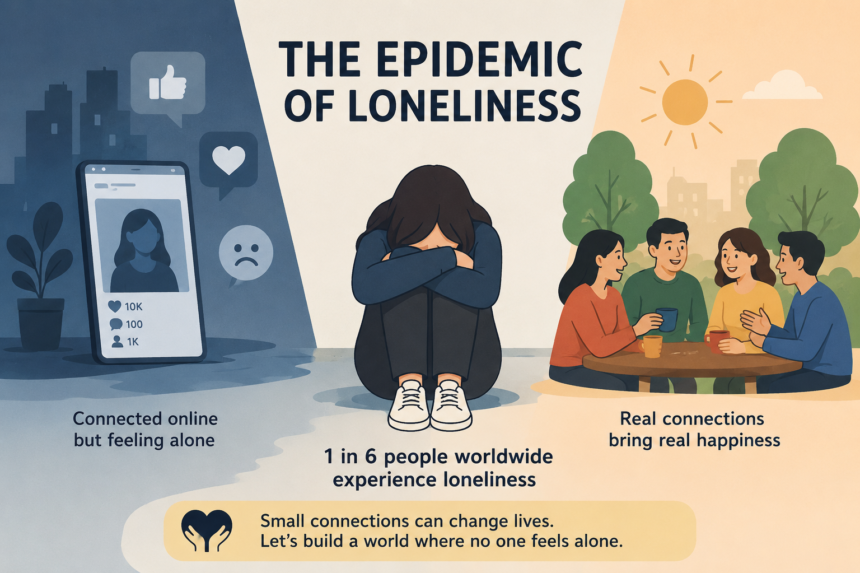
Loneliness, once regarded as a private emotional struggle, is increasingly being recognised as a global public-health emergency. From teenagers surrounded by online followers to older people living alone, millions are experiencing a painful gap between the relationships they have and the meaningful connection they need. In June 2025, the World Health Organization reported that approximately one in six people worldwide experiences loneliness. It estimated that loneliness is associated with about 871,000 deaths annually, roughly 100 deaths every hour, placing social connection alongside exercise, nutrition and healthcare as an important influence on human health.
The crisis is not confined to any single country, age group or social class. Loneliness affects people in crowded cities, remote villages, workplaces, universities and family homes. Young people can feel excluded despite being continuously connected through smartphones, while older adults may become isolated after retirement, bereavement, illness or reduced mobility. Migrants, people with disabilities, carers, unemployed workers and those living far from their families may face additional barriers to belonging. Social isolation refers to having limited contact or support, while loneliness is the subjective feeling that one’s relationships are insufficient. A person can therefore live alone without feeling lonely, or feel profoundly lonely in a room full of people.
Loneliness is not new. Industrialisation moved populations away from extended families, while urbanisation created cities where people could live close together without knowing their neighbours. In recent decades, smaller households, declining participation in community organisations, demanding work schedules and greater geographical mobility have weakened some traditional support networks. Governments gradually began treating the issue as more than a personal problem. Britain appointed a ministerial lead for loneliness in 2018 after the work of the Jo Cox Commission, becoming the first country to launch a national loneliness strategy. Japan appointed its first minister responsible for loneliness and isolation in 2021 after social disconnection and suicide became increasingly urgent concerns during the COVID-19 pandemic.
The pandemic did not create loneliness, but lockdowns, bereavement, school closures and remote working exposed and intensified it. Although social activities later resumed, many people found that their previous routines and relationships did not fully return. Flexible and remote work brought significant benefits, yet for some employees it also removed informal conversations, shared lunches and everyday contact with colleagues. Meanwhile, rising living costs, insecure employment, long commutes and the disappearance of affordable public spaces have made regular social participation more difficult.

Technology occupies a complicated position in this crisis. Messaging applications and video calls help families remain connected across borders and offer communities to people who might otherwise be excluded. However, passive scrolling, online comparison and replacing face-to-face relationships with brief digital interactions may leave users feeling less satisfied. Emerging artificial-intelligence companions are also being marketed as answers to isolation, but researchers warn that artificial intimacy is not a universal remedy and may create ethical concerns when commercial platforms profit from emotionally vulnerable users.
The health consequences can be severe. According to the WHO, loneliness and social isolation are associated with depression, anxiety, cardiovascular disease, diabetes, cognitive decline, stroke and premature death. A landmark advisory from the United States surgeon general warned that insufficient social connection can carry a mortality risk comparable to smoking as many as 15 cigarettes a day. Loneliness can also affect concentration, sleep, workplace productivity and educational performance. It may become self-reinforcing: people who feel rejected can withdraw from social situations, making meaningful connection even harder to rebuild.
There is, however, growing evidence that practical action can help. Community kitchens, neighbourhood gardens, sports clubs, libraries, volunteering programmes, faith groups and intergenerational projects are creating opportunities for regular, low-pressure interaction. Recent reporting from the United States has highlighted local groups using shared meals, farming, affordable housing projects and community events to rebuild trust and belonging. Healthcare systems are also experimenting with “social prescribing,” through which patients are connected to community activities and support services rather than being offered medical treatment alone.

The epidemic of loneliness cannot be solved simply by telling individuals to socialise more. Governments must protect public spaces, support community organisations, improve transport and design housing, schools and workplaces around human interaction. Technology companies should consider whether their products encourage genuine communication or endless consumption. Individuals can play a role by checking on neighbours, calling relatives and creating time for friendships, but social connection must also become a policy priority. Loneliness is personal, yet its causes and consequences are collective. Treating relationships as essential social infrastructure, not an optional luxury, may be one of the most important public-health investments of the modern age.