Ten years after Britain voted to leave the European Union, Brexit has changed the United Kingdom less like a single earthquake than a prolonged political and economic aftershock. It transformed how Britain trades, controls migration, regulates businesses and defines its international role. However, it also exposed deep divisions between generations, regions and social groups, leaving the country still debating whether Brexit was a historic recovery of sovereignty or an expensive act of self-isolation.
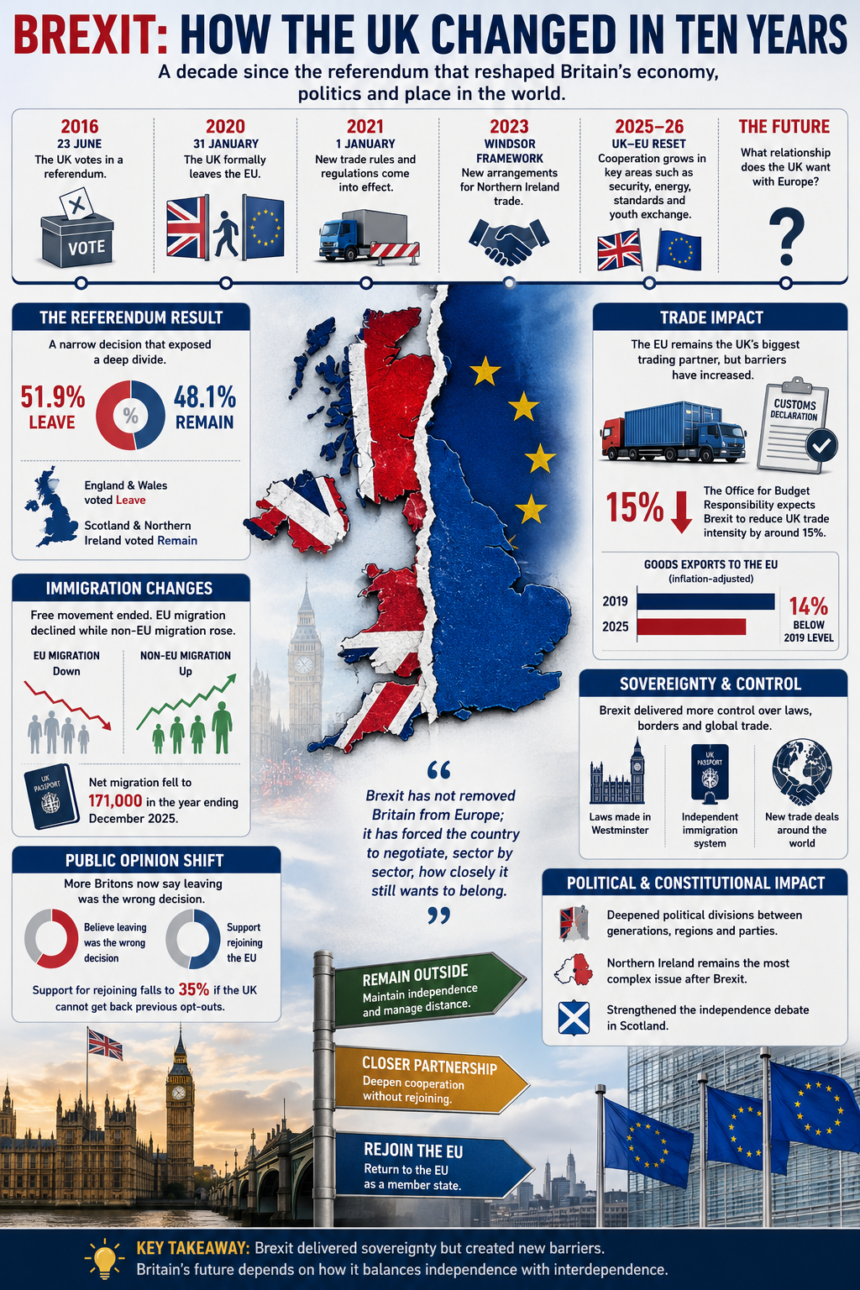
Brexit, an abbreviation of “British exit”, began with the referendum held across the United Kingdom and Gibraltar on June 23, 2016. A narrow majority of 51.9 percent voted to leave the EU, while 48.1 percent supported remaining. The result reflected a geographically divided kingdom: England and Wales backed Leave, while Scotland and Northern Ireland voted to remain. The UK formally left the European Union on January 31, 2020, after 47 years of membership. A transition period continued until December 31, 2020, after which Britain left the EU’s single market and customs union.
The Leave campaign succeeded by combining several concerns. Supporters argued that laws should be made in Westminster rather than Brussels, immigration should be controlled nationally and money contributed to the EU should be spent inside Britain. Many voters in post-industrial towns also saw Brexit as a protest against economic inequality, austerity and political elites. Immigration, national identity and dissatisfaction with rapid social change became especially powerful themes. Yet Leave supporters did not all vote for the same future: some wanted a globally open, lightly regulated Britain, while others wanted stronger borders, protected industries and reduced immigration.
Brexit did deliver formal sovereignty. Parliament can now change regulations inherited from the EU, Britain operates an independent immigration system and the government can negotiate its own trade agreements. The UK has joined the Comprehensive and Progressive Agreement for Trans-Pacific Partnership and concluded agreements with countries including Australia, New Zealand and Switzerland. Supporters say these freedoms could produce long-term benefits if Britain develops competitive regulations, invests in technology and builds stronger commercial relationships beyond Europe.

Nevertheless, sovereignty has come with economic friction. British exporters now face customs declarations, regulatory checks and rules-of-origin requirements when selling to the EU, which remains the country’s largest trading partner. The Office for Budget Responsibility continues to assume that Brexit will eventually reduce UK trade intensity by approximately 15 percent compared with remaining in the EU. Britain’s goods exports to the EU in 2025 were reportedly 14 percent below their inflation-adjusted 2019 level, although services exports have performed more strongly. The economic damage was not the sudden collapse predicted by some Remain campaigners, but a gradual loss of potential investment, productivity and trade.
Brexit also changed immigration rather than simply reducing it. Free movement between the UK and EU ended, causing European migration to decline and contributing to labour shortages in healthcare, hospitality, agriculture and construction. Employers increasingly recruited workers and students from Asia, Africa and other non-EU regions. Net migration later rose to record levels before falling sharply to an estimated 171,000 in the year ending December 2025. Non-EU nationals still produced positive net migration of 350,000, while more EU and British nationals left than arrived.
Politically, Brexit destabilised Britain. It contributed to repeated Conservative leadership contests, disputes over Parliament’s authority and years of negotiations with Brussels. Northern Ireland became the most difficult constitutional problem because Brexit created a need to protect the EU market without restoring a hard border with the Republic of Ireland. Special trading arrangements gave Northern Ireland access to both British and European markets, but checks on some goods moving from Great Britain fuelled unionist opposition. Brexit also strengthened Scottish arguments for independence because Scotland had voted to remain.

The present direction is therefore not a complete reversal but a gradual UK–EU “reset.” Britain and the EU have pursued cooperation on food standards, energy, security, policing, professional qualifications and youth mobility. The UK is also scheduled to return to the Erasmus student-exchange programme in 2027. These agreements recognise that geography continues to matter: Britain can leave EU institutions, but it cannot economically separate itself from its closest market.
Do Britons now want to rejoin? Public opinion has clearly shifted. YouGov polling published in June 2026 found that 57 percent believed leaving was the wrong decision and 55 percent supported rejoining. However, support fell to 35 percent when respondents were told Britain might not recover its former opt-outs, including special arrangements concerning the euro and European integration. An even broader 59 percent supported closer relations without rejoining the EU, single market or customs union.
Brexit’s central lesson is that sovereignty and prosperity are not automatically the same thing. Britain gained the legal power to act independently but increased the economic cost of dealing with its neighbours. Rejoining would not be an instant cure and could revive the bitter divisions of 2016. The most realistic future is deeper practical alignment with Europe while Britain remains formally outside. Brexit has not removed Britain from Europe; it has forced the country to negotiate, sector by sector, how closely it still wants to belong.