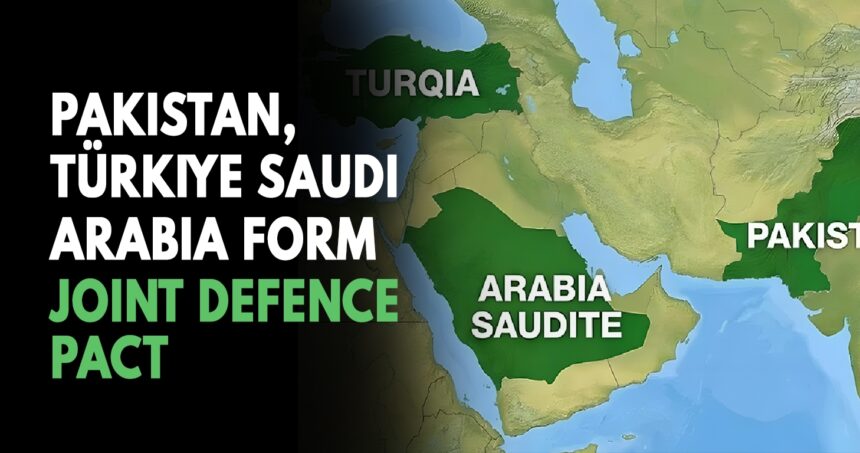
Pakistan, Türkiye and Saudi Arabia are moving rapidly to turn their newly signed Makkah Joint Defence Agreement into a functioning security alliance, establishing a permanent secretariat and laying the foundations for deeper military coordination, joint defence production and collective deterrence at a time of exceptional instability across the Middle East.
The three countries signed the landmark agreement in Makkah on August 7, 2026, after months of negotiations. Saudi Crown Prince Mohammed bin Salman, Turkish President Recep Tayyip Erdoğan and Pakistani Prime Minister Shehbaz Sharif signed the pact, formally creating a trilateral defence framework between three of the Muslim world’s most militarily and politically influential states.
Its most significant provision is straightforward: an armed attack against any one of the three countries will be regarded as an attack against all of them. The collective-defence principle has inevitably drawn comparisons with NATO’s Article 5, although the Makkah agreement has not publicly specified exactly what military response each member would be required to provide.
Why Was the Makkah Defence Pact Created?
The agreement emerged against the backdrop of a dramatically changing regional security environment. The war involving Iran, Israel and the United States, Iranian missile attacks affecting Gulf states and threats to energy infrastructure have increased concerns among regional governments about their vulnerability to missiles, drones and wider military escalation.

Saudi Arabia has traditionally depended heavily on the United States for advanced weapons and security guarantees. The new alliance, however, provides Riyadh with additional layers of protection without necessarily replacing its American relationship. Each member brings a different strategic strength.
Pakistan possesses one of the region’s largest militaries and is the only nuclear-armed member of the alliance. Türkiye has NATO’s second-largest military and an increasingly sophisticated defence industry producing drones, missiles, warships and other weapons systems. Saudi Arabia contributes enormous financial resources, strategic geography and political influence across the Arab and Islamic worlds.
The pact also builds on decades of Saudi-Pakistani defence cooperation and Pakistan’s longstanding role in training Saudi forces. For Türkiye, meanwhile, the alliance provides an opportunity to expand its strategic and defence-industrial influence across the Gulf and South Asia while remaining a NATO member.

First Major Meeting in Istanbul
The agreement moved into its next phase on August 31, when the foreign ministers, defence ministers and military chiefs of the three countries gathered at Istanbul’s Çırağan Palace for the inaugural meeting of the Strategic Political and Defence Committee. Pakistan was represented by Foreign Minister Ishaq Dar, Defence Minister Khawaja Muhammad Asif and Army Chief Field Marshal Asim Munir, while senior Saudi and Turkish political and military officials also participated.
The meeting focused on international security, strengthening collective defence capabilities, military interoperability and expanding cooperation between the countries’ defence industries. Perhaps the most important development was the decision to establish a permanent secretariat in Saudi Arabia. Pakistan will provide the alliance’s first secretary-general, who will serve for three years.
That decision matters because it transforms the agreement from a political declaration into an increasingly institutionalized organisation. The countries also agreed to develop mechanisms for cooperation and coordination, while reaffirming their commitment to regional peace and stability.
Could It Become a ‘Muslim NATO’?
The collective-defence provision has prompted widespread descriptions of the emerging bloc as a possible “Muslim NATO.” That description, however, remains premature. NATO possesses an enormous integrated military command structure, standardized procedures, decades of joint planning and established multinational forces. The Makkah alliance is still at an early stage and has yet to demonstrate how its collective-defence commitment would operate during an actual war.
Nevertheless, its potential expansion could significantly alter the strategic landscape. Türkiye has indicated that work is underway on a roadmap governing how other countries might eventually join the alliance. The development could therefore produce a broader security architecture connecting the Middle East, Türkiye and South Asia.
Nuclear Question and Regional Impact
Pakistan’s nuclear arsenal inevitably adds another dimension. The public agreement does not explicitly establish a Pakistani nuclear umbrella over Saudi Arabia or Türkiye, and analysts caution against assuming that Pakistan’s nuclear weapons automatically form part of the pact. Still, Pakistan’s nuclear status increases the alliance’s deterrent significance and is likely to influence how neighbouring powers interpret the agreement.
India will closely watch Pakistan’s expanding military partnerships, while Iran will assess whether the pact represents a defensive mechanism or an emerging strategic counterweight. Israel and the United States will similarly monitor its development. For Saudi Arabia, the alliance demonstrates an increasingly independent foreign policy: maintaining its partnership with Washington while simultaneously building stronger relationships with other military powers.
Ambitious Pact Faces Its Real Test
The Makkah agreement is strategically impressive on paper, but its real value will depend on implementation. Pakistan, Türkiye and Saudi Arabia have different foreign-policy priorities. Türkiye remains embedded in NATO; Pakistan must carefully manage relationships with China, Iran and other regional powers; and Saudi Arabia has its own complicated security relationships with Washington, Tehran and Israel.
There is also the crucial question of what “an attack on one is an attack on all” actually requires. The agreement’s publicly available details do not specify whether members must automatically deploy troops, provide weapons or directly enter a war. That ambiguity may be deliberate, providing deterrence without completely removing each government’s freedom of action.
Still, the establishment of a permanent secretariat shows that the three governments intend the arrangement to become more than symbolic diplomacy. If it develops integrated military planning, intelligence sharing, joint exercises and defence-industrial cooperation, the Makkah pact could become one of the most consequential new security organisations to emerge from the Muslim world in decades.
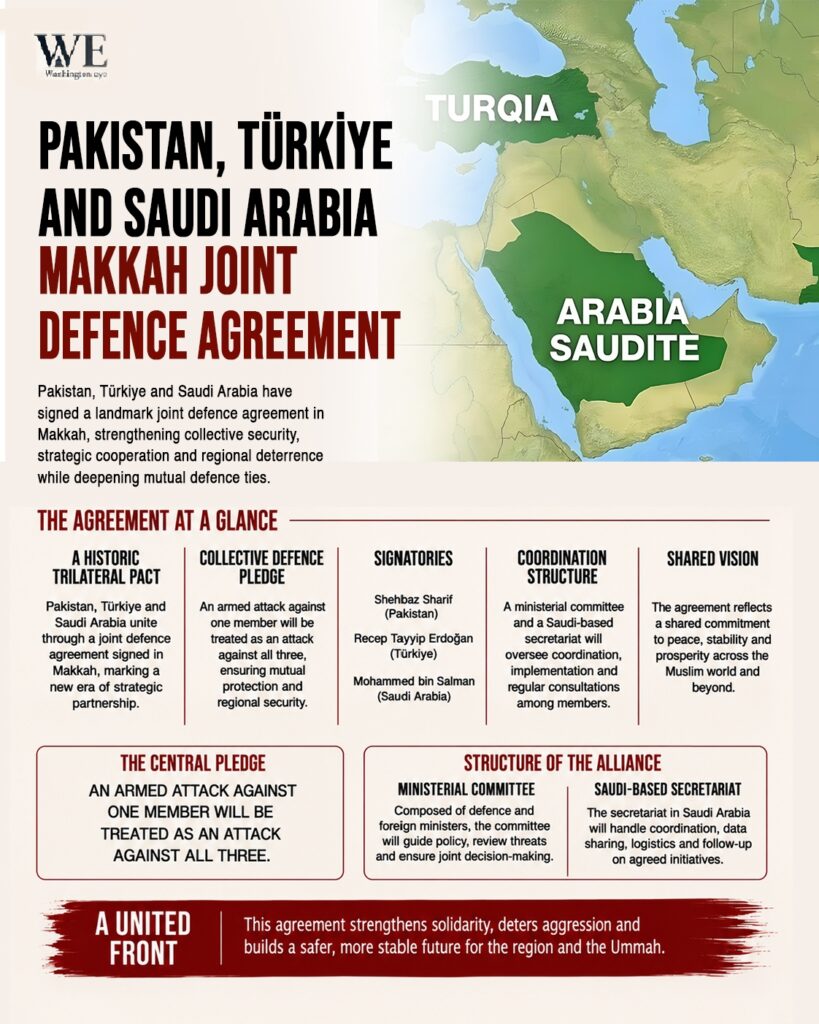
For now, its significance lies in the combination it brings together: Saudi financial and geopolitical power, Turkish military-industrial strength and Pakistan’s conventional and nuclear capabilities. Whether that combination develops into a genuine collective-defence alliance, or remains primarily a strategic partnership, will be one of the most important regional security questions to watch in the coming years.