
Thailand is confronting renewed questions over gun control and school safety after a 14-year-old student carried out a deadly shooting rampage at his home and school outside Bangkok, ultimately leaving nine people dead, including the teenage attacker. The tragedy, one of Thailand’s worst mass shootings in recent years, has prompted tighter school security, mental-health support and government promises to strengthen firearm regulations.
The attack took place on the morning of August 7 at Debsirin Nonthaburi School in Bang Kruai district, Nonthaburi province, northwest of Bangkok. According to police, the teenager first killed his two grandparents at their home before travelling to the school, where he opened fire on teachers and staff.
Five school employees were killed in the attack. The teenage gunman subsequently died after apparently shooting himself. A 12-year-old girl later died in hospital, taking the overall death toll to nine, including the shooter and his grandparents. More than 20 people were wounded, and several initially remained in critical condition.
Terror Inside the School
The shooting began at around 10 a.m. local time, turning an ordinary school morning into scenes of panic. Students initially mistook the sound of gunfire for construction noise. As more shots rang out, teachers rushed pupils into classrooms. Students barricaded doors with desks, switched off lights and hid while waiting for police and emergency services. One 14-year-old student later told Reuters she feared that she and her classmates would not survive.

Police said the teenager fired at least 26 rounds during the attack. Authorities also recovered dozens of additional rounds. The firearm reportedly belonged to his grandfather and was legally registered, highlighting a central issue in the subsequent national debate: how a young teenager was able to obtain access to a lethal weapon.
Early reports described the teenager as having experienced difficulties connected with school, including reports of bullying and stress. However, authorities have continued investigating the circumstances surrounding the attack, and such factors alone cannot explain or excuse the violence.
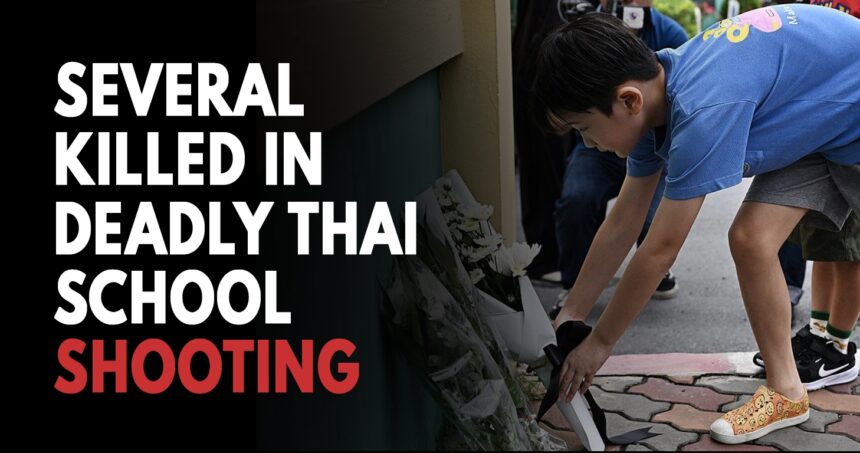
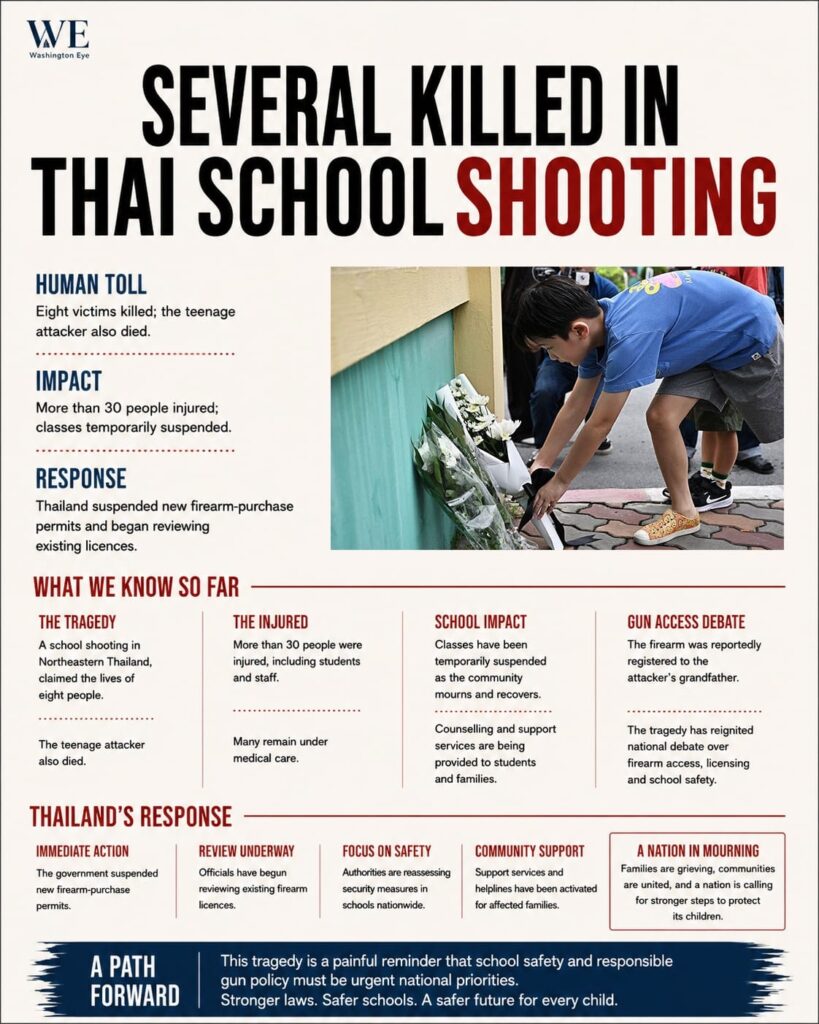
The attack devastated families and the wider school community. Flowers and memorials appeared outside the school as relatives collected the bodies of victims and parents returned to retrieve belongings left behind during the panic.
Thailand’s Gun Problem Comes Under Scrutiny
The shooting has renewed attention on Thailand’s relatively high level of civilian firearm ownership. Figures from the Small Arms Survey have estimated that Thai civilians possess approximately 10.3 million firearms, equivalent to roughly 15 guns for every 100 people. Around 6.2 million were estimated to be registered, while millions more were believed to be unregistered.
Thailand has previously experienced devastating mass killings. In 2022, a former police officer attacked a childcare centre in Nong Bua Lamphu province, killing dozens of people, many of them young children. The Nonthaburi shooting became the country’s deadliest mass killing in nearly four years, intensifying demands for stronger controls over who can possess weapons and how firearms are stored in homes.
Prime Minister Anutin Charnvirakul responded by pledging tougher action. His government suspended the issuance of new firearm permits and announced a review of existing licences. Anutin has also proposed tighter restrictions on carrying firearms in public. The challenge, however, extends beyond introducing new laws. Thailand must also address illegally held weapons, enforcement of existing regulations and secure storage of legally owned firearms.
School Reopens Under Heavy Security
Three weeks after the massacre, Debsirin Nonthaburi School reopened on September 1 under heightened security. Police officers were deployed around the campus, while bags were checked as students returned to classrooms. Mental-health specialists have also been providing support to students and staff affected by the attack.
Some parents reported that their children continued to struggle emotionally, while schools elsewhere have begun reviewing emergency procedures and conducting active-shooter drills. The psychological impact may ultimately last far longer than the physical reconstruction of school life. Students who hid from gunfire, teachers who lost colleagues and families who lost relatives will require sustained support rather than short-term intervention.
Critical View: Could the Attack Have Been Prevented?
The tragedy raises two difficult questions: how did a 14-year-old obtain a firearm, and could warning signs have been identified earlier? Debate over bullying or the teenager’s psychological condition should not obscure the role of access to a gun. Many young people experience stress, isolation or bullying without becoming violent. What made this situation particularly dangerous was the combination of personal difficulties and access to a lethal weapon.
At the same time, simply tightening school gates would address only part of the problem. Effective prevention requires secure firearm storage, responsible licensing, early intervention when young people show serious behavioural concerns, accessible mental-health services and clear emergency procedures in schools.
Thailand now faces pressure to turn public shock into lasting reform. Previous mass shootings have generated promises of stronger firearm regulation, yet millions of legal and illegal weapons remain in circulation. The return of students to Debsirin Nonthaburi School marks the beginning of recovery, but the shooting has left the country with a broader challenge: ensuring that the tragedy produces more than temporary security measures.
For the families of those killed, that debate comes too late. But stronger gun controls, safer firearm storage and better school preparedness could determine whether another Thai community experiences the same devastation.