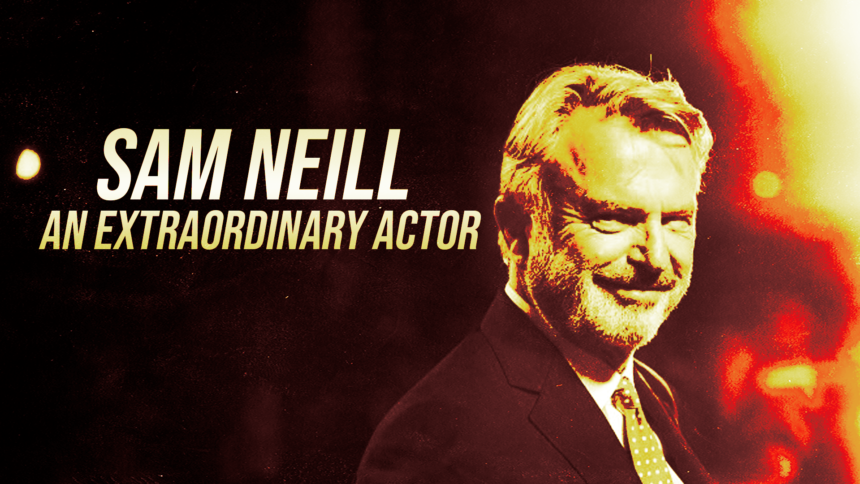
Sam Neill, the widely admired New Zealand actor whose quiet authority, warmth and versatility carried him from independent cinema to the global phenomenon of Jurassic Park, has died at the age of 78. Neill died in Sydney on Monday, July 13, 2026, surrounded by his family. His relatives described the loss as sudden and unexpected, adding that he remained free of the blood cancer he had previously overcome.
Neill’s long-time agent, Philip Grenz, later confirmed that the actor died from pneumonia. The clarification followed speculation linking his death to the stage-three angioimmunoblastic T-cell lymphoma with which he had been diagnosed in 2022. Neill had undergone chemotherapy before receiving CAR T-cell therapy, an advanced treatment that modifies a patient’s immune cells to attack cancer. In April 2026, he announced that scans showed no evidence of the disease. His agent confirmed the cause of death and plans for a private memorial.
Born Nigel John Dermot Neill in Omagh, Northern Ireland, on September 14, 1947, he moved with his family to New Zealand in 1954. He studied English literature and initially worked for the New Zealand National Film Unit, directing documentaries before establishing himself as an actor. His breakthrough came with Roger Donaldson’s 1977 political thriller Sleeping Dogs, a landmark film in the development of modern New Zealand cinema.
International audiences soon discovered Neill through the Australian drama My Brilliant Career in 1979, in which he appeared opposite Judy Davis. His performance demonstrated the understated charisma that would become a defining feature of his career. He subsequently played Damien Thorn in Omen III: The Final Conflict and earned international recognition for the television series Reilly, Ace of Spies, which brought him a Golden Globe nomination.

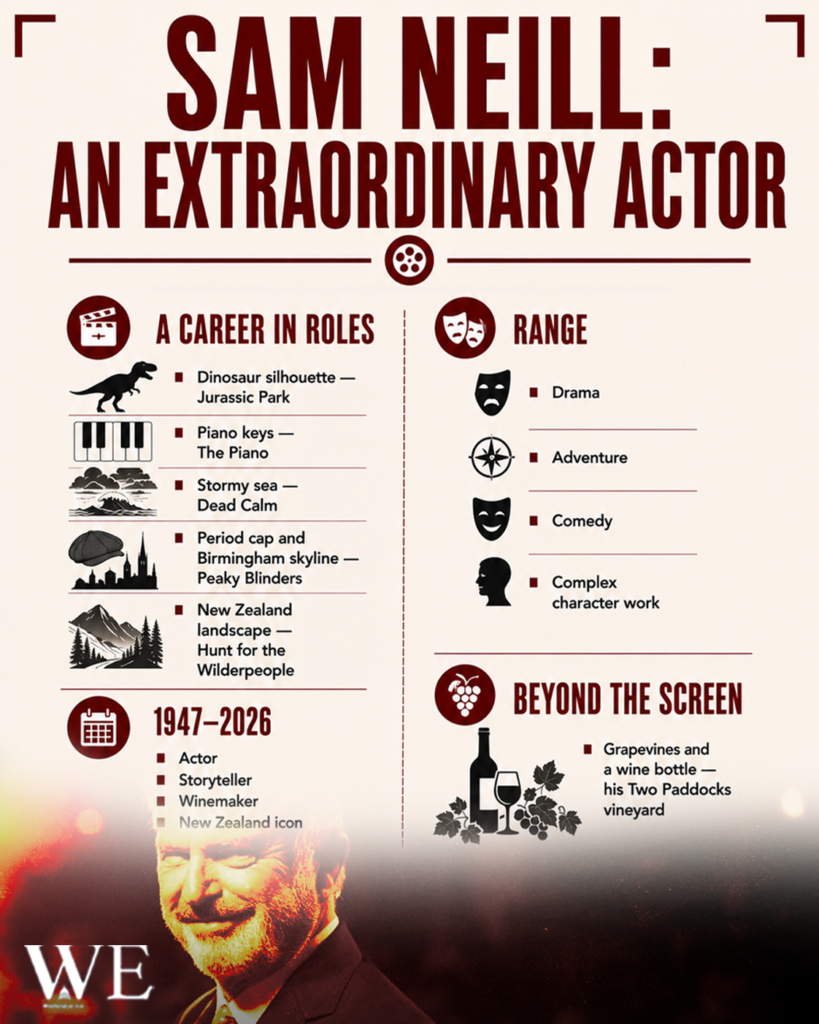
Neill proved equally convincing as a romantic lead, scientist, soldier, villain and troubled authority figure. His filmography included Dead Calm, The Hunt for Red October, The Piano, Event Horizon, The Dish and Hunt for the Wilderpeople. On television, he appeared in productions including Merlin, The Tudors, Peaky Blinders and the Australian courtroom drama The Twelve. Across more than five decades and over 150 screen credits, he moved naturally between Hollywood productions and smaller films from Australia and New Zealand.
His most famous role arrived in 1993 when Steven Spielberg cast him as palaeontologist Dr Alan Grant in Jurassic Park. With his battered hat, practical intelligence and initially uncomfortable relationship with children, Grant became one of the franchise’s most recognisable characters. Neill returned to the role in Jurassic Park III in 2001 and reunited with Laura Dern and Jeff Goldblum for Jurassic World Dominion in 2022.
Although Jurassic Park made him an international star, Neill resisted being defined by a single blockbuster. In Jane Campion’s Oscar-winning The Piano, also released in 1993, he delivered a darker and more emotionally complex performance as Alisdair Stewart. His willingness to move between commercial entertainment, historical drama, horror, comedy and arthouse cinema demonstrated an uncommon range and helped make him one of New Zealand’s most internationally respected performers.

News of his death prompted tributes from actors and filmmakers around the world. Spielberg, Dern, Nicole Kidman, Taika Waititi, Toni Collette, Richard E. Grant and others remembered Neill not only for his talent but also for his kindness, humour and generosity on set. Kidman, who starred opposite him in Dead Calm, reflected on their long friendship, while Dern celebrated the enduring bond created during the Jurassic Park films. Colleagues across the film industry paid tribute to Neill’s life and work.
Away from acting, Neill found peace at his farm and vineyard in New Zealand’s Central Otago region. He founded the Two Paddocks winery in the 1990s and became known online for humorous videos featuring his animals. His life outside the film industry reflected the modesty and affection for nature that audiences frequently associated with him. He was redesignated a Knight Companion of the New Zealand Order of Merit in 2022 for his services to acting.
Neill addressed his illness openly in his 2023 memoir, Did I Ever Tell You This? Rather than presenting the book solely as an account of cancer, he described it as a celebration of the people, films and experiences that shaped his life. Even after intensive treatment, he continued working. His agent said he had completed four projects during his final year, meaning audiences will see several posthumous performances.
His family plans to honour him with a private memorial at his New Zealand farm, in keeping with the wishes of a man who reportedly disliked ceremony and attention. Neill leaves behind four children and eight grandchildren, as well as a body of work that crosses generations and genres. From frightened audiences watching dinosaurs break free to film lovers absorbed by his most restrained performances, Sam Neill offered something increasingly rare: a screen presence that was commanding without being showy, deeply human and unmistakably his own.