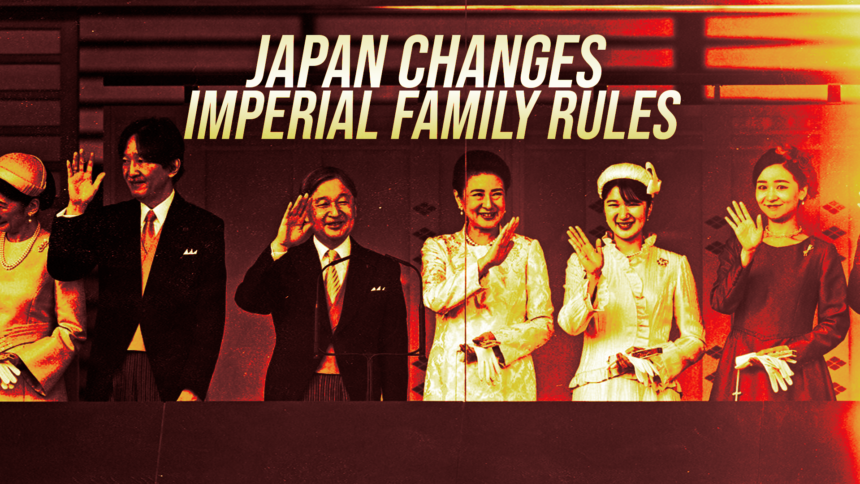
Japan has approved a historic revision of its Imperial House Law to address the rapid decline in the number of working royals and potential heirs. Parliament passed the legislation on July 17, 2026, allowing female members of the imperial family to retain their royal status after marrying commoners and permitting eligible men from former imperial branches to be adopted into the family. The new rules are expected to take effect on October 24, 2026.
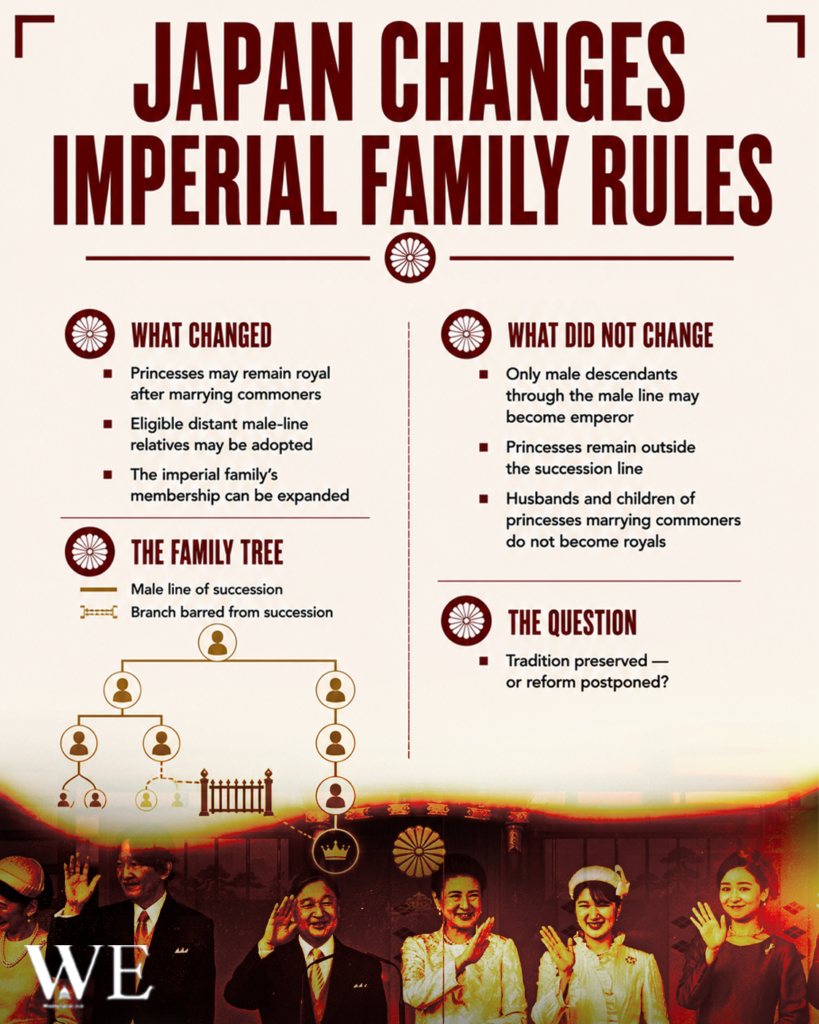
Despite being described as a relaxation of Japan’s royal succession system, the reform does not allow women to become emperor. Succession to the Chrysanthemum Throne remains restricted to men descended through the paternal line. Consequently, Princess Aiko, the popular 24-year-old only child of Emperor Naruhito and Empress Masako, remains excluded from succeeding her father.
Japan currently has only three people in line to the throne. First is Emperor Naruhito’s 60-year-old younger brother, Crown Prince Fumihito, also known as Crown Prince Akishino. He is followed by his 19-year-old son, Prince Hisahito, and the emperor’s 90-year-old uncle, Prince Hitachi. Hisahito was the first male born into the imperial family in approximately four decades, illustrating the fragility of a system entirely dependent on male births.

One part of the legislation addresses the continuing loss of female royals. Under the previous law, a princess automatically surrendered her title, public duties and membership of the imperial family if she married a commoner. Princess Mako, Emperor Naruhito’s niece, became a private citizen when she married Kei Komuro in 2021 and subsequently moved to New York.

Under the revised law, Princess Aiko, her cousin Princess Kako and other unmarried female royals will be able to retain their imperial status after marrying outside the family. They may continue performing ceremonies, attending official events and representing the emperor. However, their husbands and children will remain private citizens and will not receive imperial titles or succession rights. The measure therefore preserves the work of existing princesses without creating female-led lines of succession.
The second and more controversial provision permits the imperial family to adopt unmarried male descendants, aged 15 or older, from 11 former collateral branches of the dynasty. Fifty-one members of these branches lost their royal status during Japan’s post-war reforms in 1947. Some are now separated from Emperor Naruhito by dozens of generations and descend from a common paternal ancestor who lived centuries ago.
An adopted man would receive imperial status but would not personally become eligible for the throne. Any future son born to him through the male line, however, could enter the order of succession. Supporters believe this mechanism can produce additional male heirs without abandoning what conservatives describe as Japan’s uninterrupted paternal imperial lineage. Participation must be voluntary, and it remains unclear whether any eligible men are willing to surrender their private lives and accept the restrictions of royal membership. The revisions and adoption requirements were detailed following the parliamentary vote.

The reform was promoted as necessary because Japan’s imperial family has shrunk to 16 adult members, only five of whom are men. With princesses traditionally required to leave after marriage, fewer people have been available to perform the monarchy’s growing number of ceremonial and charitable duties. The government argues that retaining female members will stabilise the institution’s daily operations, while adoption could protect the future male succession line.
Nevertheless, critics argue that the law avoids the most direct solution: allowing Princess Aiko or another woman to inherit the throne. Public opinion surveys have repeatedly shown strong support for a female emperor, with some recent polling placing approval above 80 percent. Japan has also had eight reigning empresses in its history, the most recent being Empress Go-Sakuramachi, who ruled from 1762 until 1770.
Historians note that an exclusively male succession rule was formally written into the Imperial House Law only in 1889 and retained in the post-war law of 1947. Critics therefore challenge claims that excluding women represents an unchanged tradition stretching across Japan’s entire imperial history. They also question whether asking distant relatives raised as ordinary citizens to join the highly controlled royal household is realistic. Experts have warned that the reforms preserve the male line at the expense of a more sustainable succession system.
Supporters of the reform, including conservative Prime Minister Sanae Takaichi, maintain that paternal-line descent is central to the emperor’s legitimacy and symbolic authority. Takaichi, Japan’s first female prime minister, has resisted calls for gender-neutral succession while supporting measures intended to increase imperial family membership.
The revision therefore represents a limited modernisation rather than equal succession. It improves the position of female royals by allowing them to marry without being expelled from the family, but it leaves their husbands, children and the princesses themselves outside the succession line. Adoption may provide future male heirs, yet its success depends on willing participants and the birth of sons.
Japan has bought its ancient monarchy additional time, but the central question remains unanswered: whether a hereditary institution facing a severe shortage of male heirs can remain stable while excluding women such as Princess Aiko from the throne. The new law may preserve royal numbers in the short term, but the debate over gender, tradition and the future of the Japanese monarchy is far from over.