A new report by Médecins Sans Frontières (MSF) has warned that there is “no safe place” for women and girls in Sudan’s war-ravaged Darfur region, documenting widespread and systematic sexual violence across both conflict zones and everyday civilian spaces. The report, released on March 30–31, 2026, titled “There is something I want to tell you…”: Surviving the sexual violence crisis in Darfur, provides one of the most comprehensive accounts to date of gender-based violence since the outbreak of Sudan’s civil war in April 2023.
According to MSF, sexual violence has become a defining feature of the conflict, extending far beyond frontlines into markets, roads, farms, and displacement camps. Women and girls are being attacked while fleeing violence, collecting food or water, or even within camps that are supposed to offer refuge. The organization stated that such patterns indicate that the violence is not incidental but systematic, embedded in the broader dynamics of the war.
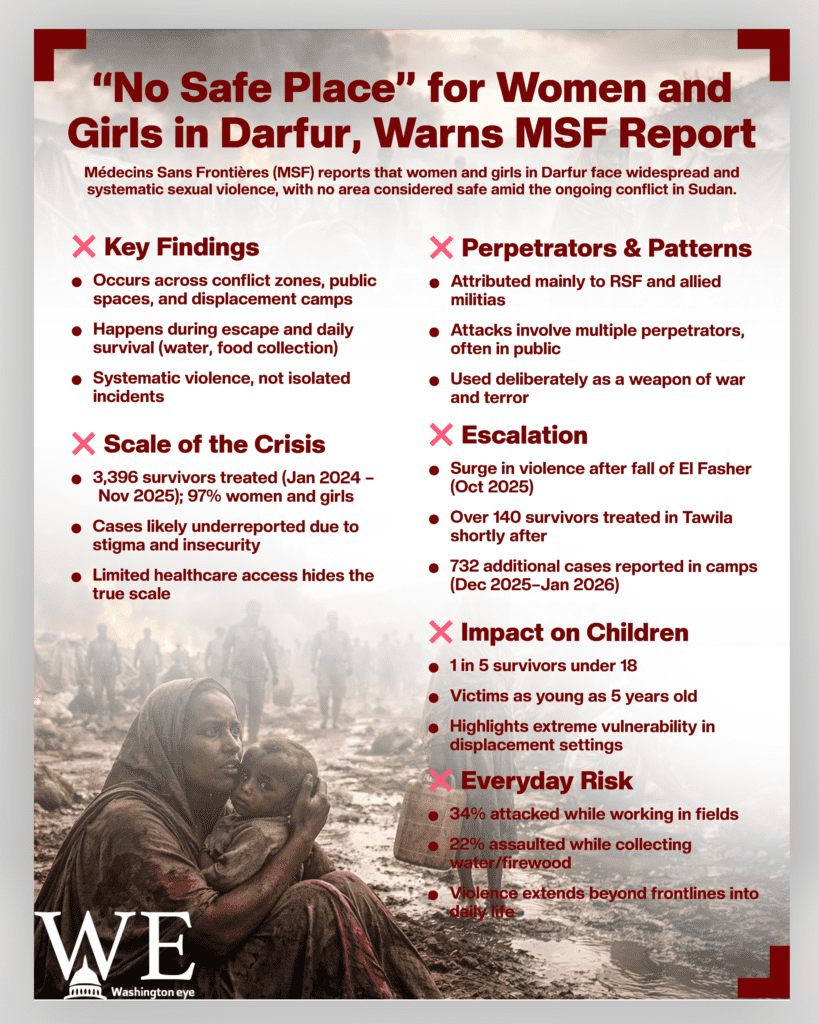
The report is based on medical data and survivor testimonies collected from MSF-supported health facilities across North and South Darfur. Between January 2024 and November 2025, at least 3,396 survivors of sexual violence sought treatment, with women and girls accounting for approximately 97 percent of the cases. However, MSF emphasized that the real number is likely far higher, as insecurity, stigma, and lack of access to healthcare prevent many survivors from seeking help.
The violence has been largely attributed to fighters from the Rapid Support Forces (RSF) and allied militias, who are accused of using sexual violence as a weapon of war. Survivors reported attacks carried out by armed men, often involving multiple perpetrators and frequently occurring in front of family members as a form of humiliation and terror. In North Darfur, more than 95 percent of survivors identified armed actors as their attackers.

The situation intensified following the RSF’s capture of El Fasher, the capital of North Darfur, in October 2025. In the weeks that followed, MSF treated over 140 survivors who had fled to the town of Tawila, many of whom reported being assaulted along escape routes. In displacement camps around Tawila, an additional 732 survivors were identified between December 2025 and January 2026 alone, highlighting the scale and continuity of the crisis.
Children have not been spared. The report revealed that one in five survivors in South Darfur was under the age of 18, including cases involving children as young as five. These findings underscore the severity of the humanitarian crisis and the vulnerability of displaced populations, particularly in overcrowded camps lacking basic security infrastructure such as safe latrines, lighting, and protected water points.
MSF further noted that sexual violence is occurring even in areas far removed from active fighting, demonstrating how deeply the crisis has permeated daily life. In South Darfur, 34 percent of survivors reported being assaulted while working in fields or traveling to farmland, while 22 percent were attacked while collecting essential resources such as water or firewood. These patterns reflect a collapse of social and protective systems amid ongoing conflict and displacement.

The broader conflict in Sudan, now entering its third year, has created one of the world’s largest humanitarian crises. Fighting between the Sudanese Armed Forces and the RSF has displaced millions and led to widespread reports of atrocities, including mass killings and ethnic targeting. Sexual violence, according to MSF and other observers, is being used deliberately to terrorize civilian populations and assert control over communities.
Survivors interviewed by MSF described extreme brutality, including repeated assaults and physical abuse. Many also face long-term consequences such as trauma, stigma, and limited access to medical or psychological care. Barriers to treatment remain significant, particularly in remote or insecure areas where humanitarian access is restricted.
MSF has called on all parties to the conflict to immediately cease acts of sexual violence and ensure accountability for perpetrators. The organization also urged the United Nations, international donors, and humanitarian agencies to scale up protection measures and healthcare services for survivors, warning that failure to act would further entrench the crisis.
Community leaders, activists, and survivors have echoed these demands, calling for urgent international intervention, justice mechanisms, and expanded support systems. As the war continues, MSF stressed that without immediate action, women and girls in Darfur will remain exposed to relentless violence with little hope of safety or recovery.