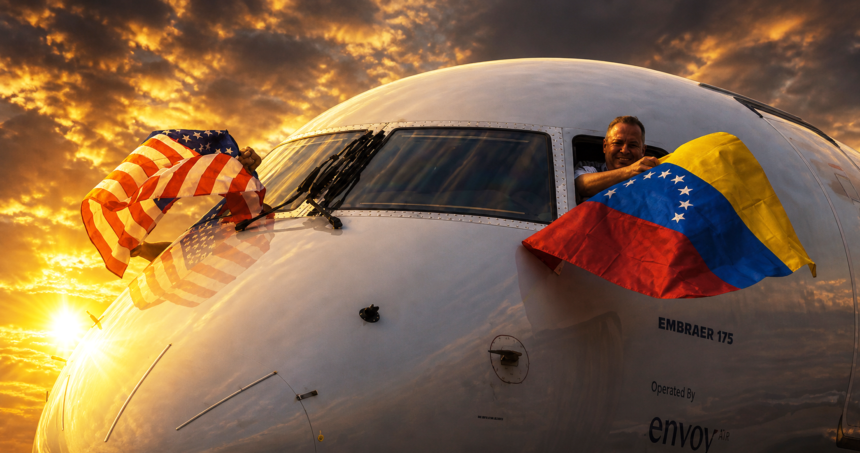
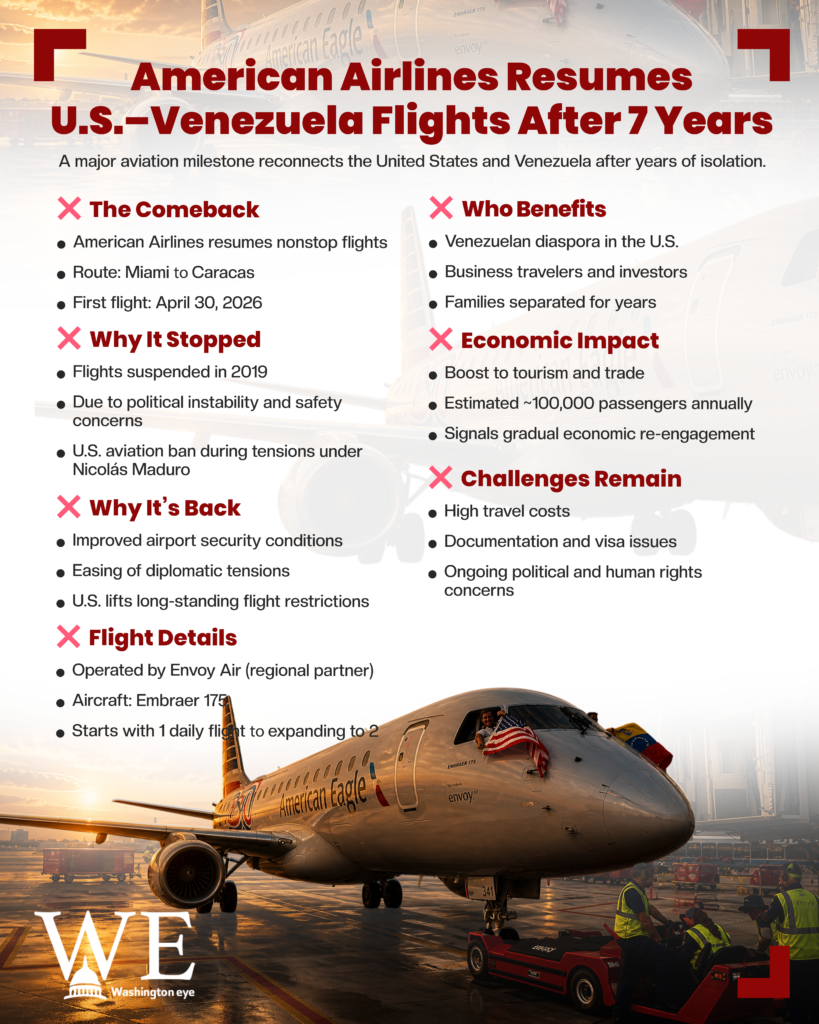
After a seven-year suspension, American Airlines has officially resumed nonstop passenger flights between the United States and Venezuela, marking a significant shift in regional aviation and diplomatic relations. The long-awaited restart took place on April 30, 2026, when the first commercial flight departed Miami and landed in Caracas, re-establishing a direct air link that had been severed since 2019.
The inaugural flight operated on the Miami–Caracas route, one of the busiest corridors prior to the suspension. The service is being run by Envoy Air, a regional subsidiary of American Airlines, using an Embraer 175 aircraft. Initially, the airline has launched one daily flight, with plans to increase frequency to two daily services starting May 21, reflecting anticipated demand from business travelers, tourists, and the Venezuelan diaspora.
This resumption comes after a turbulent seven-year hiatus triggered by political instability, safety concerns, and deteriorating relations between Washington and Caracas. In 2019, the U.S. government imposed a ban on all commercial flights to Venezuela, citing risks to passenger safety and security amid escalating tensions under then-president Nicolás Maduro. Airlines, including American, suspended operations as diplomatic ties collapsed and travel advisories intensified.
The decision to restore flights reflects a broader thaw in relations. In early 2026, U.S. authorities lifted the 2019 aviation ban after reviewing improved security conditions at Caracas’ Simón Bolívar International Airport and conducting safety inspections. The move followed political changes in Venezuela and a gradual easing of sanctions, signaling renewed engagement between the two countries.
Officials from both nations described the return of flights as a milestone. Venezuelan Transport Minister Jacqueline Faria welcomed the first aircraft, emphasizing that renewed connectivity would drive economic activity, tourism, and international trade. U.S. representatives echoed similar sentiments, noting that the route would facilitate family reunification, humanitarian travel, and commercial exchange after years of isolation.
Historically, American Airlines has had a strong presence in Venezuela, operating in the country since 1987 and once serving multiple cities from major U.S. hubs. Before the suspension, it was the largest U.S. carrier in the Venezuelan market. The abrupt halt in 2019 forced travelers to rely on indirect routes through neighboring countries, increasing travel time, cost, and inconvenience.
The first flight in 2026 carried government officials, media personnel, and passengers eager to witness the reopening of the route. The journey, lasting just under three and a half hours, symbolized a renewed chapter in bilateral ties. However, despite the celebratory tone, challenges remain. Travel costs are still high, documentation issues persist for many Venezuelans abroad, and concerns over political stability and human rights continue to shape travel decisions.

From a commercial perspective, the airline industry views the route as both symbolic and strategic. American Airlines is testing the market cautiously with a single daily service, reflecting uncertainty about demand and regulatory conditions. Other U.S. carriers, such as United and Delta, have not yet announced plans to resume operations, though industry analysts expect further expansion if stability continues.
The revival of nonstop flights is expected to reconnect families separated by migration, particularly the large Venezuelan community in Florida, while also opening doors for investment and tourism. Analysts estimate that the route could serve around 100,000 passengers annually in its initial phase, with potential for growth as confidence in travel to Venezuela improves.
In essence, the return of American Airlines’ nonstop service is more than just a logistical development, it is a reflection of shifting geopolitical realities. While uncertainties remain, the reopening of this air corridor signals cautious optimism for deeper engagement, economic recovery, and the gradual reintegration of Venezuela into global travel networks after years of isolation.