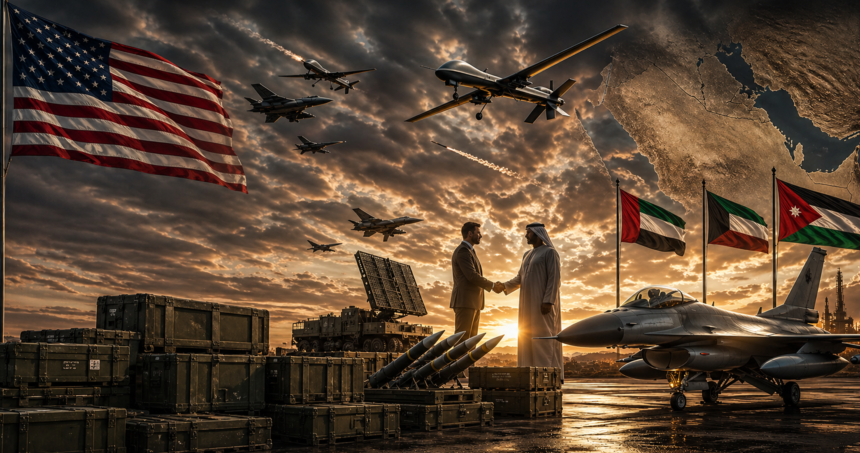
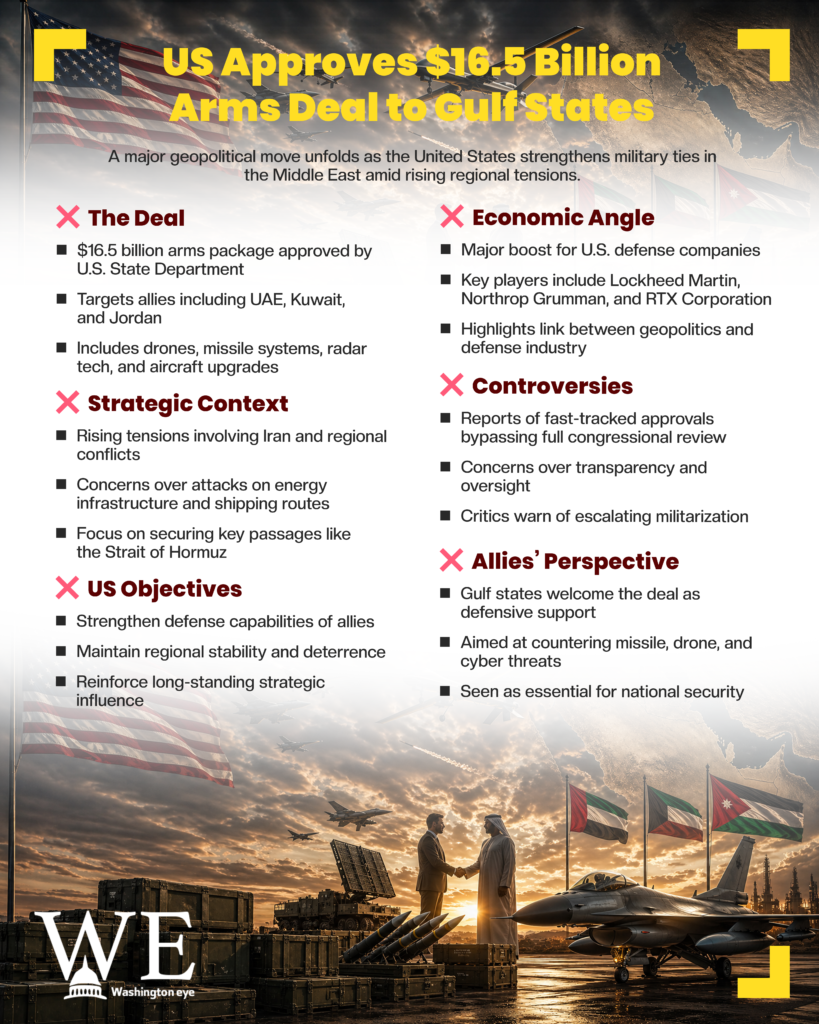
The United States has approved a massive $16.5 billion arms deal to key Gulf and Middle Eastern allies, a move that underscores Washington’s deepening strategic engagement in the region amid escalating tensions with Iran. Announced by the U.S. State Department in March 2026, the deal involves potential sales of advanced military equipment, including drones, missile systems, radar technologies, and aircraft upgrades, to countries such as the United Arab Emirates, Kuwait, and Jordan.
The timing of the agreement is significant. The Middle East is currently witnessing heightened instability, particularly following a series of military escalations involving Iran, Israel, and U.S.-aligned states. Reports indicate that Iranian strikes on energy infrastructure and maritime routes, including tensions around the Strait of Hormuz, have intensified regional insecurity. In this context, Washington’s approval of the arms package is widely viewed as a strategic effort to strengthen allied defense capabilities and deter further aggression.
From the U.S. perspective, the deal is rooted in both security and political calculations. Official statements emphasize that enhancing the military capacity of Gulf allies will help maintain regional stability and protect critical global energy routes. Additionally, the deal reflects long-standing U.S. foreign policy in the Middle East: maintaining influence through defense partnerships while countering perceived threats from Iran. Major American defense contractors, including RTX Corporation, Northrop Grumman, and Lockheed Martin, are expected to benefit significantly from the agreement, highlighting the intersection of geopolitics and the defense industry.

However, the negotiations and approvals surrounding the deal have not been without controversy. In some cases, the U.S. reportedly fast-tracked the process, bypassing traditional congressional review procedures to expedite delivery. Critics argue that such moves undermine democratic oversight and raise questions about transparency in arms exports. They also warn that rapid militarization may escalate tensions rather than resolve them.

On the receiving end, Gulf states have largely welcomed the agreement. For countries like the UAE and Kuwait, the deal represents a critical reinforcement of their defense systems at a time when regional threats are perceived to be increasing. These nations have repeatedly called for stronger international support in countering missile attacks, drone warfare, and cyber threats linked to regional adversaries. From their standpoint, the arms package is defensive in nature, aimed at safeguarding sovereignty and infrastructure rather than provoking conflict.
Nevertheless, reactions from other global actors and analysts have been mixed. Some European policymakers have expressed concern that continued arms transfers to conflict-prone regions could fuel an arms race. Human rights organizations have also raised alarms, arguing that the influx of advanced weaponry may exacerbate ongoing conflicts and contribute to civilian harm. Meanwhile, Iran and its allies have criticized the move, interpreting it as a direct challenge to regional balance and a sign of U.S. alignment against Tehran.
The broader geopolitical implications are complex. On one hand, the deal reinforces U.S. influence in the Middle East at a time when other powers, such as China and Russia, are seeking to expand their presence. By deepening defense ties, Washington secures strategic partnerships that extend beyond military cooperation to include economic and political alliances. On the other hand, such deals risk entrenching divisions in an already volatile region, potentially prolonging cycles of conflict.

Critically, the deal raises fundamental questions about the effectiveness of military solutions in addressing political crises. While strengthening allies may provide short-term security assurances, it does little to address underlying issues such as regional rivalries, ideological divides, and unresolved conflicts. Analysts warn that without parallel diplomatic efforts, arms deals may contribute to a security dilemma, where increased militarization by one side prompts escalation by others.
In conclusion, the U.S. approval of the $16.5 billion arms deal to Gulf states represents a significant development in Middle Eastern geopolitics. It highlights Washington’s commitment to its allies while simultaneously exposing the tensions between security strategy, economic interests, and global stability. As the region continues to grapple with conflict and uncertainty, the long-term impact of such agreements will depend not only on military strength but also on the willingness of all parties to pursue diplomatic solutions.