

Global financial markets, spanning equities, bonds, currencies, and commodities, are increasingly shaping economic narratives worldwide, with 2026 witnessing renewed investor focus amid geopolitical shifts, economic recovery, and evolving financial literacy. From New York to Shanghai, and from London to emerging economies, understanding how global markets operate has become central not only to policymakers and corporations but also to individual investors navigating a complex financial landscape.
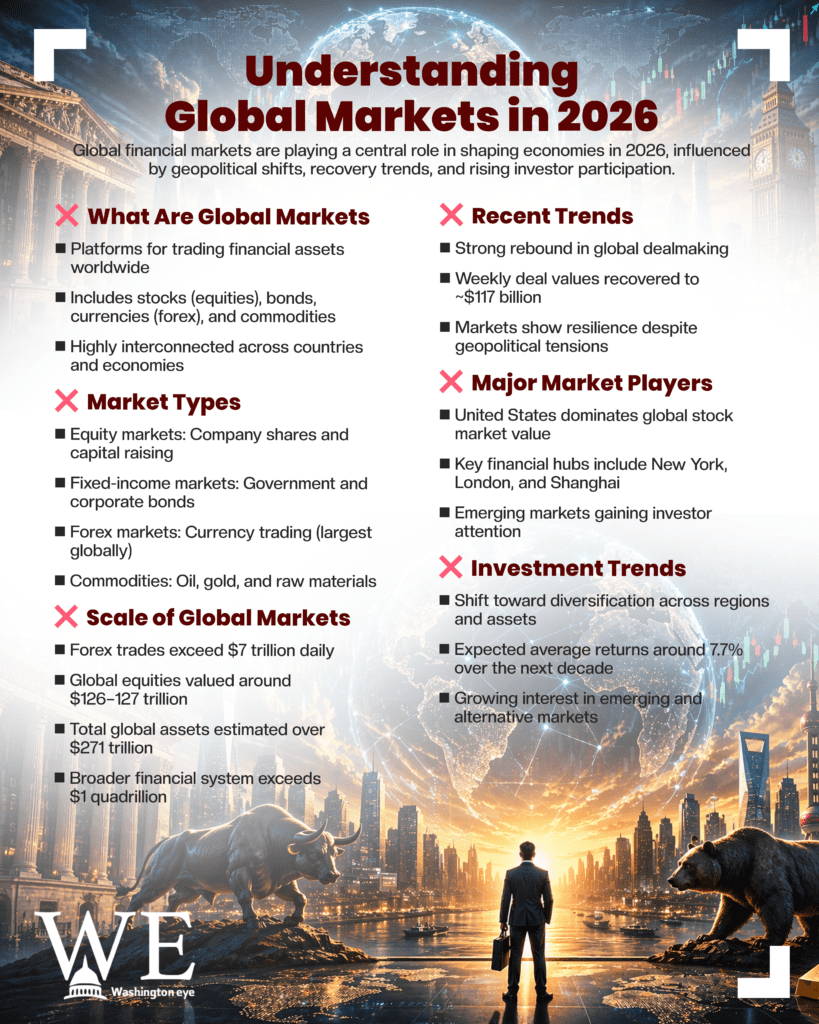
In recent months, global markets have shown resilience despite geopolitical tensions. According to a Reuters report published in April 2026, global dealmaking rebounded strongly after an initial dip triggered by conflict-related uncertainty, with weekly deal values climbing back to approximately $117 billion after falling to $39 billion in early March. This recovery reflects investor confidence and the ability of markets to stabilize despite shocks, highlighting their dynamic and interconnected nature.
Global markets broadly refer to platforms where financial assets, such as stocks, bonds, currencies, and commodities, are traded internationally. These markets are categorized into major types: equity markets (stocks), fixed-income markets (bonds), foreign exchange (forex), and commodities markets. Among these, the foreign exchange market stands as the largest, with daily transactions exceeding $7 trillion, enabling currency exchange and supporting global trade. Meanwhile, equity markets, where companies raise capital, are valued at around $126–127 trillion globally, underscoring their central role in economic growth.
The overall size of global financial markets is staggering. Estimates suggest that the combined global market portfolio, including stocks, bonds, and private assets, reached approximately $271 trillion by the end of 2023, with investable assets alone accounting for over $213 trillion. When broader derivatives and financial instruments are included, the notional value of global markets surpasses $1 quadrillion, illustrating the immense scale of global finance.

Major financial centers such as the United States, China, and Europe dominate global markets. The U.S. alone accounts for nearly half of global stock market value, while exchanges like the New York Stock Exchange and Nasdaq lead in market capitalization. At the same time, emerging markets in Asia, Latin America, and Africa are gaining importance due to higher growth potential and increasing investor interest.
Understanding global markets is crucial because they directly influence economic indicators such as employment, inflation, and growth. For instance, rising stock markets often signal economic expansion, while falling bond yields may indicate recession fears. Moreover, currency markets affect international trade balances, impacting exports and imports across countries.
Investment trends in 2026 indicate a shift toward diversification. Analysts suggest that global stocks could deliver average annual returns of around 7.7% over the next decade, driven by earnings growth and dividends. Investors are increasingly looking beyond traditional markets, exploring emerging economies and alternative assets to manage risk and maximize returns. This diversification reflects a deeper understanding of global market interconnections and volatility.

However, global markets are not without challenges. Geopolitical tensions, inflationary pressures, and central bank policies continue to influence investor sentiment. Recent volatility linked to conflicts and economic uncertainties demonstrates how quickly markets can react to global events. While large-scale mergers and acquisitions signal confidence, smaller transactions remain subdued due to ongoing risks.
Critically, the understanding of global markets is evolving beyond institutional investors to include individuals. Digital platforms, financial education, and real-time data access have democratized market participation. Yet, experts caution that greater access must be accompanied by informed decision-making, as volatility and speculative behavior can lead to significant losses.
In conclusion, global markets in 2026 represent a vast, interconnected system influencing economies and societies worldwide. Their scale, ranging from trillions to quadrillions of dollars, highlights their significance, while ongoing shifts in investment strategies and geopolitical dynamics underscore the need for deeper understanding. As markets continue to evolve, the ability to interpret their signals and navigate their complexities will remain essential for both economic stability and individual financial success.