

Europe’s legal cannabis industry has entered a transformative phase, with Germany emerging as the continent’s largest regulated market following sweeping reforms that began in 2024. The shift, widely regarded as a landmark moment in European drug policy, has positioned the country at the center of a rapidly growing multi-billion-euro sector, reshaping debates around legalization, public health, and economic opportunity across the region.
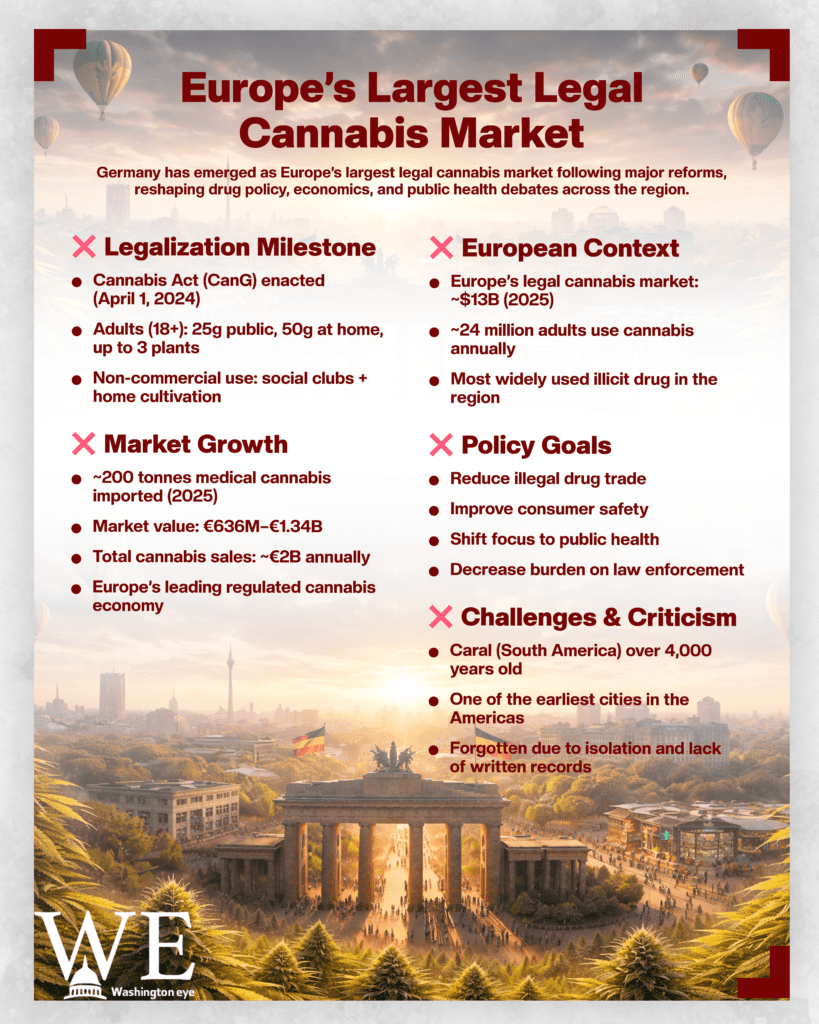
The turning point came on April 1, 2024, when Germany legalized adult possession and limited cultivation of cannabis under its Cannabis Act (CanG). Adults aged 18 and above were permitted to carry up to 25 grams in public and up to 50 grams at home, as well as grow up to three plants for personal use. Unlike full commercial legalization models seen in North America, Germany adopted a “two-pillar” system, initially focusing on non-commercial cannabis social clubs and home cultivation, while leaving retail sales largely restricted.
This policy shift has propelled Germany into the position of Europe’s largest legal cannabis market, particularly in the medical sector. Reports indicate that the country imported nearly 200 tonnes of legal medical cannabis in 2025 alone, underscoring the scale of demand. The medical cannabis market itself is projected to range between €636 million and €1.34 billion in 2025, with overall cannabis-related sales already reaching around €2 billion annually. Analysts estimate that the broader legal cannabis market in Germany was worth over $2 billion in 2024 and is expected to grow significantly in the coming years.

The rise of Germany’s cannabis sector reflects broader trends across Europe, where legalization, particularly for medical use, has been expanding. The European legal cannabis market was valued at approximately $13 billion in 2025 and is forecast to grow rapidly over the next decade. Cannabis remains the most widely used illicit drug in Europe, with an estimated 24 million adults reporting use annually, highlighting the scale of the existing demand that legalization policies aim to regulate.
The rationale behind legalization in Germany has centered on reducing illegal drug markets, protecting consumers, and shifting policy toward public health. Authorities have argued that regulating cannabis use would weaken organized crime and ensure safer consumption. Early data suggests that legal access is gradually displacing parts of the black market, though experts caution that the impact on organized crime remains unclear. Additionally, legalization has reduced the burden on law enforcement and judicial systems by decriminalizing minor possession cases.
However, the policy has not been without controversy. Critics, including some health officials, warn that legalization could undermine youth protection efforts and increase health risks, particularly with the growing availability of high-potency cannabis. Concerns have also been raised about the surge in medical cannabis prescriptions and imports, prompting regulatory changes such as restricting online sales and requiring in-person consultations for prescriptions.
The types of cannabis products available in Europe’s legal market vary widely, ranging from dried flower (the most common form) to oils, edibles, and pharmaceutical-grade cannabis. Cannabidiol (CBD), a non-psychoactive compound, dominates the medical segment due to its therapeutic applications in treating conditions such as epilepsy, anxiety, and chronic pain. Meanwhile, tetrahydrocannabinol (THC)-rich products are more tightly regulated due to their psychoactive effects.

Despite Germany’s leadership, cannabis remains illegal in many European countries, with strict penalties still in place in nations such as France and parts of Eastern Europe. Others, including Malta, Luxembourg, and Switzerland, have adopted partial legalization or pilot programs, indicating a gradual but uneven shift across the continent.
Public and political reactions across Europe remain divided. Supporters view Germany’s model as a pragmatic approach to drug policy reform, potentially setting a precedent for other EU nations. Opponents, however, argue that the long-term societal and health impacts are not yet fully understood, calling for stricter regulations or even policy reversals. A comprehensive evaluation of Germany’s cannabis law is expected by 2028, which will likely shape the future direction of legalization in Europe.
As Europe’s largest economy continues to expand its legal cannabis framework, the region stands at a critical crossroads. Germany’s experiment is being closely watched by policymakers worldwide, as governments weigh the balance between economic opportunity, public health, and social responsibility in the evolving global cannabis landscape.