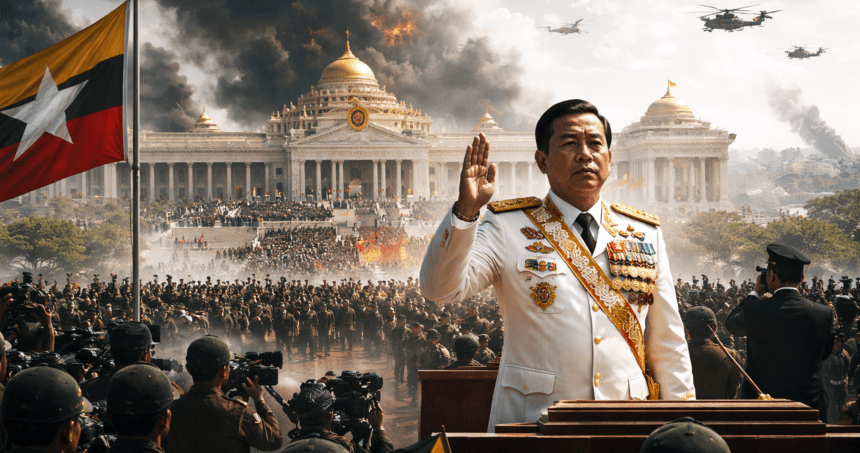
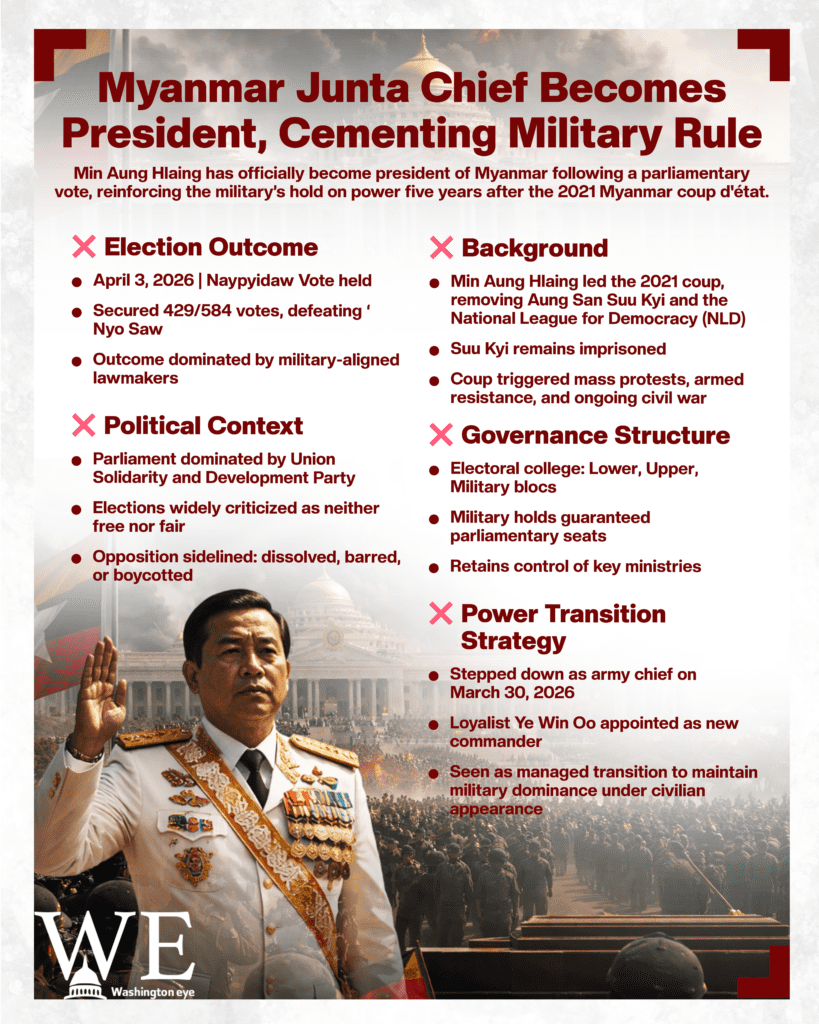
Myanmar’s military leader Min Aung Hlaing has formally become president of Myanmar following a parliamentary vote that critics say cements the military’s grip on power five years after a coup that plunged the country into civil war. The development marks a significant political shift, though analysts argue it represents continuity rather than change, with the armed forces maintaining dominant control over the state.
The vote took place on April 3, 2026, in the capital Naypyidaw, where a parliament dominated by military-backed lawmakers elected Min Aung Hlaing by a large margin. He secured 429 out of 584 votes cast, defeating rival candidate Nyo Saw, according to official results announced by parliamentary speaker Aung Lin Dwe. The landslide victory had been widely expected, as the legislature is controlled by the military-aligned Union Solidarity and Development Party (USDP), which won a majority in elections earlier this year that were widely criticised as neither free nor fair.
Min Aung Hlaing, 69, rose to power after leading the February 2021 coup that ousted the elected government of Nobel laureate Aung San Suu Kyi and her National League for Democracy (NLD). Since then, Suu Kyi has remained imprisoned, while opposition parties were either dissolved, barred from contesting elections, or chose to boycott the process. The coup triggered mass protests that evolved into an armed resistance movement, leaving thousands dead and millions displaced as the country descended into a prolonged civil conflict.
The 2026 presidential vote was conducted under Myanmar’s constitutional framework, where an electoral college made up of three blocs, the lower house, upper house, and military-appointed lawmakers, nominates candidates and votes for the president. However, the military retains significant structural power, including a guaranteed share of parliamentary seats and control over key ministries, limiting the influence of civilian institutions.
Min Aung Hlaing’s transition from commander-in-chief to president was carefully orchestrated. He stepped down from military leadership on March 30 to meet constitutional requirements, with loyalist Ye Win Oo appointed as the new head of the armed forces. Analysts say this move ensures continuity of military control while presenting a façade of civilian governance to both domestic audiences and the international community.
The elections that paved the way for his presidency were held in late 2025 and early 2026 and were widely dismissed by Western governments, human rights organisations, and opposition groups as a “sham.” Voting was restricted in conflict zones, major opposition parties were excluded, and turnout was reportedly low amid fear and repression. Critics argue that the process was designed to legitimize military rule rather than restore democracy.
International reaction to Min Aung Hlaing’s presidency has been largely negative. Rights groups and Rohingya organisations have condemned his elevation, citing alleged atrocities committed under his leadership, particularly against the Rohingya Muslim minority during operations in 2016–2017. The International Criminal Court has also pursued legal action related to these allegations, further isolating Myanmar diplomatically.
Domestically, resistance groups, including forces aligned with the ousted NLD, continue to challenge the junta’s authority. Large parts of the country remain outside government control, and fighting persists across multiple regions. Analysts warn that Min Aung Hlaing’s presidency is unlikely to bring stability, as the underlying political crisis remains unresolved.
Despite this, the military leadership has framed the transition as a return to constitutional governance. Officials argue that the election and presidential appointment mark a step toward normalcy after years of emergency rule. However, critics maintain that the change is largely symbolic, with real power still firmly in the hands of the armed forces.
Min Aung Hlaing’s presidency now positions him as both the formal head of state and the central figure in Myanmar’s ongoing political and military strategy. Observers say his next challenge will be navigating international pressure while attempting to consolidate control internally, even as the country faces economic decline, humanitarian crises, and persistent armed resistance.