
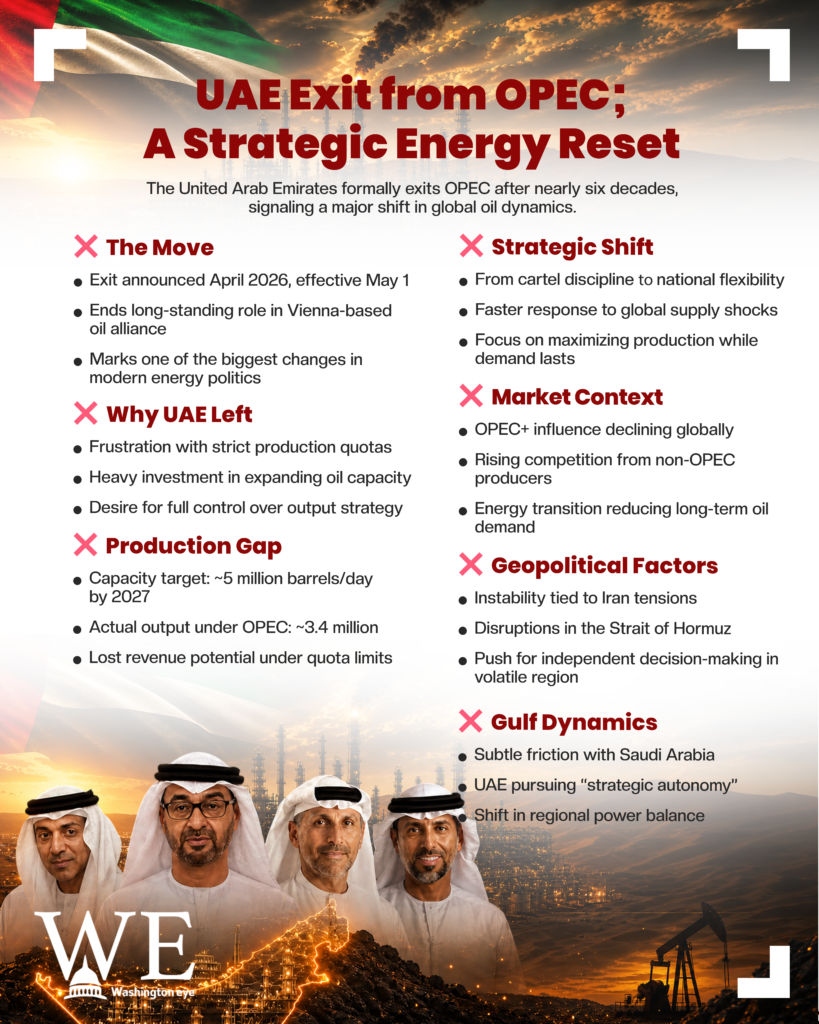
The United Arab Emirates’s decision to withdraw from Organization of the Petroleum Exporting Countries marks one of the most significant shifts in global energy politics in decades. Announced in late April 2026 and effective from May 1, the move ends nearly six decades of UAE membership in the Vienna-based oil cartel, which was founded in 1960 to coordinate oil production and stabilize global prices.
OPEC, established by founding members including Iran, Iraq, Kuwait, Saudi Arabia, and Venezuela, has historically functioned as a powerful alliance controlling a large share of global oil supply. Over the years, it expanded and later evolved into the broader OPEC+ grouping in 2016, incorporating major producers such as Russia. Its primary strategy has been to regulate output through quotas, ensuring price stability and maximizing revenue for member states. However, the UAE’s departure highlights growing tensions within the organization and shifting priorities among its members.
The immediate trigger for the UAE’s exit appears to be a combination of geopolitical instability and economic strategy. The ongoing conflict involving Iran and disruptions to the Strait of Hormuz, one of the world’s most critical oil transit routes, have severely impacted regional energy flows and exposed divisions among Gulf nations. At the same time, analysts point to long-standing dissatisfaction within the UAE regarding OPEC’s production quotas, which limited its ability to fully utilize its expanding oil capacity.

In recent years, the UAE has invested heavily in increasing its oil production capacity, aiming to reach up to 5 million barrels per day by 2027. Under OPEC constraints, however, it was producing significantly less, around 3.4 million barrels per day, leading to frustration over lost revenue opportunities. By exiting OPEC, the UAE gains full autonomy over its production policies, enabling it to respond more flexibly to global market conditions and maximize output.

Beyond production limits, the decision reflects broader economic and strategic considerations. Unlike some OPEC members that rely heavily on oil revenues, the UAE has diversified its economy into sectors such as tourism, finance, and logistics. This diversification reduces its dependence on high oil prices and allows it to prioritize production volume over price control. Additionally, with global energy demand expected to peak in the coming decades due to the transition toward renewable energy, the UAE appears keen to monetize its oil reserves while demand remains strong.
The exit also underscores political dynamics within the Gulf region. Relations between the UAE and Saudi Arabia, OPEC’s de facto leader, have shown signs of strain, particularly over production policies and regional security responses. The UAE has increasingly pursued a policy of “strategic autonomy,” reassessing its alliances and positioning itself as an independent energy and geopolitical actor.
Globally, the implications of the UAE’s departure are mixed. In the short term, analysts suggest limited impact on oil prices due to ongoing supply disruptions and geopolitical constraints. However, in the long term, the move could weaken OPEC’s ability to control global oil markets. As one of the group’s largest producers, the UAE’s exit reduces the cartel’s collective production capacity and may encourage other dissatisfied members to reconsider their participation.

Some experts argue that reduced coordination among producers could lead to lower oil prices, benefiting consumers but increasing market volatility. Others warn that the move signals deeper fractures within OPEC, raising questions about its future relevance in an evolving energy landscape.
Despite these concerns, OPEC has sought to project unity by adjusting production quotas and emphasizing continuity among remaining members. Yet the UAE’s departure highlights a fundamental shift: the growing divergence between traditional cartel discipline and individual national strategies in a rapidly changing global energy market.
In conclusion, the UAE’s exit from OPEC is not merely a policy adjustment but a strategic realignment. It reflects changing economic priorities, geopolitical tensions, and the realities of an energy transition era. While the immediate market impact may be limited, the long-term consequences could reshape the balance of power in global oil markets and redefine the role of OPEC in the decades ahead.