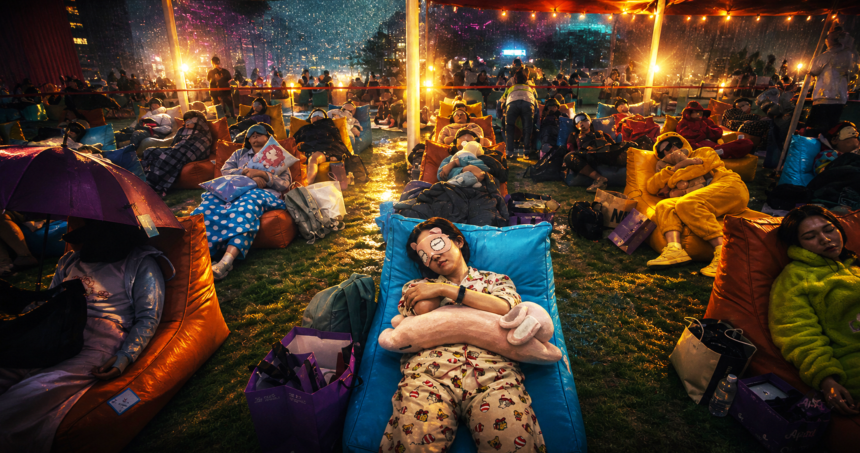
In a striking reflection of modern urban stress, South Korea has turned one of the most basic human needs, sleep, into a public competition, as hundreds gathered along Seoul’s Han River to take part in a unique “nap contest” that blends wellness awareness with spectacle.
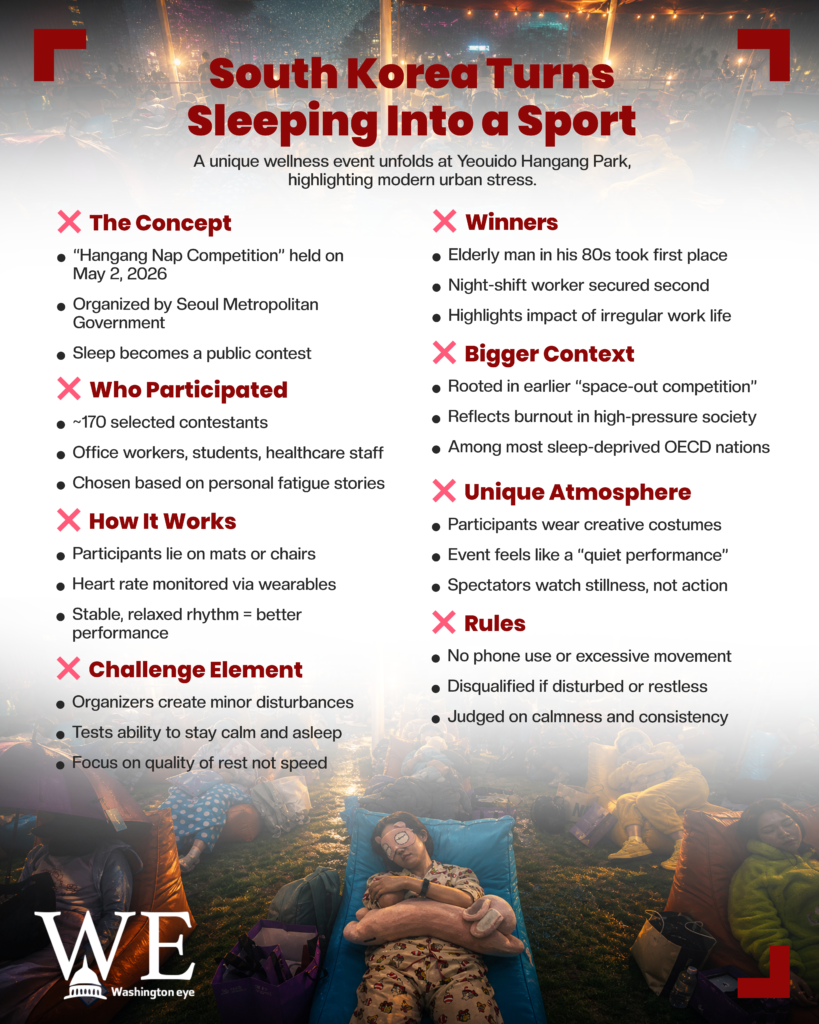
The event, officially known as the Hangang Nap Competition, took place on May 2, 2026, at Yeouido Hangang Park in Seoul, organised by the Seoul Metropolitan Government as part of its broader public wellness and leisure initiatives. Beginning at 3 p.m. and lasting several hours, the contest invited participants to do something many South Koreans struggle to achieve regularly: sleep deeply and peacefully in a bustling city environment.
This year’s edition featured around 170 selected participants, chosen through an application process where candidates submitted personal stories explaining why they needed rest. Contestants ranged from exhausted office workers and students to healthcare staff and couples, all united by a shared fatigue rooted in South Korea’s fast-paced, high-pressure lifestyle.

The competition is not merely about falling asleep quickly. Instead, it is designed to measure the quality of rest. Participants lie on yoga mats, beanbags or camping chairs while organisers monitor their heart rates using wearable devices. A stable and relaxed heart rhythm is considered a key indicator of deep rest and determines performance. In some cases, organisers even attempt to disrupt contestants with sounds or minor disturbances to test how well they maintain their calm state.

In the 2026 contest, the winner was an elderly man in his 80s, whose calm physiological readings and ability to remain undisturbed earned him top honours. A 37-year-old night-shift office worker, Hwang Du-seong, secured second place, highlighting how the event resonates particularly with those burdened by irregular work schedules and chronic fatigue.
The origins of such unconventional competitions in South Korea can be traced back to the broader “space-out competition,” first introduced in 2014 by local artist Woopsyang. That earlier event challenged participants to do nothing, neither sleeping nor using phones, while maintaining a stable heart rate, as a critique of overwork and burnout in Korean society. Over time, the concept evolved into various formats, including the more recent nap contest, which explicitly encourages rest rather than passive stillness.
Officials say the initiative reflects growing concern over sleep deprivation in South Korea, which ranks among the most sleep-deprived countries in the OECD. Long working hours, intense academic pressure, and a 24-hour urban culture have contributed to widespread exhaustion, particularly among young professionals and students. By turning sleep into a “sport,” authorities hope to spark conversation about mental health, work-life balance, and the importance of rest in a productivity-driven society.

The event also carries a cultural and symbolic dimension. Participants often dress in creative costumes, ranging from traditional Korean royal attire to animal-themed sleepwear, adding a festive, almost theatrical atmosphere. Spectators gather to watch what organisers describe as a “quiet performance,” where the challenge lies not in action but in stillness.
Strict rules govern the competition. Participants are disqualified if they wake up prematurely, move excessively, use their phones, or create disturbances. Judges combine biometric data with observational criteria, including posture, calmness, and overall consistency throughout the session. In some editions, public voting and costume categories further enhance audience engagement.
Beyond entertainment, experts view the event as a subtle critique of modern work culture. Despite policy efforts such as a 52-hour workweek cap, many South Koreans continue to experience long hours and insufficient rest. Events like the Hangang Nap Competition aim to normalize the idea that rest is not laziness but a necessary component of well-being.
As the sun set over the Han River and participants slowly awoke, the message was clear: in one of the world’s most industrious societies, even sleep has become both a necessity and a performance. The popularity of such events suggests that, in South Korea, the pursuit of rest may soon rival the pursuit of success.