
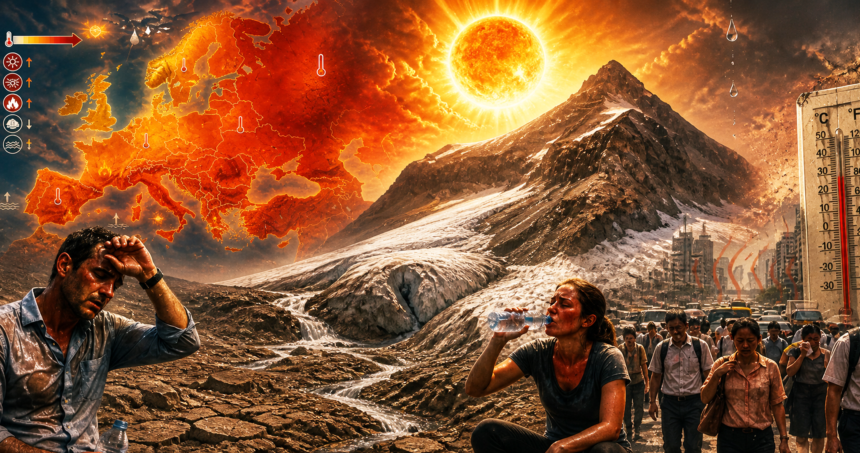
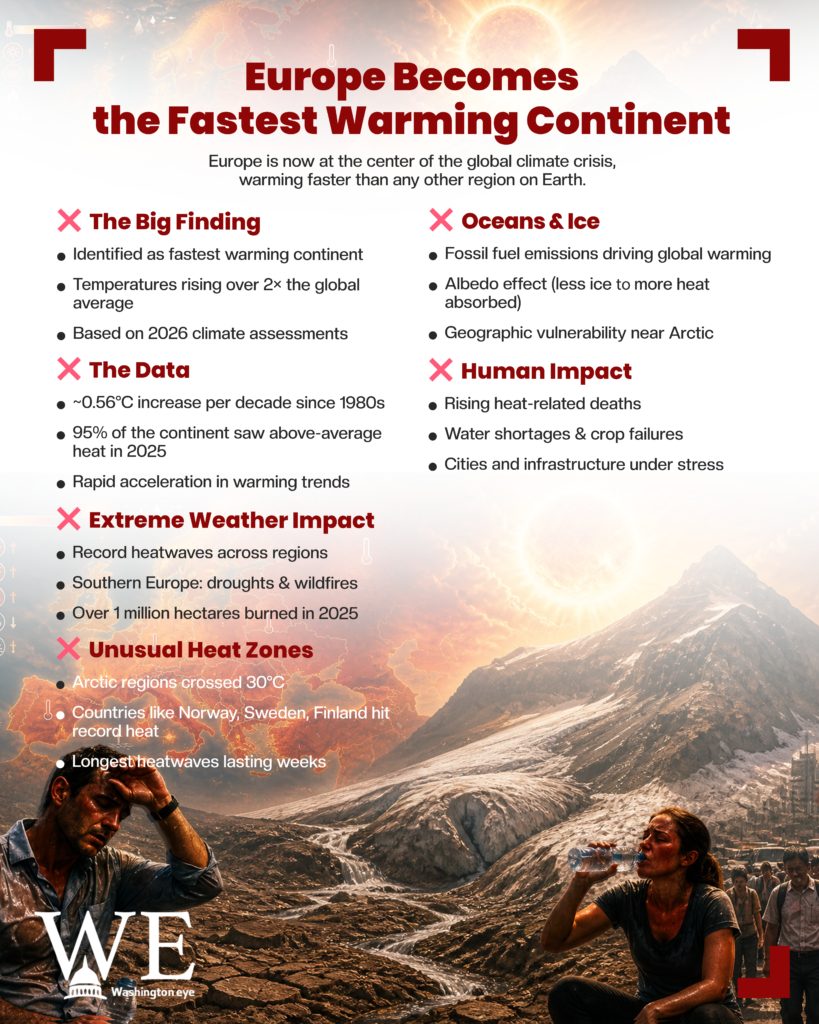
Europe has officially been identified as the fastest warming continent on Earth, according to the latest climate assessments released in 2026 by the World Meteorological Organization and the Copernicus Climate Change Service. The findings, based on the “European State of the Climate 2025” report, show that temperatures across the continent are rising at more than twice the global average, signaling a deepening climate crisis with widespread consequences for ecosystems, economies, and human life.
The report highlights that Europe’s warming trend has accelerated significantly since the 1980s. Over the past three decades, temperatures in the region have increased by approximately 0.56°C per decade, faster than any other continent globally. Scientists attribute this rapid rise to a combination of human-driven climate change, regional geography, and feedback mechanisms such as reduced snow and ice cover. As glaciers melt and reflective ice surfaces shrink, more heat is absorbed by land and oceans, further intensifying warming, a process known as the albedo effect.
The year 2025 serves as a stark example of this accelerating trend. Nearly 95% of Europe experienced above-average temperatures, with extreme heatwaves stretching from the Mediterranean to the Arctic Circle. In an unprecedented development, temperatures exceeded 30°C inside the Arctic Circle, particularly in countries such as Norway, Sweden, and Finland. These regions, traditionally known for cold climates, recorded their longest heatwaves on record, lasting up to three weeks.
Southern Europe also endured severe conditions, including record-breaking heat, drought, and wildfires. Portugal recorded temperatures nearing 46°C, while Spain faced multiple large-scale wildfires burning vast areas of land. Across the continent, more than one million hectares were scorched by fires in 2025 alone, the highest annual total ever recorded. These extreme events have placed immense pressure on agriculture, water supplies, and public health systems.

In addition to land-based impacts, Europe’s surrounding seas have also experienced dramatic warming. Sea surface temperatures reached record highs, with approximately 86% of European waters affected by marine heatwaves. This has disrupted marine ecosystems, threatened fisheries, and contributed to biodiversity loss. At the same time, glaciers across the Alps and Iceland have continued to shrink at alarming rates, contributing to rising sea levels and long-term environmental instability.
Experts emphasize that the primary driver behind Europe’s rapid warming is global climate change fueled by greenhouse gas emissions from fossil fuels. Industrialization, transportation, and energy production have significantly increased atmospheric carbon dioxide levels, trapping heat and altering global weather systems. However, Europe’s geographical features, such as its large landmass relative to ocean influence and its proximity to the rapidly warming Arctic, make it particularly vulnerable to accelerated temperature increases.
The consequences for people across Europe are becoming increasingly visible. Heat-related deaths have risen sharply during recent summers, with thousands of fatalities linked to extreme temperatures. Cities have struggled to cope with prolonged heatwaves, while rural communities face crop failures and water shortages. In northern regions, infrastructure designed for cold climates is now being tested by unusual heat, while southern regions are grappling with desertification-like conditions.

Despite these challenges, European governments and institutions continue to push for climate action. The European Union has committed to reducing emissions and transitioning toward renewable energy under its Green Deal framework. However, experts warn that current efforts may not be sufficient to keep global warming within the 1.5°C target set by the Paris Agreement.
The latest findings underscore a critical message: climate change is no longer a distant threat but a present reality. As scientists stress, every fraction of a degree increase brings more severe consequences. Europe’s rapid warming serves as both a warning and a case study for the rest of the world, highlighting the urgent need for coordinated global action to reduce emissions, adapt to changing conditions, and protect vulnerable populations.