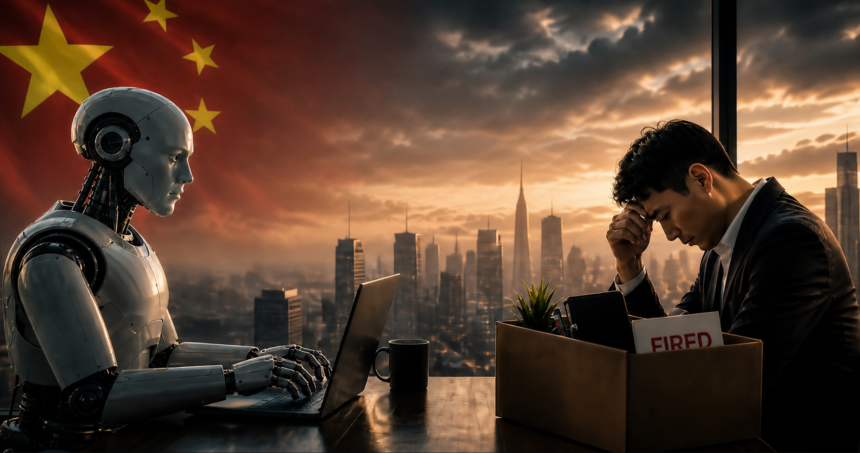
In a landmark development highlighting the growing tension between technological advancement and labour rights, courts in China have ruled that companies cannot dismiss employees solely to replace them with artificial intelligence (AI), effectively making it illegal to substitute human workers purely for cost-cutting automation. The decision, delivered in late April 2026 and gaining widespread attention around International Workers’ Day, marks one of the most significant legal interventions globally in the debate over AI-driven job displacement.
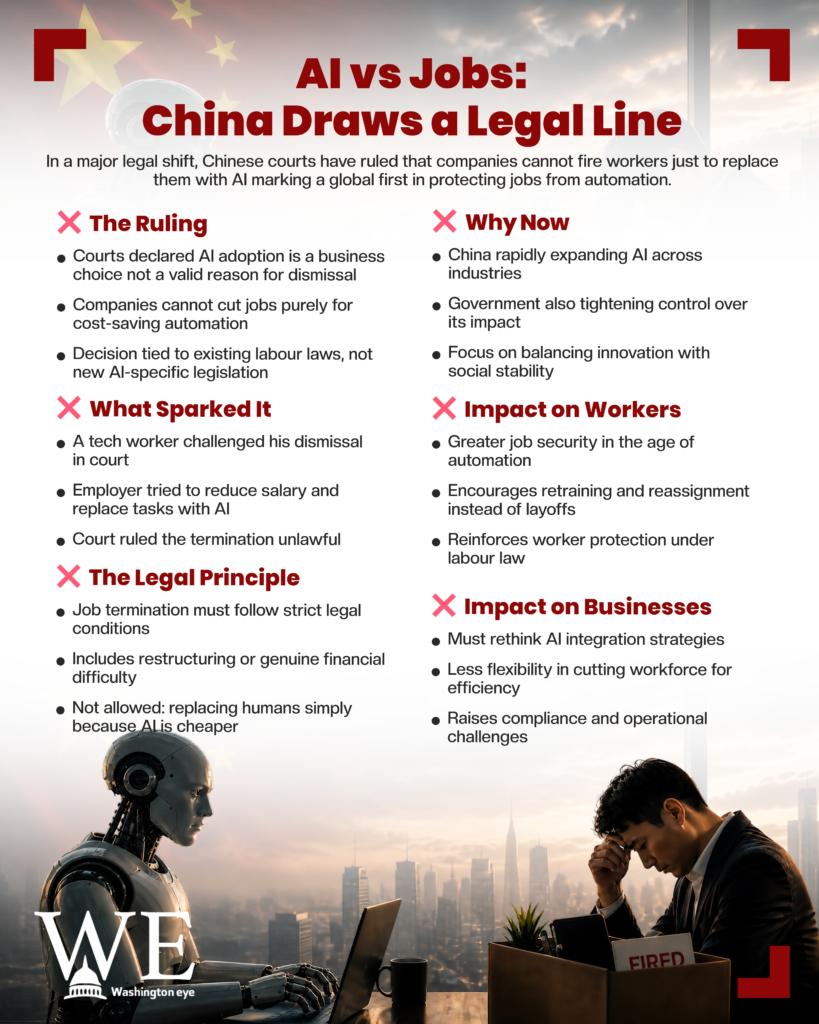
The ruling emerged from cases heard by the Hangzhou Intermediate People’s Court, where a technology worker challenged his dismissal after his employer attempted to reduce his salary and replace parts of his role with AI systems. The court found the termination unlawful, stating that adopting AI is a business choice rather than a legally valid reason to end employment contracts. The judgement reinforced that companies cannot unilaterally shift the economic burden of technological upgrades onto employees or justify layoffs simply because machines can perform tasks more cheaply.
Legal experts note that the ruling is grounded in China’s existing Labour Contract Law rather than a brand-new AI-specific statute. The court clarified that termination is only permissible under defined conditions such as operational difficulties or redundancy due to genuine restructuring, not merely efficiency gains through automation. This interpretation effectively sets a precedent that protects workers from being replaced outright by AI without due process, retraining opportunities, or reassignment.
The decision comes at a time when China is rapidly expanding its artificial intelligence capabilities while simultaneously tightening regulatory oversight. Over the past few years, authorities have introduced a layered framework governing AI, including the 2023 generative AI regulations and broader data and cybersecurity laws that emphasize ethical use, social stability, and human oversight. Officials have repeatedly stressed that AI development must align with “human control” and societal values, indicating that technological progress should not undermine employment security or social cohesion.
The move also reflects broader policy concerns within Beijing about maintaining labour market stability amid slowing economic growth and demographic challenges. With AI increasingly being adopted across sectors, from customer service to data processing, the government appears keen to avoid a surge in unemployment that could trigger social unrest. Analysts say the ruling sends a clear message: innovation is encouraged, but not at the expense of workers’ rights.
Reactions to the decision have been mixed. Labour advocates and social commentators have welcomed the ruling as a necessary safeguard in an era of rapid automation, arguing that it provides a model for balancing innovation with human dignity. Some experts suggest it could influence global policy debates, particularly as countries grapple with the societal impact of AI.
However, business groups and technology firms have expressed concern that strict labour protections may slow down AI adoption and reduce competitiveness in a fast-moving global market. Critics argue that companies need flexibility to restructure operations in response to technological change, warning that excessive regulation could hinder efficiency and innovation.

Despite these concerns, Chinese authorities appear committed to a controlled approach to AI integration. Recent campaigns by regulators, including efforts by the Cyberspace Administration of China to curb misuse of AI technologies, further demonstrate the government’s intent to shape how AI is deployed across industries. The emphasis is not on halting automation, but on ensuring that it unfolds within a framework that prioritizes social stability, legal compliance, and ethical governance.
The broader impact of this ruling could be far-reaching. For workers, it offers a degree of security in an uncertain technological landscape, reinforcing the expectation that employers must provide retraining or alternative roles rather than resorting to layoffs. For companies, it introduces a new compliance challenge, requiring careful planning when integrating AI into their operations.
Globally, the decision positions China as a unique case in the AI governance landscape, one that simultaneously pushes forward with advanced technology while imposing strict controls on its social consequences. As automation continues to reshape economies worldwide, the Chinese approach may serve as both a model and a point of debate for policymakers seeking to balance efficiency with equity.