Across the arc of human civilization, empires have risen, expanded, and eventually declined, but a select few have demonstrated extraordinary longevity, shaping politics, culture, and global systems for centuries. From ancient Asia to Europe and the Middle East, historians continue to examine how certain empires managed to endure far longer than others, offering lessons on governance, adaptability, and power.
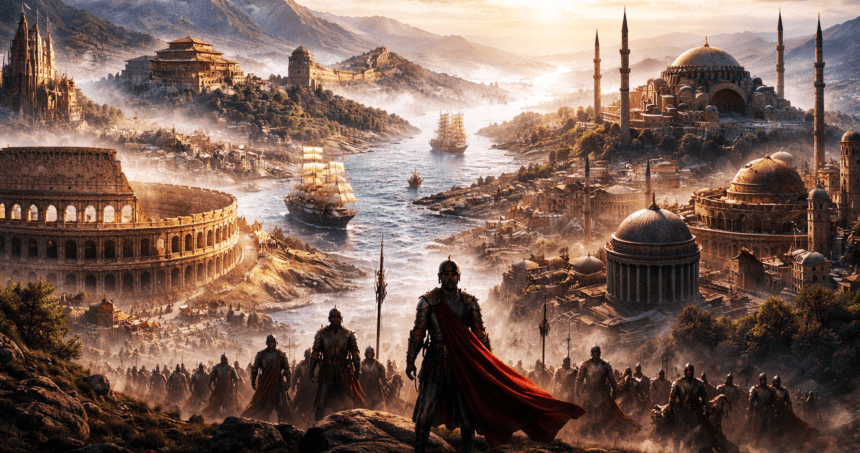
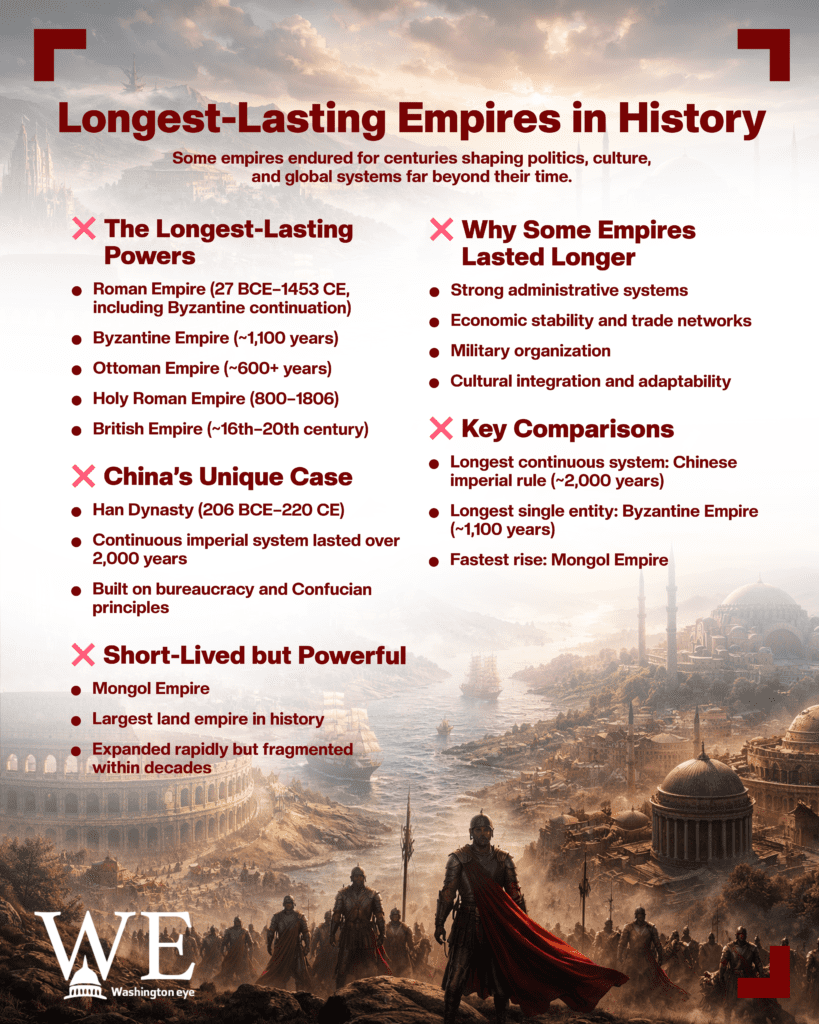
One of the longest-lasting empires in recorded history was the Roman Empire, which began in 27 BCE under Augustus and, in its eastern continuation, lasted until 1453 CE. The western half collapsed in 476 CE, but the eastern continuation, known as the Byzantine Empire, preserved Roman governance, law, and culture for nearly another millennium. Its capital, Constantinople, remained a political and cultural hub until it fell to the Ottoman Empire in 1453.
The Ottoman Empire itself stands as another example of endurance, lasting from 1299 to 1922, over 600 years. At its height in the 16th and 17th centuries, it controlled vast territories across Southeast Europe, Western Asia, and North Africa. Its longevity is often attributed to administrative flexibility, religious tolerance within a structured system, and strong military institutions like the Janissaries.

In East Asia, imperial China produced several long-lasting dynasties, notably the Han Dynasty (206 BCE–220 CE) and later the Tang and Qing dynasties. Although dynasties changed, the broader Chinese imperial system persisted for over two millennia. The Han Dynasty, in particular, laid foundations in governance, trade (notably the Silk Road), and culture that influenced Chinese civilization for centuries. Its endurance was supported by bureaucratic governance and Confucian ideology.

Meanwhile, the Holy Roman Empire lasted from 800 to 1806, spanning over 1,000 years in central Europe. Though often decentralized and fragmented, its survival came from a loose political structure that allowed local rulers autonomy while maintaining a shared imperial identity. It played a crucial role in shaping medieval European politics.
The British Empire, often described as “the empire on which the sun never sets,” lasted roughly from the late 16th century until the mid-20th century. At its peak, it controlled territories across every inhabited continent. Its strength lay in naval dominance, trade networks, and industrial power. However, unlike ancient empires, its decline came relatively quickly after World War II, as colonies gained independence.
Not all empires lasted centuries. The Mongol Empire, founded by Genghis Khan in 1206, became the largest contiguous land empire in history within decades but fragmented by the late 13th century. Despite its short lifespan compared to others, its impact on trade, communication, and cultural exchange across Eurasia was profound.

Historians note that the longest-lasting empires shared key characteristics: administrative adaptability, economic strength, military organization, and cultural integration. The Roman and Byzantine systems thrived on law and infrastructure, while the Ottoman Empire leveraged diversity and governance reforms. In contrast, empires that expanded too rapidly without stable institutions, such as the Mongol Empire, often struggled to sustain control.
The question of “who ruled the longest” often depends on definitions. If continuity is considered, Chinese imperial rule spans over 2,000 years, making it arguably the longest enduring imperial system. However, as a single political entity, the Byzantine Empire’s nearly 1,100-year run is among the most remarkable.
Ultimately, the study of empires is not just about duration but influence. These powers shaped languages, borders, religions, and political systems that continue to affect the modern world. While no empire has proven permanent, their legacies remain deeply embedded in today’s global order.