
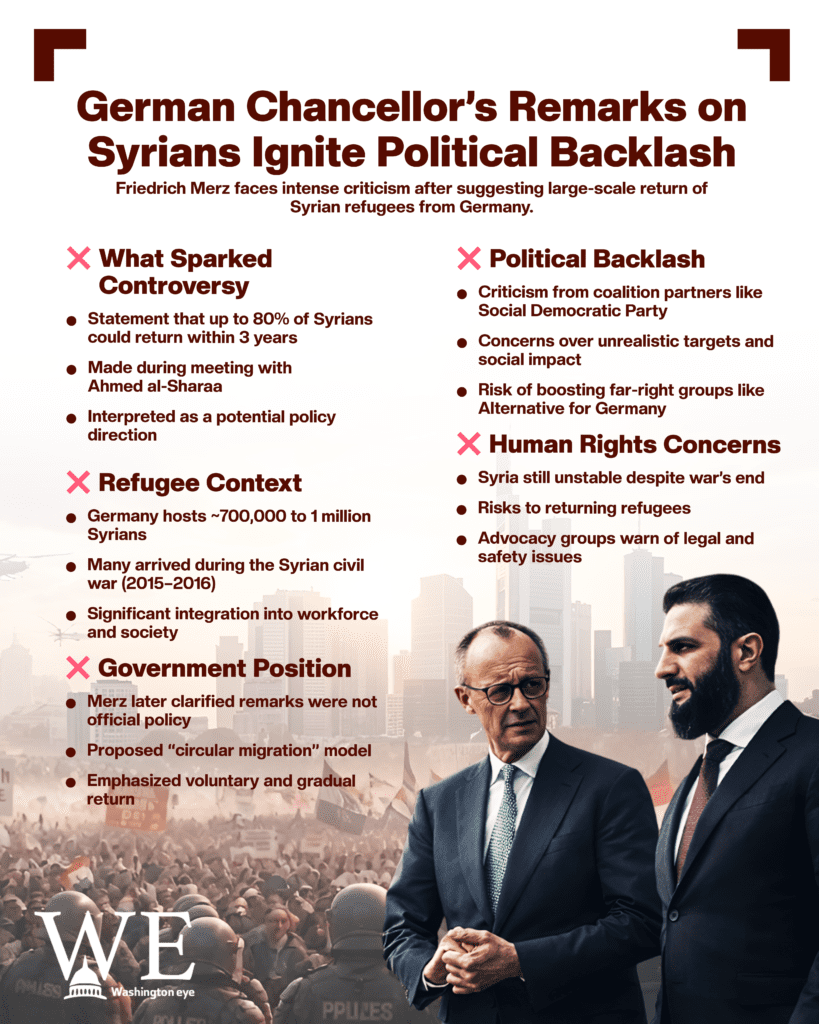
German Chancellor Friedrich Merz has come under intense criticism after controversial remarks about Syrian refugees in Germany triggered a nationwide political and social debate, highlighting deep divisions over immigration policy in Europe’s largest economy. The comments were made in late March 2026 during a high-profile meeting in Berlin with Syria’s interim president, Ahmed al-Sharaa, where discussions focused on post-war reconstruction and the future of Syrian refugees.
At the center of the controversy was Merz’s statement suggesting that up to 80 percent of Syrians living in Germany could return to their homeland within the next three years. The remark, delivered during a joint press conference, was interpreted by many as a policy direction, even though Merz later clarified that the figure reflected what the Syrian president had hoped for rather than a formal German government target. However, the damage had already been done, as headlines quickly framed the statement as a concrete plan to send back hundreds of thousands of refugees.
Germany currently hosts between 700,000 and nearly one million Syrians, many of whom arrived during the peak of the Syrian civil war between 2015 and 2016 under former Chancellor Angela Merkel’s open-door policy. Over the past decade, a significant number of these refugees have integrated into German society, with around 250,000 acquiring citizenship and many others contributing to key sectors such as healthcare, transportation, and construction.

Merz defended his broader position by arguing that Syria, following the end of its civil war in 2024 and the fall of Bashar al-Assad’s regime, now requires its citizens to return and help rebuild the country. He emphasized that many Syrians have skills that could support reconstruction efforts and suggested that cooperation between Berlin and Damascus could facilitate a “circular migration” model, allowing refugees to move between both countries. At the same time, he indicated that individuals without legal residency or those involved in criminal activities would be prioritized for return.

The remarks, however, sparked immediate backlash across Germany’s political spectrum. Leaders from coalition partners, including members of the Social Democratic Party (SPD), warned that setting numerical targets for deportations or returns was unrealistic and potentially harmful. Critics argued that such statements risk undermining integration efforts and could fuel anti-immigrant sentiment, particularly benefiting far-right groups like the Alternative for Germany.
Human rights organizations and refugee advocacy groups also strongly condemned the comments, stressing that Syria remains unstable despite the official end of the war. They warned that large-scale returns could endanger lives and violate international protection norms. The advocacy group Pro Asyl described the proposal as irresponsible, pointing out that many Syrians still face security risks and lack basic infrastructure in their home regions.
Economic concerns further intensified the debate. Experts and industry representatives cautioned that a mass return of Syrian refugees could exacerbate labor shortages in Germany, particularly in healthcare. According to estimates, more than 5,700 Syrian doctors are currently working in German hospitals, and their departure could significantly strain the system. Similar concerns were raised about other sectors that rely heavily on migrant labor.

Even within Merz’s own conservative bloc, the Christian Democratic Union (CDU), some lawmakers expressed unease. They argued that the chancellor’s remarks were politically risky and could create expectations that are difficult to meet, both domestically and internationally. Observers noted that the controversy comes at a time when migration remains a highly sensitive issue in Germany, with rising public anxiety and increasing support for stricter immigration policies.
In response to mounting criticism, Merz attempted to clarify his position, reiterating that any return of refugees would need to be voluntary, gradual, and aligned with legal frameworks. He also acknowledged the complexity of the issue, emphasizing that Germany remains committed to humanitarian obligations while seeking long-term solutions for migration management.
The episode has reignited a broader debate over Europe’s migration policies, particularly as countries reassess asylum frameworks in the aftermath of prolonged conflicts. It also underscores the political challenges leaders face in balancing domestic pressures, economic needs, and international responsibilities. As Germany navigates this complex terrain, Merz’s comments have become a flashpoint in the ongoing discussion about the future of refugees in Europe.