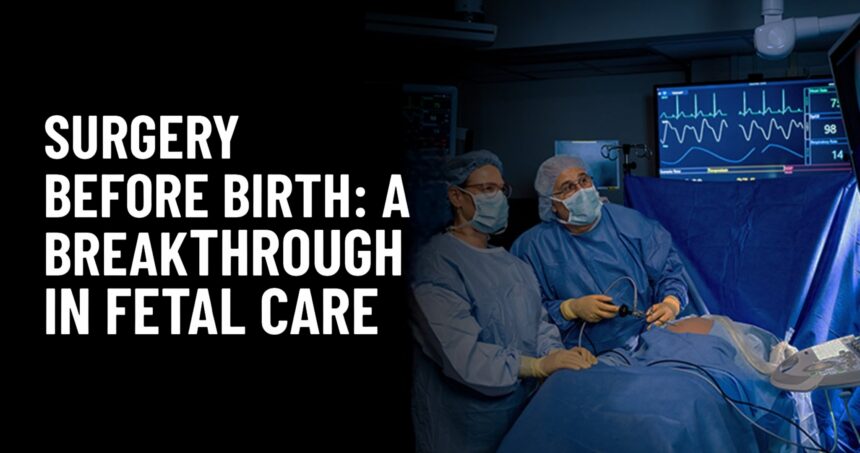
A British baby born with a serious abdominal-wall defect is thriving after surgeons carried out a pioneering operation before he was even born, placing his intestines back inside his abdomen while he was still in his mother’s womb. The procedure, performed at Texas Children’s Hospital in Houston, United States, represents a potentially major advance in fetal surgery.
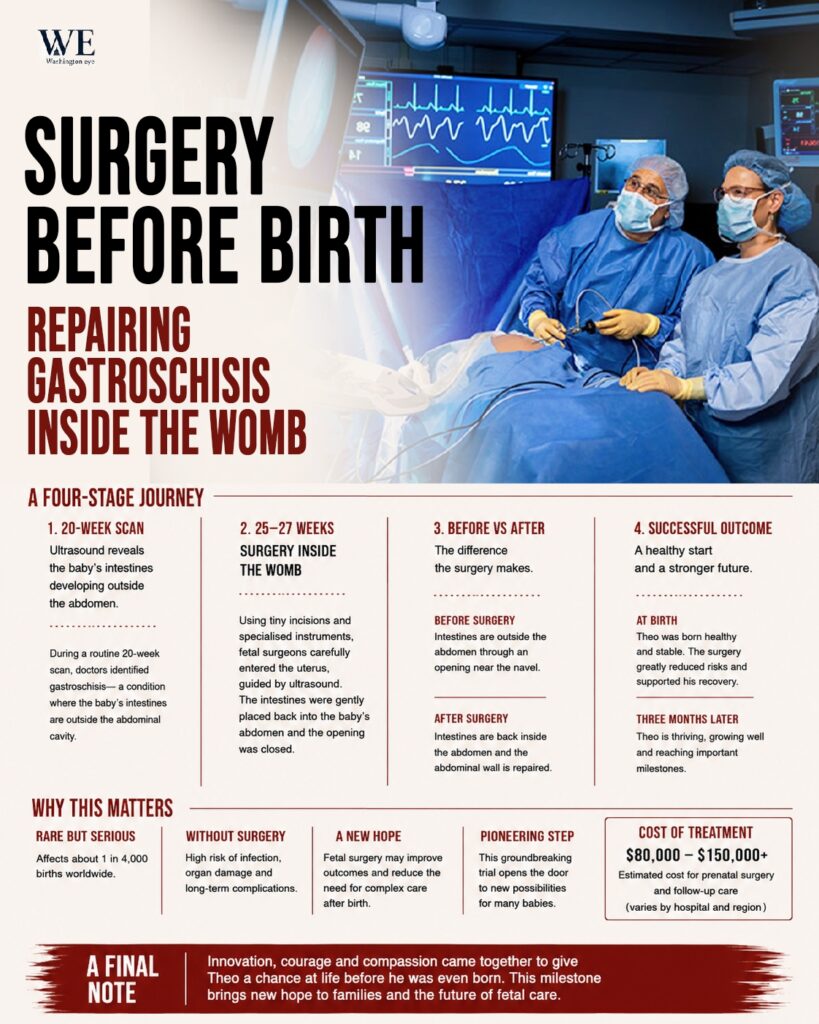
Baby Theo had been diagnosed with complex gastroschisis, a congenital condition in which an opening develops in the abdominal wall and allows the intestines to grow outside the body. His mother, Maisie Savage, 29, and her partner, Josh French, 36, both teachers from London, learned about the condition during the routine 20-week pregnancy ultrasound. Further investigations showed that Theo had a particularly severe form of the disorder.
Gastroschisis usually leaves loops of bowel exposed directly to the amniotic fluid. This can irritate and damage the intestines, causing swelling and potentially serious complications. Traditionally, babies with the condition undergo surgery after birth, either immediately returning the bowel to the abdomen or gradually doing so using a special protective “silo.” For Theo, however, doctors offered his parents an extraordinary alternative: experimental surgery while he was still developing inside the womb.

Pioneering Operation at 26 Weeks
At around 26 weeks of pregnancy, Savage underwent fetal surgery at Texas Children’s Hospital as part of a clinical trial led by fetal-surgery specialists including Dr Michael Belfort. Theo became only the third baby in the world reported to undergo this experimental procedure and the first baby from the UK to benefit from it.

The procedure required surgeons to gain access to the uterus and create enough room to operate using minimally invasive instruments. Amniotic fluid was drained and carbon dioxide was introduced to provide operating space. Using keyhole surgical techniques, doctors carefully moved Theo’s exposed organs back into his abdominal cavity and repaired the defect.
Before the main operation, Savage had also travelled to Belgium, where specialists administered a Botox injection through the womb to relax the muscles of Theo’s abdominal wall and help facilitate the later repair. The Houston procedure was completed without reported complications for either mother or baby. The approach is particularly significant because fetal surgeons are trying to intervene before prolonged exposure to amniotic fluid causes further bowel damage.
Theo Born Healthy Three Months Later

After undergoing such complex surgery during pregnancy, Savage continued carrying Theo for approximately another three months. He was eventually born naturally at full term in Texas in February 2026. The outcome was striking. Theo was able to breastfeed soon after birth and was discharged from hospital after only four days. By August, reports described him as healthy and thriving with his family back in Britain.
That recovery is particularly important because babies with complex gastroschisis can otherwise face prolonged hospital stays, feeding difficulties, bowel damage and multiple operations. In complicated cases, portions of the intestine can become blocked, twisted or severely damaged. The operation therefore aims not merely to avoid post-birth surgery, but potentially to prevent some of the intestinal injury occurring before delivery.
Could Womb Surgery Change Gastroschisis Treatment?
The procedure is part of a clinical trial involving specialists in the United States and Europe, with expertise from institutions including Great Ormond Street Hospital and KU Leuven. Researchers hope the results will establish whether prenatal repair can offer better outcomes than conventional treatment after birth.
The implications could be significant. Gastroschisis is generally identified during pregnancy by ultrasound, often at the routine 18-to-20-week scan. Ultrasound can reveal loops of intestine floating outside the fetal abdomen. If doctors can reliably identify the babies most at risk of severe bowel damage and safely operate before birth, fetal surgery could eventually transform the management of the most complicated cases.
However, specialists are cautious about declaring the technique a new standard of care. This remains an experimental procedure, and fetal surgery carries risks for both mother and unborn baby. Most gastroschisis cases are still treated after birth, and established medical guidance continues to describe postnatal surgery as the conventional treatment.
Theo’s success is nevertheless an important proof of what may be possible. Techniques developed for fetal conditions such as spina bifida are increasingly being adapted to other congenital abnormalities, potentially allowing doctors to treat serious diseases months before a child takes their first breath.
For Savage and French, the medical breakthrough is far more personal. A diagnosis that initially suggested their son might face a difficult beginning involving intensive care and repeated operations instead resulted in a baby who was able to go home just days after birth.
Theo’s case is now being watched internationally as researchers assess whether the procedure can be reproduced safely. If larger trials confirm its benefits, operating on gastroschisis inside the womb could eventually become an option for babies with the most severe forms of the condition.