
For most of the world, the calendar says 2026. But travel to Ethiopia, Iran, Nepal or Thailand and the year displayed on an official document, government notice or local calendar may be completely different. Depending on the calendar being followed, people around the world are currently living in years ranging from 1405 to 5786 and beyond.
The difference does not mean these countries are literally “behind” or “ahead” in time. Instead, calendars begin counting years from different historical, religious or political events. Although the Gregorian calendar has become the international standard for business, aviation, diplomacy and much of everyday life, several countries continue to use their own calendars officially or alongside it.
Ethiopia: The Year 2018

Perhaps the most famous example is Ethiopia, where August 2026 falls in 2018 according to the Ethiopian calendar. Ethiopia will enter 2019 in September 2026, when it celebrates its New Year. The Ethiopian calendar is approximately seven to eight years behind the Gregorian calendar because of different historical calculations concerning the date of the Annunciation and the birth of Jesus Christ. It is derived from ancient Alexandrian and Coptic traditions.
It also has 13 months. Twelve months contain 30 days each, while a short 13th month, Pagume, contains five days, or six during a leap year. This makes Ethiopia one of the clearest examples of a country where saying “it is 2026” does not necessarily match the calendar used domestically.

Iran, Nepal and Thailand
In Iran, the official calendar is the Solar Hijri calendar. As of August 2026, Iran is in the year 1405. Its year count is linked to the Hijra, the migration of Prophet Muhammad from Mecca to Medina in 622, but unlike the Islamic Hijri calendar, Iran’s system is solar rather than lunar. Its New Year, Nowruz, begins around the March equinox. Meanwhile, Nepal is far ahead of 2026 numerically. The country officially uses the Vikram Samvat calendar, which is approximately 56 to 57 years ahead of the Gregorian system. Thus, dates corresponding to 2026 appear in the 2080s under Vikram Samvat.
Then there is Thailand, where 2026 corresponds to 2569 BE, or Buddhist Era. Thailand’s year numbering is 543 years ahead of the Gregorian count. The system is based on the traditional Buddhist era associated with the passing of Gautama Buddha. Thailand’s solar calendar otherwise closely follows the Gregorian system for months and days. Japan provides another interesting variation. Japan uses the Gregorian calendar but also officially uses imperial era names. The reign of Emperor Naruhito began the Reiwa era in 2019, meaning that 2026 is Reiwa 8.
India and the Islamic Calendar

India also recognizes the Saka calendar, or Indian National Calendar, alongside the Gregorian calendar for certain official purposes. The Saka year corresponding to much of 2026 is 1948. Across Muslim countries, another year is also being observed: the Hijri year 1448 AH during the latter part of 2026. The Islamic calendar begins from the Hijra in 622 CE and follows lunar cycles.
Because a Hijri year contains only about 354 or 355 days, Islamic dates move approximately 10 or 11 days earlier each Gregorian year. The calendar is particularly important for determining Ramadan, Eid al-Fitr, Eid al-Adha and Hajj. Saudi Arabia and several other Muslim-majority countries use the Hijri calendar for religious and some administrative purposes while also relying extensively on Gregorian dates for modern civil, commercial and international activities.
Why Does the World Have Different Years?
The answer lies in history. The Gregorian calendar traces its present system to reforms introduced by Pope Gregory XIII in 1582, whereas other calendars calculate years from different religious, astronomical, imperial or historical starting points. These differences demonstrate that a calendar is more than a tool for counting days. It can preserve religion, national identity, political history and cultural memory.
Globalization has nevertheless made the Gregorian calendar overwhelmingly dominant for international communication. Airlines, multinational companies, financial institutions, governments and digital systems need a common dating standard. Consequently, many countries use two systems simultaneously: a traditional or national calendar domestically and Gregorian dates internationally.
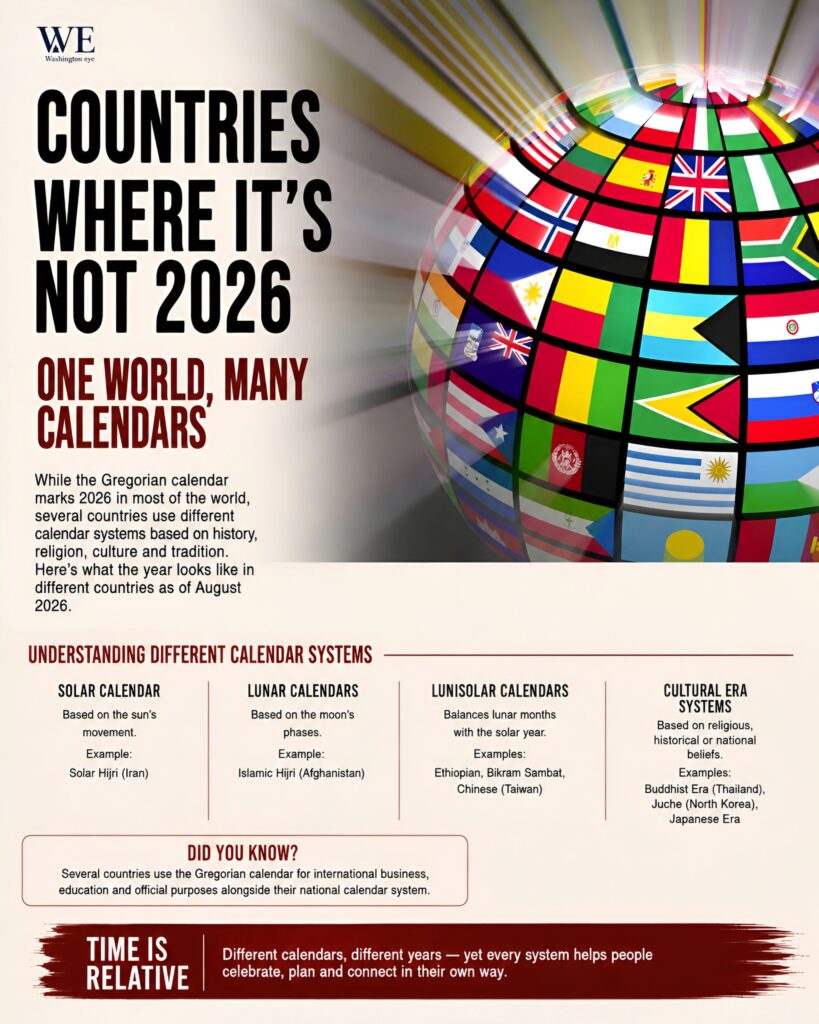
The phrase “countries where it is not 2026” therefore comes with an important qualification. Everyone is experiencing the same moment in time; societies simply number that moment differently. From 2018 in Ethiopia and 1405 in Iran to 2569 in Thailand and 5786 in the Hebrew calendar, the world’s different calendars offer a striking reminder that even something as seemingly universal as the year depends on culture, history and perspective.