

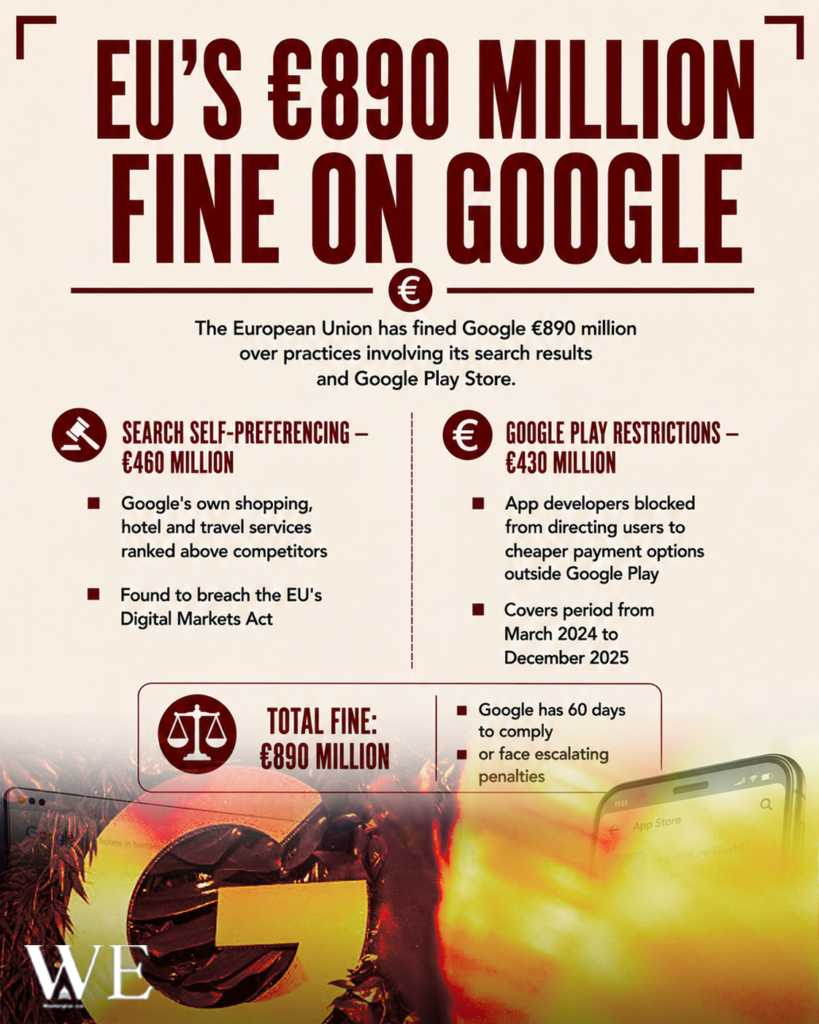
The European Commission has fined Google a combined €890 million, approximately $1 billion, for violating the European Union’s Digital Markets Act by favouring its own services in search results and restricting app developers from directing customers towards cheaper purchasing options.
The penalty, announced on July 23, 2026, consists of two separate decisions. Google received a €460 million fine for giving preferential treatment to its services on Google Search and a €430 million fine over restrictions imposed on developers distributing applications through Google Play.
These are Google’s first penalties under the Digital Markets Act, or DMA, but its fifth and sixth major European competition-related fines. According to Reuters, EU penalties imposed on the company for anti-competitive practices have now reached approximately €10.38 billion over nearly two decades.

The DMA was introduced to regulate large digital platforms classified as “gatekeepers” because their services provide crucial access between businesses and consumers. It applies to major search engines, app stores, social networks, operating systems and other platforms whose market power allows them to influence how digital businesses compete.

Unlike traditional competition investigations, which may require regulators to spend years proving that a company abused a dominant position, the DMA establishes a list of obligations that designated gatekeepers must follow. Companies can be fined up to 10 per cent of their worldwide annual turnover for violations and up to 20 per cent for repeated breaches.
The first Google decision concerned self-preferencing in Search. The Commission found that Google displayed its shopping, hotel, transport and sports services more prominently than comparable services offered by competitors. Google’s results could appear at the top of the page or receive enhanced images, interactive filters and other features unavailable to rival services.
EU officials argued that these differences gave Google’s products an artificial advantage. Under the DMA, a gatekeeper must apply transparent, fair and non-discriminatory ranking conditions instead of using control over a platform to promote its other businesses. The Commission’s decision therefore ordered Google to treat competing services fairly.

The second violation involved “steering” on Google Play. European rules require app developers to be able to inform customers, without charge, about alternative offers available through websites, competing app stores or other payment channels.
The Commission found that Google prevented developers from freely communicating and promoting these alternatives. Although Google is permitted to charge a reasonable fee when its Play Store helps a developer acquire a new customer, regulators concluded that its steering-related fees and the length of time for which they were charged exceeded what the DMA allows.
For consumers, greater steering freedom could mean seeing lower subscription prices or alternative payment options that do not include Google’s commission. Developers, meanwhile, could communicate directly with customers and choose how their digital products are sold.
Google strongly disagreed with both findings and indicated that it could challenge the decisions in court. Kent Walker, the company’s president of global affairs, argued that the required changes would remove useful real-time Search features, including instant prices and availability for hotels, flights and restaurants.
The company also maintained that relaxing its Google Play restrictions could weaken protections against fraud and unsafe payments. Google described the Commission’s approach as product degradation that would harm European consumers and businesses rather than create fair competition.
The Commission rejected that argument, saying the DMA is intended to ensure that the best service succeeds because of its quality rather than because its owner controls the platform through which customers discover it. EU competition chief Teresa Ribera said European laws must be fully respected, while technology commissioner Henna Virkkunen described the decisions as necessary for a fair and competitive digital market.
Google has been given 60 days to end the violations. Continued failure to comply could expose the company to periodic penalties of up to five per cent of its average daily worldwide turnover. Regulators nevertheless acknowledged that Google had made significant progress and was engaged in constructive discussions, making immediate additional fines less likely.
The company has started testing changes to the presentation of shopping, hotel and flight results. It has also proposed new Google Play terms intended to give developers more freedom to promote outside offers. The Commission said the principles of its Search decision could also apply to AI-generated products such as AI Overviews and AI Mode.
The investigation began in March 2024, shortly after the DMA’s obligations became applicable to designated gatekeepers. Preliminary findings issued in March 2025 concluded that Google’s proposed compliance measures were insufficient. The final decisions followed more than two years of regulatory discussions and market testing.
The fines have also increased tensions between Brussels and Washington. The Trump administration has accused European regulators of disproportionately targeting successful American technology companies and has warned of possible trade consequences. EU officials maintain that the rules apply equally to every designated gatekeeper regardless of nationality.
The financial penalty may be only part of Google’s eventual cost. Competitors, price-comparison companies and app developers could use the EU findings to support private damages lawsuits. Reuters reported that Google already faces European claims potentially worth billions of dollars.
Google can appeal the decisions before the EU courts, meaning the legal battle may continue for years. However, the €890 million fine sends an immediate message: Europe intends to prevent dominant platforms from using their control of search engines and app stores to determine which businesses consumers can see and where they can make purchases.