
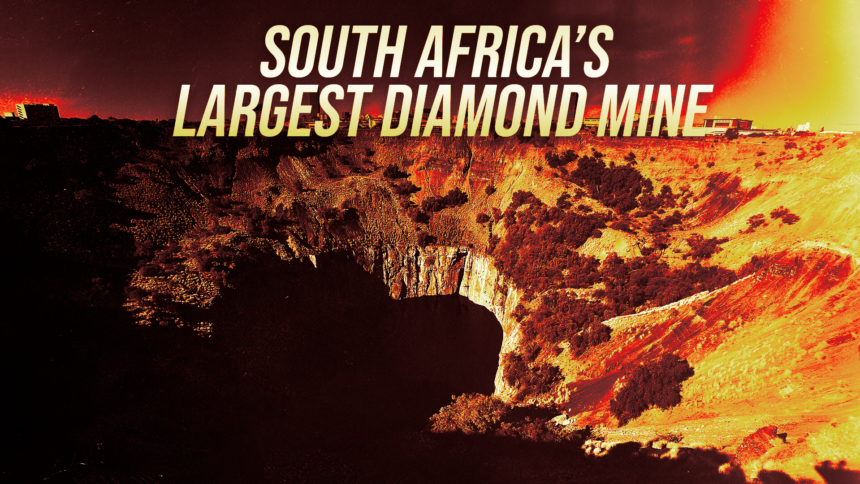
De Beers has announced plans to suspend production for two years at Venetia, South Africa’s largest diamond mine by value, as the global natural-diamond industry struggles with falling prices, weaker demand and increasing competition from laboratory-grown stones.
The company announced the decision on July 13, 2026, as part of a broader cost-reduction and restructuring programme. De Beers said the temporary shutdown would help reduce operating expenses while allowing it to reschedule spending on Venetia’s multibillion-dollar underground expansion. The company did not provide precise dates for the beginning and end of the production pause.
Venetia is situated in South Africa’s northern Limpopo province, around 80 kilometres from the town of Musina. The operation is particularly important to nearby communities in the Musina and Blouberg municipalities, where it provides employment, business contracts and community-development funding. The mine has approximately 4,400 employees and contractors, although some news reports have placed the directly affected workforce at around 3,500.

De Beers said it was consulting employees, unions and other stakeholders and would support workers affected by the decision. It also promised to continue investing in local communities and fulfilling its commitments under South Africa’s Social and Labour Plan system. However, the company had not disclosed the final number of jobs likely to be lost or suspended.

The decision is significant because Venetia contributes approximately 40 per cent of South Africa’s total diamond production. The mine recovered around 2.2 million carats in 2025, representing roughly 10 per cent of De Beers’ global output. Its closure is therefore expected to cause a substantial decline in South African diamond production unless output from the country’s smaller mines increases. De Beers describes Venetia as South Africa’s largest diamond producer by value.
Venetia opened in 1992 and has operated for approximately 34 years. Its original open-pit mine reached a depth of around 450 metres before open-cast operations ended in December 2022 after three decades of production. From 1992 to the end of 2018 alone, the mine recovered approximately 123 million carats of diamonds.
To extend Venetia’s productive life, De Beers launched a $2.3 billion project to move operations underground. It was the largest single investment in South Africa’s diamond-mining industry in decades. The underground mine delivered its first diamonds in July 2023 and was designed to continue operating until at least 2045.

The highly mechanised underground operation was expected to process as much as seven million tonnes of diamond-bearing kimberlite ore annually and eventually produce around four million carats of diamonds each year. Its main shafts extend more than one kilometre below the surface. When underground production began, the project was about 70 per cent complete, according to an earlier De Beers announcement.
Despite pausing diamond extraction, De Beers intends to continue selected construction and infrastructure work at Venetia. The company said this investment would improve the mine’s capacity and efficiency, allowing production to expand when market conditions recover. The announcement therefore represents a temporary production suspension rather than the permanent closure of the mine.
The main reason for the pause is the prolonged downturn in the natural-diamond market. Rough-diamond prices have fallen sharply from the record levels reached in 2022. Demand has weakened in major markets, particularly China, while economic uncertainty has made consumers more cautious about expensive jewellery purchases.
Laboratory-grown diamonds have added further pressure. These stones have the same chemical structure as natural diamonds but can be produced more quickly and sold at significantly lower prices. Their growing popularity, particularly among younger consumers and buyers seeking affordable jewellery, has forced traditional diamond companies to reconsider production and marketing strategies.
Large inventories held by diamond cutters and traders have also reduced demand for newly mined stones. Although De Beers said natural-diamond jewellery demand showed signs of recovery in the United States during 2025 and early 2026, trading conditions for rough diamonds remained difficult. The company has removed more than $100 million in annual overhead costs since 2024 and has sold or closed several non-core operations.
“Rough diamond trading conditions are expected to remain challenging in the near term,” De Beers said in its official restructuring statement. The suspension also comes as Anglo American seeks to sell its controlling interest in De Beers and concentrate on commodities including copper. The Botswana government owns the remaining 15 per cent of the diamond company. Weak market conditions have complicated the sale and reduced De Beers’ valuation.
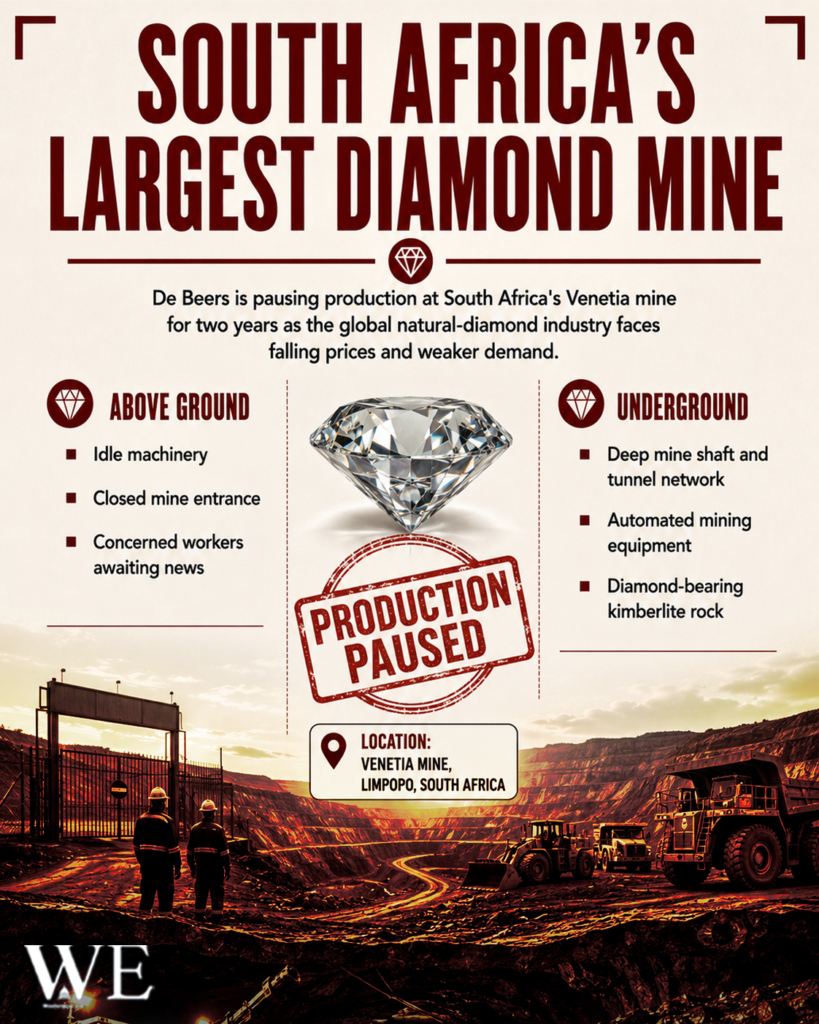
For South Africa, the production pause threatens jobs, export income and businesses that depend on the mine. It also illustrates the wider transformation of a diamond industry that has played an important role in the country’s economy since the nineteenth century. Venetia may possess enough resources to operate well into the 2040s, but its immediate future now depends on whether demand and prices for natural diamonds recover.