Renewed attacks on commercial vessels have returned international attention to Bab al-Mandeb, a narrow but strategically critical waterway connecting the Red Sea with the Gulf of Aden and the wider Indian Ocean. Any serious disruption there can delay global trade, increase energy prices and force ships travelling between Asia and Europe to take a much longer route around Africa.
The danger became clear again on August 11, 2026, when the Egyptian-owned cargo ship Tihamah was attacked near Yemen’s Perim Island. Yemeni authorities said four crew members, three Pakistanis and one Indonesian, were killed. Two Yemeni rescuers also died in a second strike. The Houthis later confirmed carrying out an attack, saying the vessel was transporting Saudi military equipment, according to Reuters.
Bab al-Mandeb, commonly translated from Arabic as the “Gate of Tears” or “Gate of Grief,” lies between Yemen on the Arabian Peninsula and Djibouti and Eritrea in the Horn of Africa. It forms the southern entrance to the Red Sea and is approximately 26 kilometres wide at its narrowest point. Perim, also known as Mayyun Island, divides the strait into eastern and western channels.
Its modern economic importance increased dramatically after the Suez Canal opened in 1869. Together, Bab al-Mandeb, the Red Sea and the Suez Canal created the shortest major maritime connection between Asian markets and Europe. Ships carrying manufactured products from China, energy supplies from the Gulf, grain, food, vehicles and consumer goods commonly pass through the strait before travelling north towards Egypt and the Mediterranean.

The Suez route normally carries approximately 15 per cent of global maritime trade and around 30 per cent of the world’s container traffic. Because Bab al-Mandeb is the southern gateway to that corridor, most ships using the Suez Canal on voyages between Europe and Asia must also cross the strait. This makes it one of the world’s most important maritime chokepoints.
Bab al-Mandeb is particularly important for energy security. Oil and petroleum products travelling from the Persian Gulf to Europe and North America frequently pass through the Strait of Hormuz, cross the Arabian Sea and then enter Bab al-Mandeb. They continue north through the Red Sea towards the Suez Canal or Egypt’s SUMED pipeline.
An estimated 8.7 million barrels of oil and petroleum products passed through Bab al-Mandeb each day in 2023. Following Houthi attacks that began in November that year, the volume dropped to about four million barrels per day during the first eight months of 2024. The US Energy Information Administration warns that disruptions at major oil chokepoints can cause supply delays, increase shipping costs and place upward pressure on global energy prices.

The strait does have an alternative, but it is expensive. Ships avoiding the Red Sea must sail around the Cape of Good Hope at the southern end of Africa. That diversion can add between 3,000 and 3,500 nautical miles to a typical Asia–Europe journey and extend delivery times by seven to 10 days. Some voyages take even longer, depending on the ship, weather and destination.
Longer journeys require additional fuel, vessels and crew time. They also raise insurance costs and reduce the number of ships available to carry goods. These expenses can eventually reach consumers through higher prices for fuel, food, clothing, electronics and other imported products. The diversion also increases greenhouse-gas emissions because vessels burn more fuel while travelling around Africa.
The security situation has deteriorated since the Houthis began attacking ships during the Gaza conflict, initially describing their operations as support for Palestinians. The group later expanded its maritime threats amid wider regional confrontation. Shipping through Bab al-Mandeb and the Red Sea has fallen by more than half compared with levels before the attacks.
The Houthis declared a maritime embargo against Saudi Arabia on July 20, 2026, further discouraging vessels from using the waterway. Shipping data showed average daily passages falling from around 50 vessels before the announcement to approximately 32 afterward. On August 25, about 31 commodity vessels crossed Bab al-Mandeb, broadly matching the preceding 10-day average, but traffic remained well below earlier historical levels.
The International Maritime Organization has repeatedly condemned attacks on commercial ships. It warned in July 2026 that violence in the Red Sea endangered civilian seafarers, threatened the marine environment and undermined global supply-chain stability. The organisation urged shipping companies to conduct careful security assessments before entering the region. Its official statement also called for freedom of navigation to be protected.
Bab al-Mandeb has geopolitical importance beyond trade. Control of the passage affects Yemen, Gulf countries, Egypt, East Africa and major trading powers in Europe and Asia. Nearby Djibouti hosts several foreign military facilities, while international naval forces regularly patrol the Red Sea and Gulf of Aden to protect shipping and counter piracy.
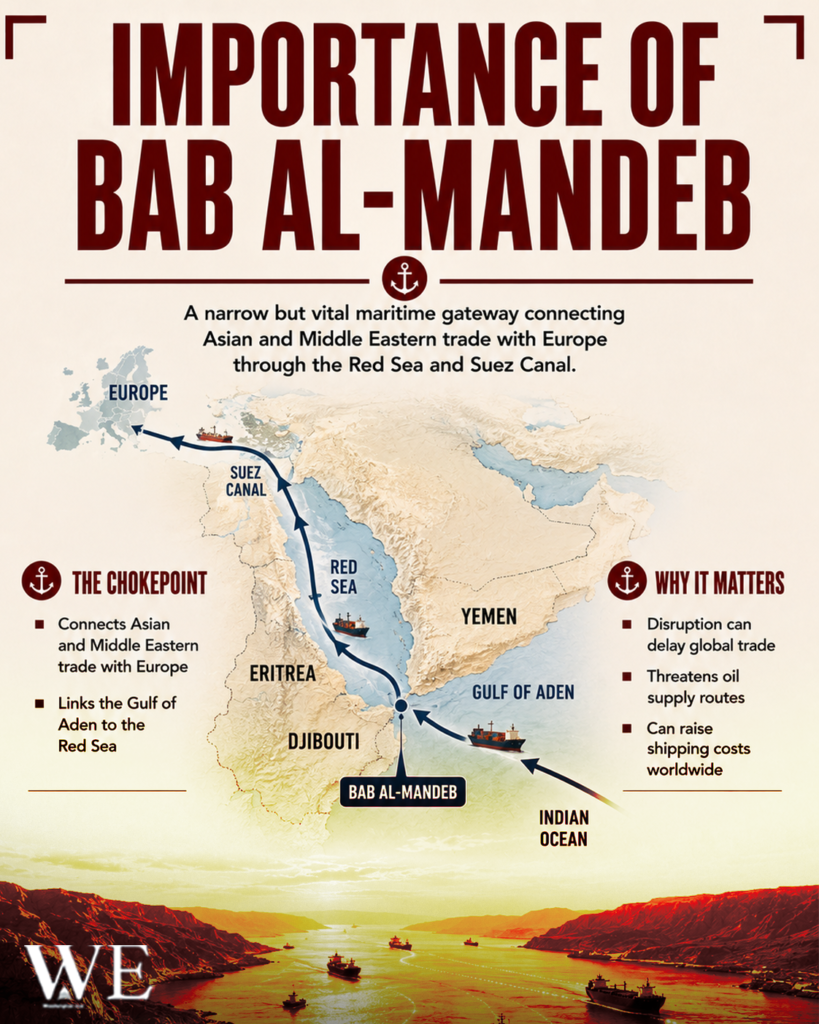
A complete physical closure is not required to disrupt the strait. Missile attacks, drones, piracy or even the fear of violence can convince shipping companies to reroute their vessels. That is why the narrow Gate of Tears has consequences far beyond its shores: instability across a few kilometres of water can reshape trade, raise prices and disturb supply chains worldwide.