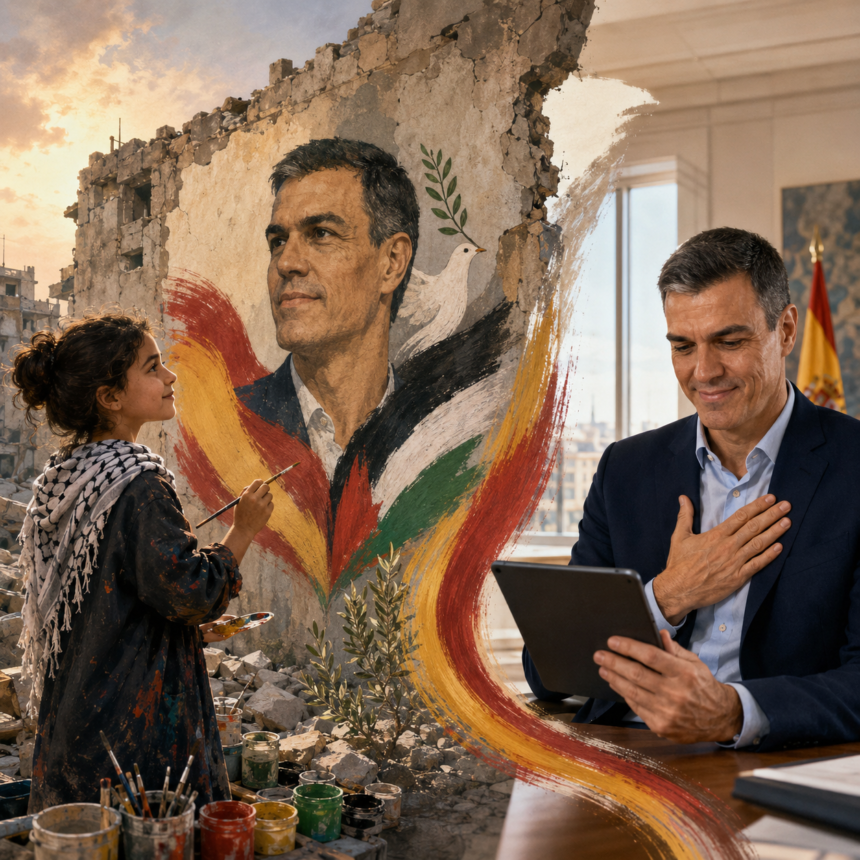
Spanish Prime Minister Pedro Sánchez has personally thanked an 11-year-old Palestinian artist after she helped paint his portrait on a damaged wall in Gaza as a gesture of gratitude for Spain’s support of the Palestinian people.
Layan Al Quqa created the mural with Ubay Karim and other local artists amid the ruins of Gaza City. The artwork depicts Sánchez and symbolises the friendship between the Spanish and Palestinian peoples. In a video recorded beside the painting, Layan introduced herself and expressed hope that the image would reach both the prime minister and the Spanish public.
Her message travelled much farther than she expected. Sánchez responded in a video published on his official Instagram account, thanking Layan and the other artists for finding a way to send affection to Spain despite the destruction and suffering surrounding them.
“We hear you, we see you, we love you, and we haven’t forgotten you,” Sánchez told Layan, Gaza’s children and their families. He said he hoped they would soon be able to return to school, draw without fear and live in peace. The Spanish leader’s direct response surprised Layan, who said she had expected, at most, a written comment. She described receiving the video as one of the happiest moments of her life and said it gave her hope that the voices of Gaza’s children could still reach people outside the territory.
In a second recording, Layan thanked Sánchez and reflected on their exchange across linguistic and geographical barriers. Although they did not speak the same language, she said, they shared compassionate hearts. She also thanked the artists and social-media users who helped circulate the original video.
Behind that joyful reaction lies a childhood heavily disrupted by war. Layan told Al Ghad television that she had been unable to attend school regularly since she was in the second grade. She said she uses drawings to communicate the experiences of Gaza’s children and wants the world to understand that they seek safety, education and an end to the fighting.
Layan now plans to create another mural showing a Palestinian girl raising her country’s flag amid the destruction. She hopes to become a professional artist and continue telling the stories of Gaza and of people who support justice and peace. In her interview, she said her principal wish was for Gaza’s children to live peacefully and return to school.

The decision to paint Sánchez was politically significant. Under his leadership, Spain has become one of the European Union’s strongest advocates for Palestinian statehood, humanitarian access and a permanent ceasefire. His government has also repeatedly criticised the scale of Israel’s military operations and the humanitarian conditions facing civilians in Gaza.
On May 28, 2024, Spain formally recognised the State of Palestine alongside Ireland and Norway. Sánchez said recognition was intended to advance a two-state solution in which Israel and Palestine could coexist in peace and security. He stressed that the decision was not directed against Israel and reiterated Spain’s condemnation of Hamas’s October 7 attacks and its demand for the release of Israeli hostages.
The Spanish government simultaneously called for a permanent ceasefire and unrestricted humanitarian assistance for Gaza. It said a viable Palestinian state should include Gaza and the West Bank, connected by a corridor, with East Jerusalem as its capital and governance under the Palestinian Authority. Sánchez outlined those conditions in Spain’s official declaration recognising Palestinian statehood.
Spain later hosted its first intergovernmental meeting with Palestinian officials following recognition and committed at least €75 million in assistance over two years. The cooperation agreements covered education, employment, youth and agriculture, while Madrid continued campaigning internationally for wider recognition of Palestine.
These policies have made Sánchez a prominent figure among Palestinians, explaining why Layan and her fellow artists chose him as the subject of their mural. The painting was more than a portrait of a foreign political leader: it was a public expression of appreciation for a country they believe has acknowledged their suffering and national aspirations.
The exchange also demonstrated how art can carry a message beyond closed borders. A painting produced on the wall of a ruined building reached millions of people online and received a response from the head of a European government. It transformed an anonymous piece of rubble into a platform for diplomacy, gratitude and testimony.
A video message cannot rebuild schools, restore homes or deliver humanitarian supplies. Nevertheless, Sánchez’s reply gave Layan something increasingly scarce in Gaza—a moment of recognition and hope. Her mural showed that even amid destruction, children continue to create, communicate and imagine a future in which they can paint inside their classrooms rather than on the ruins outside them.