
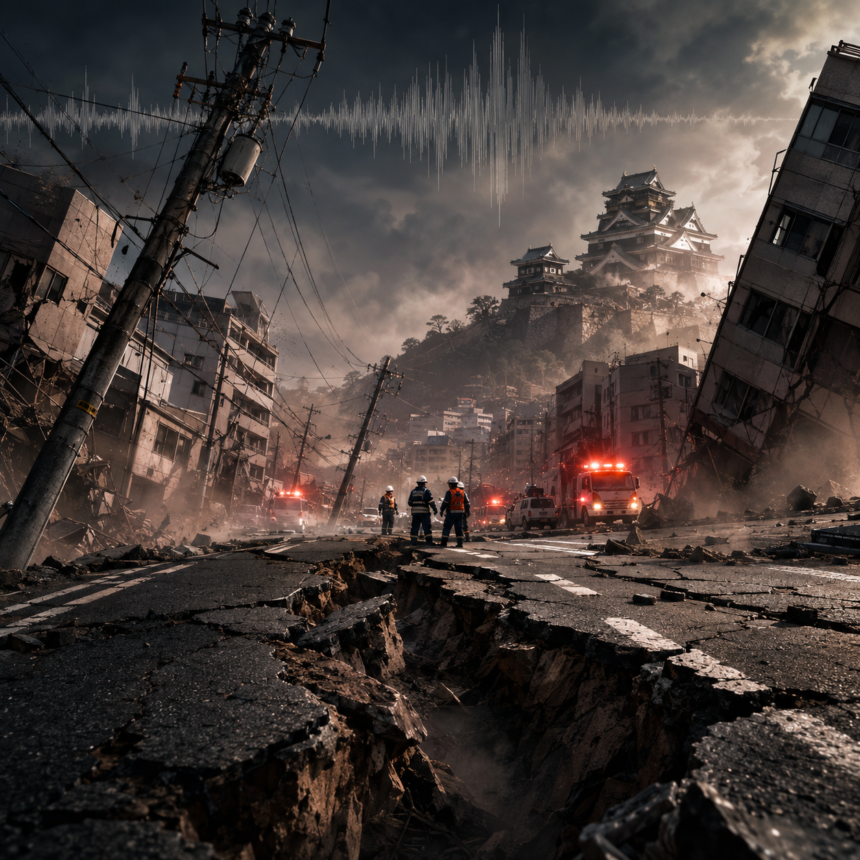
A powerful magnitude 7.1 earthquake that struck Japan’s southwestern island of Kyushu has killed 38 people, injured hundreds and damaged more than 42,000 homes, leaving communities in Kumamoto Prefecture facing a long and difficult recovery.
The earthquake occurred at 4:27 p.m. local time on July 28, 2026, with its epicentre in the Kumamoto region and a depth of approximately 16 kilometres. The Japan Meteorological Agency registered a magnitude of 7.1, while the US Geological Survey calculated 6.8. Such differences are common because agencies use different instruments, datasets and magnitude-calculation methods.
The quake reached level 7—the highest category on Japan’s seismic-intensity scale, in Uki City and Hikawa Town. Intensity 7 indicates exceptionally violent ground movement capable of throwing people off their feet, moving heavy furniture and causing severe damage even to some earthquake-resistant buildings. Other parts of Kumamoto experienced intensities of upper 6 and lower 6, while strong shaking was recorded across neighbouring prefectures.

Japan’s latest official figures list 38 deaths and 364 injured people, including 33 with serious injuries. Kumamoto authorities estimate that 1,735 homes were completely destroyed, nearly 3,000 were half-destroyed and tens of thousands sustained partial or still-unclassified damage. Approximately 2,460 people remained in 61 evacuation centres a month after the disaster. The August 27 report from the Kumamoto prefectural government provides the latest casualty, housing and evacuation figures.

Some of the worst destruction occurred at an Aeon shopping centre in Kashima, where part of the building collapsed and an explosion reportedly followed a gas leak. Although customers were evacuated, employees and rescue workers were caught in the disaster. A large chimney also collapsed at a paper factory in Yatsushiro, trapping workers beneath debris.
Roads, bridges and railway infrastructure were damaged, while a train derailed at Yatsushiro station. Stone walls at the historic Kumamoto Castle also collapsed, damaging a landmark that was still undergoing restoration following the region’s destructive earthquakes in 2016. Factories operated by Toyota, Honda and other major manufacturers temporarily suspended production while safety inspections were conducted.
Electricity and water supplies were interrupted across large areas. At the height of the crisis, more than 100,000 households experienced water disruption, while thousands of residents sought shelter in schools, public buildings, vehicles and outdoor spaces. Recovery efforts were made more difficult by temperatures above 35 degrees Celsius, increasing the danger of heatstroke among evacuees, emergency workers and people clearing damaged homes.

Prime Minister Sanae Takaichi established a government emergency task force and later visited the affected region. Thousands of Self-Defence Force personnel, firefighters, police officers and medical teams were mobilised for search-and-rescue operations, water distribution, debris removal and support at evacuation centres.
A tsunami advisory was issued for the Ariake and Yatsushiro seas two minutes after the earthquake. It was cancelled at 6:10 p.m., less than two hours later, without a damaging tsunami. Regulators also reported no abnormalities at three nearby nuclear power stations. The Associated Press documented the initial rescue operations, transport disruption and temporary tsunami advisory.
The earthquake originated within the Earth’s crust and involved primarily horizontal, or strike-slip, movement. Scientists linked the rupture to the Hinagu Fault Zone, close to the Futagawa-Hinagu fault system responsible for the 2016 Kumamoto disaster. Investigations found surface displacement of up to approximately two metres near Hikawa, while satellite measurements recorded movement of about 87 centimetres at one observation point in Yatsushiro.
Researchers estimate that the ruptured fault extended for approximately 30 to 40 kilometres. The event did not occur on the offshore Nankai Trough, the source of Japan’s feared future megathrust earthquake, and there is no evidence that it means such a disaster is imminent. However, it demonstrates the danger posed by active inland faults, which can generate extremely intense shaking close to populated communities.
Aftershocks continued across a zone approximately 50 kilometres long. By August 12, more than 620 tremors strong enough to register at least intensity 1 had been detected. By August 27, authorities had recorded 100 aftershocks of intensity 3 or higher, including five that reached lower 5. Officials warned that already weakened buildings, slopes and roads could suffer additional damage from further shaking or heavy rain.
The Earthquake Research Committee said seismic activity was gradually declining but remained above normal levels. Residents were advised to avoid unstable structures, secure heavy furniture, prepare emergency supplies and remain alert for landslides.
Japan is among the world’s most earthquake-prone countries because several tectonic plates meet around its islands. Strict construction codes, early-warning systems and regular emergency drills reduce casualties, but they cannot eliminate the danger, particularly from shallow earthquakes directly beneath towns and cities.
The Kumamoto disaster illustrates both Japan’s preparedness and its continuing vulnerability. Rapid warnings, evacuations and emergency mobilisation saved lives, yet the deaths, destroyed homes and prolonged displacement show that even one of the world’s best-prepared countries can suffer devastating losses when a major fault ruptures close to the surface.