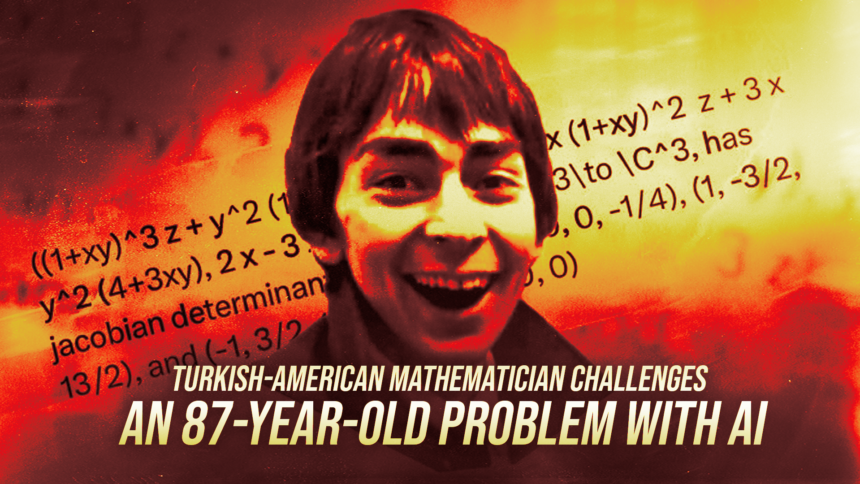
Turkish-American mathematician Levent Alpöge has used an artificial-intelligence model developed by Anthropic to produce a counterexample to the Jacobian conjecture, overturning the famous 87-year-old problem in three and higher dimensions.
The discovery represents one of the most significant examples yet of AI contributing directly to advanced mathematical research. However, reports that the entire Jacobian conjecture has been settled require an important qualification: its two-dimensional form remains unsolved.
Alpöge, a number theorist working at Anthropic and a former Harvard University Junior Fellow, announced the result on X on July 20, 2026. He credited mathematician Akhil Mathew with suggesting the problem and Anthropic’s Claude Fable 5 model with finding the counterexample while the 2026 FIFA World Cup final was taking place.

The Jacobian conjecture was introduced by German mathematician Ott-Heinrich Keller in 1939. It concerns polynomial maps, systems of polynomial equations that transform a collection of input numbers into outputs.
The conjecture proposed that if the Jacobian determinant of such a map is always the same non-zero number, the map must be reversible and its inverse must also consist of polynomials. In simpler terms, if a mathematical transformation behaves locally as though it never folds, crushes or merges nearby space, the conjecture claimed that every output should lead back to one unique input.
The statement appeared as Problem 16 on mathematician Stephen Smale’s influential 1998 list of major problems for the 21st century. Despite decades of research and numerous claimed solutions, mathematicians had been unable either to prove the general statement or produce a valid counterexample.
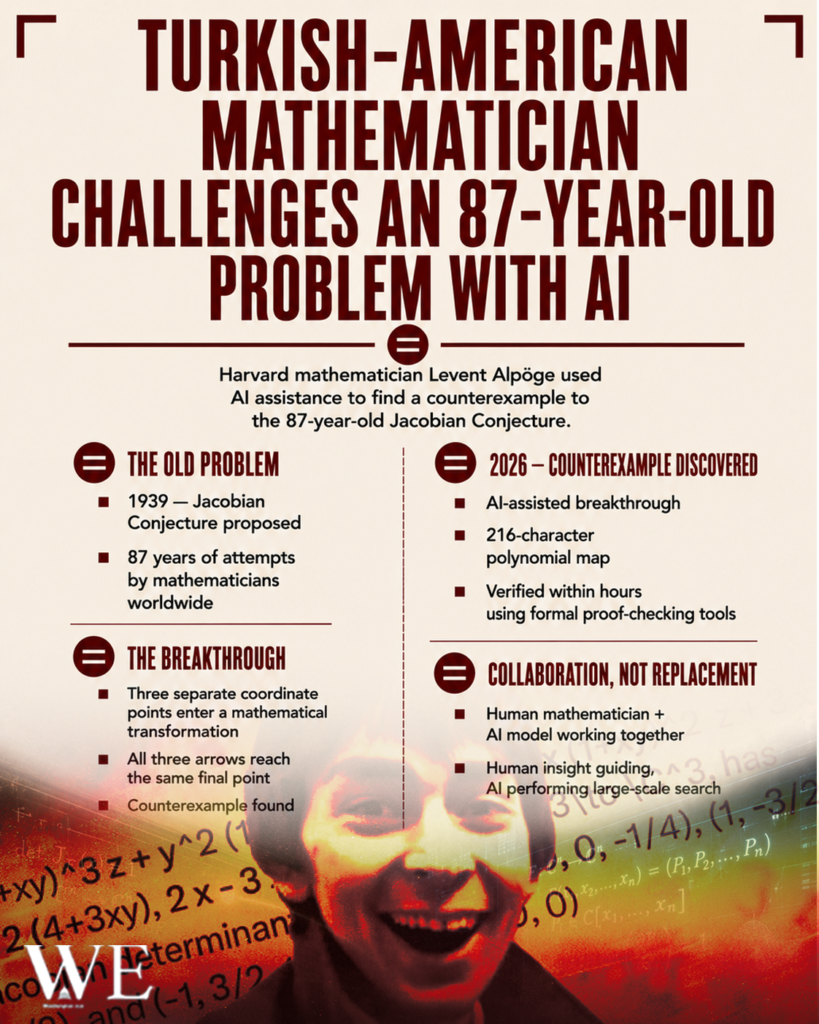
Claude Fable 5 changed that by constructing a comparatively short polynomial map involving three variables. Its Jacobian determinant is constantly negative two, meeting the central condition of Keller’s conjecture. Yet the map sends three different input points to exactly the same output.

Because several inputs produce one result, the transformation cannot be reversed uniquely. The example therefore directly contradicts the conjecture in three-dimensional complex space. Higher-dimensional counterexamples can be created by adding additional unchanged coordinates, making the conjecture false in every dimension greater than two.
The formula was surprisingly compact. Alpöge shared the entire construction in a single social-media post and identified three points—, and —that all map to . Its constant determinant and repeated output can be checked through exact algebra rather than approximate computer calculations.
Mathematicians began examining the result immediately. Independent calculations confirmed the basic identities, while researchers developed geometric explanations showing why the construction works. Mathematician Shuhong Gao subsequently published a self-contained analysis on arXiv, producing further counterexamples and extending the underlying method to every dimension above two.
The speed of verification distinguished the discovery from many previous claims involving famous mathematical problems. Although full journal peer review takes considerably longer, this counterexample does not depend on an uncheckable chain of thousands of AI-generated steps. Anyone with the necessary algebraic knowledge and symbolic-computation tools can verify that the determinant is constant and that the three inputs have the same output.
The result does not settle the two-dimensional Jacobian conjecture. No comparable counterexample has been found for a polynomial map from two-dimensional complex space to itself, and existing mathematical evidence suggests the planar version could still be true. Dimension one was already known to satisfy the conjecture.
Alpöge studied mathematics at Harvard and later completed advanced studies at Cambridge and Princeton. Harvard records show that he served as a Junior Fellow from 2021 to 2025 before joining Anthropic, where he works on AI and mathematical reasoning.
The discovery also provides insight into how AI may contribute to research. The model was not simply asked to perform a routine calculation. It reportedly explored different constructions, tested them with symbolic tools and searched for an example satisfying two difficult requirements: a constant non-zero determinant and failure of global invertibility.
Human judgment remained essential. Mathew identified the problem, Alpöge directed the model and recognised the significance of its output, and other mathematicians verified and explained the result. The achievement is therefore best understood as AI-assisted mathematics rather than a machine operating without human involvement.
The work follows other recent AI-supported advances, including an OpenAI model’s disproof of a longstanding conjecture connected to Paul Erdős’s unit-distance problem. Anthropic has also described how multi-agent mathematical systems can generate ideas, reject failed approaches and verify each other’s arguments. Its research on Claude’s mathematical capabilities confirms that similar prompting methods helped produce the Jacobian counterexample.
The breakthrough does not mean AI can reliably solve every difficult problem. Mathematical models can still hallucinate, overlook conditions or generate convincing but invalid proofs. What makes this case important is that the machine produced a genuinely new, compact and independently checkable object.
For mathematicians, the result closes the general Jacobian conjecture in dimensions three and above while directing renewed attention towards the unresolved two-dimensional case. For artificial-intelligence research, it provides striking evidence that advanced models are beginning to act not merely as calculators, but as creative collaborators capable of uncovering mathematical structures humans had missed for generations.