
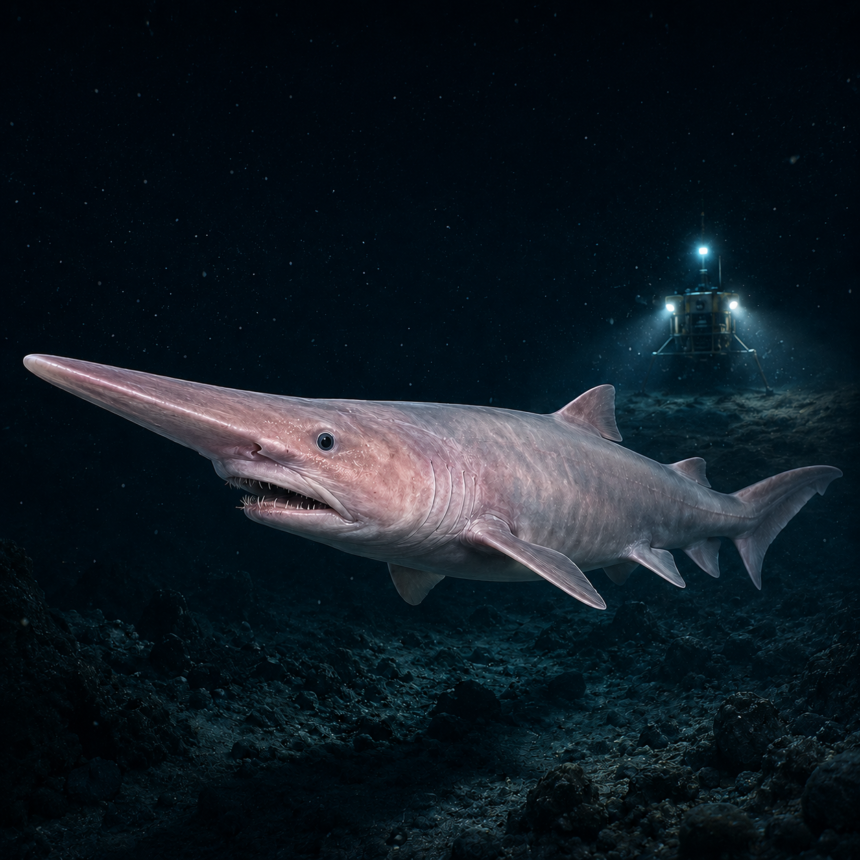
Scientists have published the first confirmed observations of goblin sharks swimming alive and apparently healthy in their natural deep-sea habitat, revealing that the mysterious species occupies a much wider and deeper part of the Pacific Ocean than previously known. Two sharks were recorded during separate research expeditions, one near Jarvis Island in 2019 and another on the slope of the Tonga Trench in 2024, but the importance of the footage was fully established only after researchers examined archived recordings.
The findings were published on May 19, 2026, in the peer-reviewed Journal of Fish Biology by a team led by Aaron Judah of the University of Hawaiʻi at Mānoa. The researchers described the recordings as the first published “in situ” observations of the goblin shark, meaning the animals were seen alive in their normal environment rather than after being captured or pulled towards the surface.
The expression “125-million-year-old shark” refers to the age of the goblin shark’s evolutionary family, not to the age of either animal in the videos. The modern goblin shark, scientifically named Mitsukurina owstoni, is the only surviving species in the family Mitsukurinidae, whose fossil record extends to the Early Cretaceous period, when dinosaurs still dominated the land. This survival has earned it the popular description “living fossil,” although scientists use that term cautiously because the species has continued to evolve.

The first shark was filmed in July 2019 by the remotely operated vehicle Hercules during an Ocean Exploration Trust expedition aboard the exploration vessel Nautilus. It appeared at an unnamed seamount northwest of Jarvis Island in the Pacific Remote Islands Marine National Monument, at a depth of approximately 1,237 metres. The footage was publicly archived but was not initially confirmed as a goblin shark.

Judah revisited the video in 2025 after colleagues mentioned the possible sighting. Physical proportions visible in the recording—including the animal’s long flattened snout, pale body, small rounded fins and extended tail—helped the researchers identify it. The shark was estimated to be a male approximately 3.4 metres long and potentially more than 50 years old, although measurements and age estimates made from video carry uncertainty.
A second shark was recorded on August 9, 2024, during an expedition aboard the research vessel Dagon. A baited camera mounted on a deep-sea lander captured it swimming along the slope of the Tonga Trench at 1,997 metres. The animal, which researchers believe may have been female, appeared for only slightly more than 20 seconds. The expedition collected more than 50 days of continuous footage at depths ranging from 800 to 10,800 metres, demonstrating how rarely the species is encountered.
The Tonga observation was nearly 700 metres deeper than the range commonly associated with goblin sharks and established a new depth record for the species. It also extended the confirmed depth limit for Lamniformes, the order of mackerel sharks that includes great white, mako and basking sharks—by approximately 108 metres.

Goblin sharks usually have pinkish or whitish skin, a soft body and an elongated blade-like snout containing electroreceptors that detect the weak electrical signals produced by prey. Their most dramatic adaptation is a highly protrusible jaw that shoots forward to seize fish, squid and crustaceans. The mechanism compensates for the shark’s relatively slow swimming speed in the cold, dark and food-scarce deep ocean.
Until this research, most scientific knowledge came from dead or dying animals caught accidentally in commercial fishing gear. Goblin sharks have been reported from parts of the Atlantic, Indian and Pacific oceans, particularly near Japan, Australia and the western United States. The two Central Pacific observations therefore fill a substantial gap in the species’ recognised distribution.
Only two sharks were documented in the new study. Scientists do not know the total global population, how frequently the animals reproduce or whether their numbers are increasing or declining. The species is generally considered naturally rare and is not deliberately targeted by major fisheries, although individuals can be taken as bycatch.
Researchers say the discovery matters for more than establishing records. Confirming the shark’s presence in the Central Pacific allows governments and conservation organisations to include it in regional biodiversity inventories and management planning. Remote cameras can also study deep-sea animals without the injuries and pressure changes caused by bringing them to the surface.
“The Goblin Shark is one of these deep-sea charismatic animals that I never thought we’d see alive,” study co-author Alan Jamieson of the Minderoo-University of Western Australia Deep-Sea Research Centre said. The two fleeting encounters, separated by five years and a vast stretch of ocean, show that even a lineage surviving for 125 million years can remain almost entirely hidden from modern science.