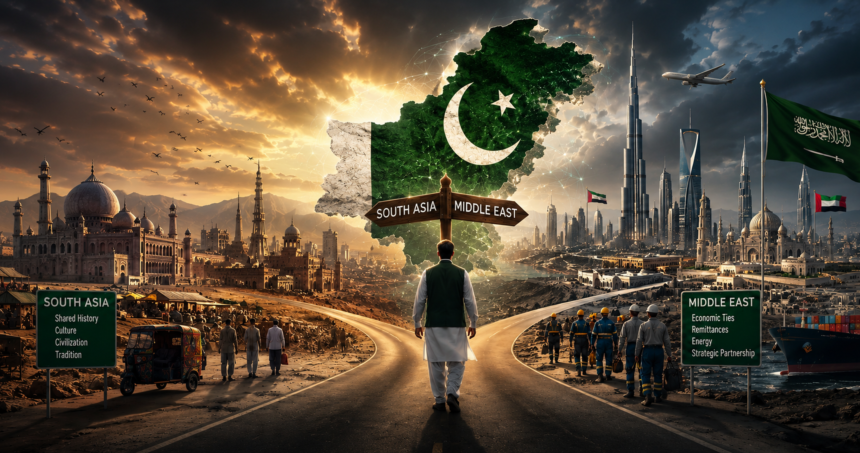
Pakistan’s place between South Asia and the Middle East has become the center of renewed debate after reports emerged that the World Bank shifted Pakistan from its traditional South Asia classification into a broader Middle East and North Africa grouping for fiscal year 2026. The move triggered political discussions, online reactions, and geopolitical analysis over whether Pakistan should now be viewed as part of the Middle East instead of South Asia.
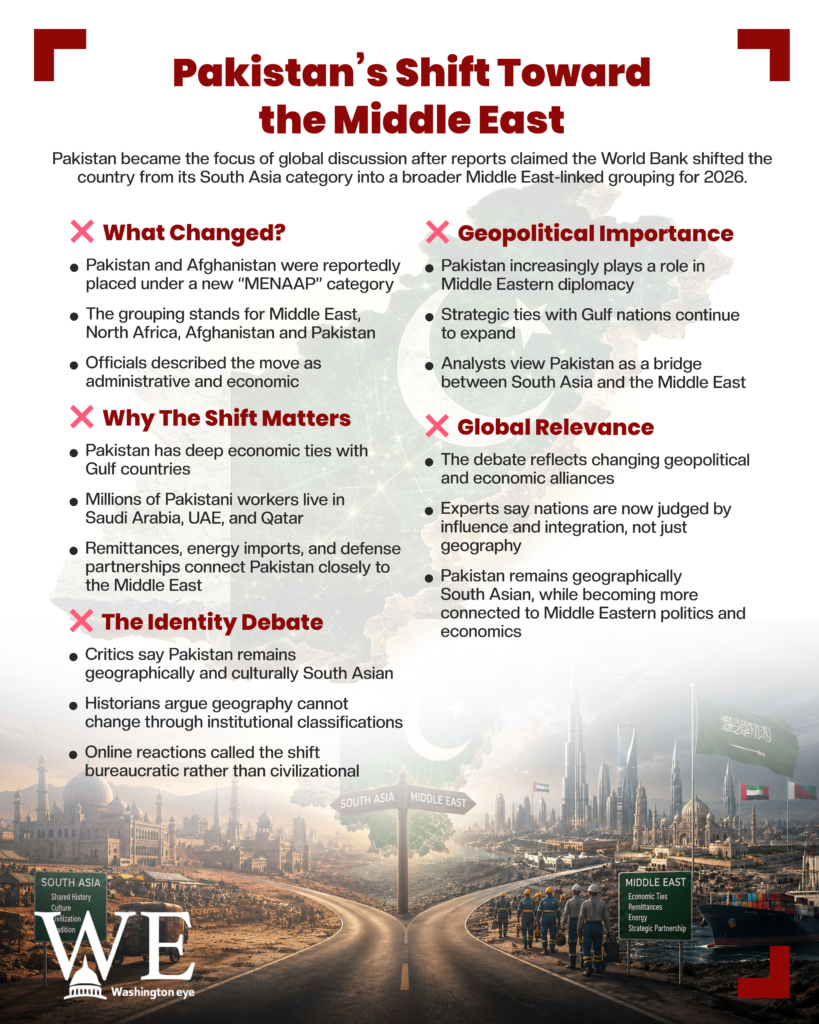
The discussion intensified in April 2026 after reports revealed that the World Bank had placed Pakistan and Afghanistan under a new “MENAAP” category, Middle East, North Africa, Afghanistan and Pakistan, in its internal development and economic classification system. For decades, Pakistan had been grouped with India, Bangladesh, Sri Lanka, Nepal, Bhutan and the Maldives under South Asia. Analysts noted that the change was not geographical but administrative and economic in nature.
According to reports, the World Bank described the adjustment as being “for analytical purposes only,” emphasizing that the grouping reflects economic patterns, remittance structures, labor markets and geopolitical realities rather than physical geography. Pakistan remains geographically located in South Asia on the Asian continent, sharing borders with India, Afghanistan, Iran and China.
The debate quickly spread across social media platforms in Pakistan, India and the broader region. Supporters of the shift argued that Pakistan’s economy, foreign policy and labor market are deeply tied to Gulf and Middle Eastern countries. Millions of Pakistani workers live in Saudi Arabia, the UAE, Qatar and other Gulf states, sending billions of dollars in remittances back home annually. Pakistan also relies heavily on Middle Eastern energy imports and maintains strong defense and diplomatic ties with Gulf nations.

Others, however, rejected the narrative that Pakistan had “left South Asia.” Historians, geographers and political analysts stressed that geography cannot be altered through institutional classifications. Critics argued that Pakistan’s languages, culture, cuisine, history and civilization remain deeply rooted in South Asia despite its strategic links with the Middle East. Many online users described the move as bureaucratic rather than civilizational.
The issue gained further attention because Pakistan has increasingly become involved in Middle Eastern diplomacy in recent years. International media reports highlighted Islamabad’s role in mediation efforts linked to tensions involving Iran, Gulf states and Western powers. Pakistan’s diplomatic outreach, military cooperation with Gulf countries and strategic location connecting South Asia, Central Asia and the Middle East have strengthened perceptions of the country as a bridge between regions.
Analysts say the reclassification could carry economic and diplomatic implications. Regional development groupings influence how countries are compared in terms of economic growth, poverty reduction, infrastructure development and investment priorities. Some experts believe Pakistan could benefit from stronger integration with Gulf economies and Middle Eastern investment frameworks. Others warn that moving away from South Asian benchmarks could reduce access to certain regional development opportunities.

The timing of the debate also reflects broader geopolitical changes across Asia and the Middle East. Pakistan’s strategic importance has increased amid regional instability, energy crises and evolving alliances. Recent global discussions involving Iran, Gulf security and trade routes have frequently included Pakistan due to its geographic proximity and diplomatic relevance.
Experts argue that the controversy highlights a growing global trend where countries are increasingly defined not only by geography but also by economic integration, strategic influence and political alignment. Pakistan today occupies a unique position: geographically South Asian, culturally connected to South Asia, yet economically and diplomatically intertwined with the Middle East.
For now, no official international geographic body has changed Pakistan’s continental or regional location. Maps, atlases and academic geography still classify Pakistan as a South Asian country. However, the World Bank’s administrative shift has sparked a wider conversation about identity, geopolitics and Pakistan’s evolving role in global affairs.