

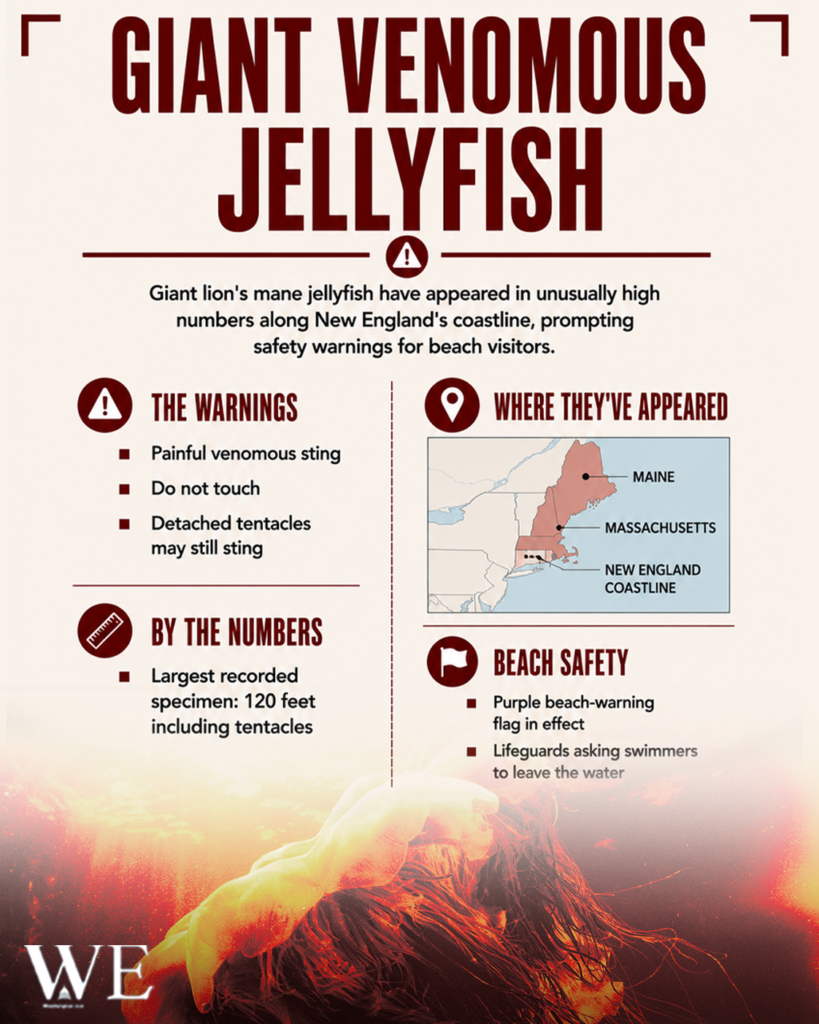
Large numbers of lion’s mane jellyfish have appeared along New England’s coastline, prompting safety warnings for swimmers, families and pet owners. Sightings have been reported from Massachusetts’ North Shore to Cape Cod and Nantucket, with additional jellyfish observed farther north in Maine. Some beaches and coastal marshes have reportedly received thousands of the creatures during the summer bloom.
The jellyfish began appearing in May 2026, earlier than many residents expected, before their numbers increased sharply during June and July. Harbour authorities, lifeguards and marine organisations have urged people to remain alert, follow local beach advisories and avoid touching jellyfish found either in the water or washed onto the sand.
Known scientifically as Cyanea capillata, the lion’s mane is the largest known jellyfish species. Its name comes from the dense mass of reddish, orange or brown tentacles trailing beneath its bell like a lion’s mane. These tentacles contain microscopic stinging structures called nematocysts, which inject venom into fish, smaller jellyfish and other prey.

News reports have repeatedly described the animals as “toxic,” but “venomous” is the more accurate scientific term because the jellyfish delivers venom through its tentacles. A toxic or poisonous animal generally causes harm when it is eaten or touched, while a venomous creature actively injects a substance through a sting, bite or similar mechanism.

Some headlines have warned that the jellyfish now appearing near New England possess tentacles measuring 120 feet. Lion’s mane jellyfish can reach that extraordinary length, but such individuals are extremely unusual. The largest recorded specimen washed ashore in Massachusetts Bay in 1870 and reportedly had a bell measuring seven feet six inches across and tentacles extending approximately 120 feet.
Most lion’s mane jellyfish encountered in coastal waters are substantially smaller. They commonly have bells measuring between six and 12 inches, although larger mature individuals may develop bells several feet wide and tentacles stretching tens of feet. The tentacles can be difficult to see underwater and may extend far beyond the visible bell. The Smithsonian identifies the lion’s mane as the world’s largest jellyfish species.
Contact with the tentacles can produce an immediate burning or stinging sensation, followed by red lines, swelling, itching or painful welts. Some people may also experience headache, nausea, muscle cramps or sweating. Serious systemic reactions affecting breathing or consciousness are possible but uncommon, and most healthy people recover without lasting complications.

The lion’s mane is not considered as dangerous to humans as certain tropical box jellyfish. Nevertheless, a large exposure, a sting to the face or neck, or an allergic reaction can become a medical emergency. Children may be more vulnerable because of their smaller body size, while panic following a painful sting can place swimmers at risk of drowning.
A stranded jellyfish should never be assumed to be harmless. Its stinging cells operate independently and may still discharge after the animal has died. Detached pieces of tentacle can also remain capable of stinging for an extended period, potentially for days or even weeks under suitable conditions. Beachgoers should therefore keep children and animals away from jellyfish remains and should never attempt to move one with bare hands.
Lion’s mane jellyfish are native to cold and temperate waters of the northern Atlantic, Pacific and Arctic oceans. Their presence in New England is not itself unusual, particularly from late spring through summer. What has attracted attention in 2026 is their unusually high concentration near populated beaches and harbours. Reports from Cape Cod described exceptionally high densities by mid-June.
Scientists say jellyfish blooms can be influenced by water temperature, currents, wind direction, reproduction cycles and the availability of plankton and other food. Because jellyfish are weak swimmers, winds and tides can push large numbers into bays, marshes and shallow coastal areas. Warmer seas may favour some jellyfish populations, but experts caution that a single bloom cannot automatically be attributed to climate change without longer-term evidence.
Despite their alarming appearance, lion’s mane jellyfish are important members of marine ecosystems. They consume plankton, fish and other jellyfish while providing food for sea turtles, seabirds and ocean sunfish. Their abundance can nevertheless disrupt swimming, tourism and fishing when currents carry them towards densely used coastal areas.
Anyone stung should leave the water calmly and seek help from a lifeguard. Visible tentacles can be carefully removed with fine tweezers without rubbing the skin. The affected area should then be soaked in hot—but not scalding—water at approximately 43 to 45 degrees Celsius for 20 to 45 minutes. Urine, cold freshwater, ammonia and vigorous scraping should not be used because they may worsen the injury. Mayo Clinic provides evidence-based first-aid advice for jellyfish stings.
Emergency assistance is required if a person develops breathing difficulty, chest pain, severe swelling, vomiting, faintness, seizures or loss of consciousness. For most visitors, however, the risk can be reduced by observing warning signs, swimming near lifeguards and admiring these remarkable ocean giants from a safe distance.