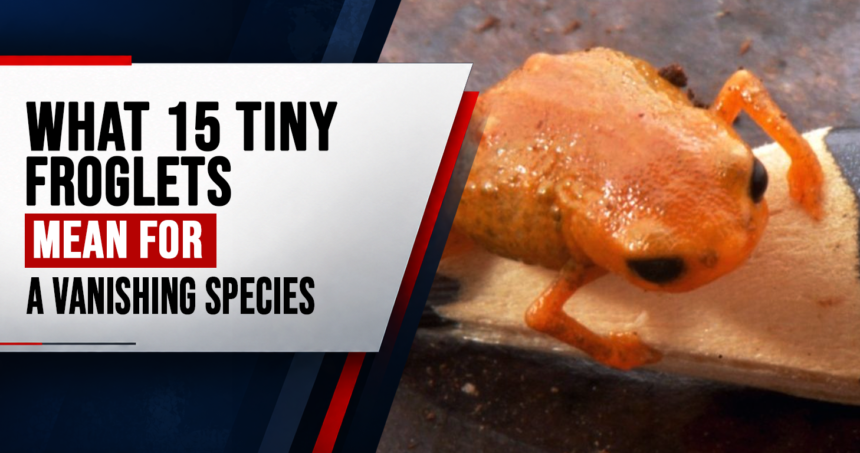
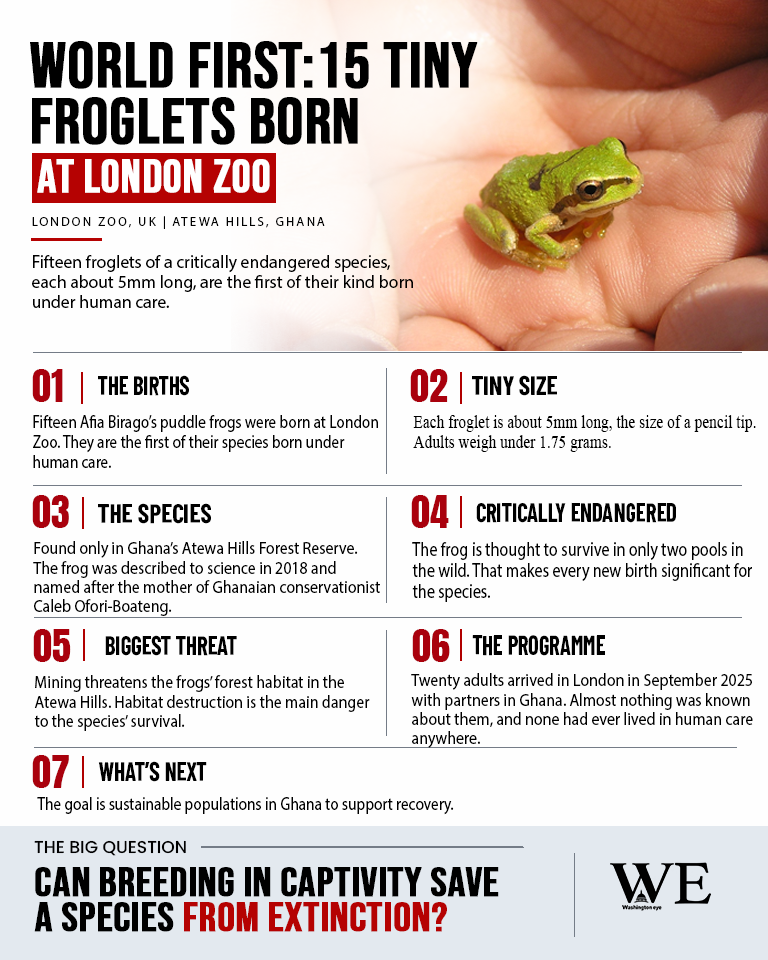
Fifteen critically endangered frogs, each measuring just five millimetres and no bigger than the tip of a pencil, have been successfully bred at London Zoo in a world-first conservation breakthrough. The tiny amphibians, known as Afia Birago’s puddle frogs, are native to Ghana and face an imminent threat of extinction because of mining activities destroying their natural habitat. Their birth marks an important milestone in an international effort to protect one of the world’s smallest and rarest frog species.
The Zoological Society of London (ZSL) announced the achievement on October 14, confirming that the 15 froglets were the first members of their species ever born and raised under human care. The successful breeding followed the arrival of 20 adult frogs from Ghana in September 2025 as part of an emergency conservation programme involving London Zoo, Herp Conservation Ghana and the CSIR-Forestry Research Institute of Ghana.
Afia Birago’s puddle frog, scientifically known as Phrynobatrachus afiabirago, was formally described by scientists only eight years ago, in 2018. Despite its relatively recent discovery, the species is already classified as Critically Endangered. Researchers have found it in just two permanent pools within Ghana’s Atewa Hills Forest Reserve, making its known natural distribution exceptionally restricted.

The Atewa Hills forest is an important biodiversity hotspot, supporting numerous plant and animal species. However, mining activities, particularly those associated with bauxite extraction, threaten the region’s ecosystems. For the tiny frogs, whose survival depends on suitable freshwater habitats, the destruction of even a small area could have devastating consequences.

The urgency of the situation prompted conservationists to develop an emergency rescue plan in September 2025. With limited specialist facilities and equipment available locally, the international team decided to transfer 20 adult frogs to London Zoo, where experienced amphibian keepers could establish suitable conditions for their survival and reproduction.
The move was not simply intended to protect individual animals. Researchers hoped to develop a reliable breeding programme that could eventually be replicated in Ghana, helping establish sustainable populations and potentially supporting future reintroduction efforts. Ben Tapley, London Zoo’s curator of reptiles and amphibians, described the births as a major achievement for a species facing an uncertain future. He explained that although the newborn frogs were small enough to fit on a fingertip, their arrival represented an important advance in efforts to prevent extinction.
The achievement required extensive scientific observation because very little was known about the species’ reproductive behaviour, environmental requirements or development. London Zoo’s amphibian team studied the frogs’ feeding habits, habitat preferences and breeding conditions to create an environment suitable for successful reproduction.

Unnar Aevarsson, an amphibian keeper at London Zoo, explained that the team had gained valuable knowledge since the adult frogs arrived in 2025. The successful births demonstrated that researchers had begun developing the techniques necessary to breed the species under human care. The newly born froglets measure approximately five millimetres, while fully grown adults weigh less than 1.75 grams and can comfortably fit on a British one-pound coin. Their extremely small size makes them particularly challenging to study and care for, requiring carefully controlled conditions and specialised feeding methods.
The conservation initiative extends beyond the United Kingdom. Before the frogs arrived in London, Aevarsson travelled to Ghana to help establish a dedicated amphibian breeding facility in Kumasi, described by ZSL as the first of its kind in West Africa. Knowledge gained from the successful breeding programme is now being shared with Ghanaian conservationists to support the development of a sustainable population within the species’ native country.
Meanwhile, ZSL conservation fellow Anthony Churcher is investigating potential habitats on privately owned land surrounding the Atewa Hills Forest Reserve that could accommodate future releases. The project also carries a deeply personal significance for Ghanaian conservationist Caleb Ofori-Boateng, who helped identify the species and named it in honour of his mother, Afia Birago. He expressed hope that the successful breeding programme would ensure her name remained associated with a species saved from extinction rather than one lost forever.
Dr Kwame Antwi Oduro, director of Ghana’s CSIR-Forestry Research Institute, highlighted the importance of international scientific cooperation in protecting the country’s threatened wildlife. The partnership is also helping develop local expertise and facilities needed for long-term amphibian conservation.
Visitors to London Zoo can now observe the conservation programme at its Secret Life of Reptiles and Amphibians exhibit, where the frogs are being cared for by specialist keepers. The display also aims to raise awareness about the global decline of amphibians and the importance of protecting vulnerable ecosystems. Amphibians worldwide face increasing threats from habitat destruction, pollution, infectious diseases and climate change.
Because many species depend on specific environmental conditions, even relatively small changes to their habitats can significantly affect survival. Although the birth of 15 froglets does not guarantee the species’ recovery, conservationists consider it an essential first step. Establishing breeding populations, protecting remaining habitats and strengthening local conservation capacity will be critical to securing the frogs’ future.
For a species discovered less than a decade ago and already facing extinction, the achievement at London Zoo offers renewed hope. The tiny froglets demonstrate how international collaboration, scientific expertise and timely conservation action can help protect some of the planet’s most vulnerable wildlife.