
The human brain and heart represent two of the most sophisticated organs in the body, working continuously to regulate essential functions, maintain circulation and sustain life. While the brain coordinates thought, memory, movement and countless automatic processes, the heart ensures that oxygen-rich blood reaches the body’s organs and tissues. Together, they form an interconnected biological system whose extraordinary anatomy continues to inspire medical research and technological innovation.
Advances in neuroscience, cardiovascular imaging, artificial intelligence and surgical techniques have transformed scientists’ understanding of these organs, revealing the remarkable complexity of their structures and the close relationship between brain activity and cardiovascular health.
From the billions of neurons responsible for human consciousness to the coordinated muscular contractions that circulate blood throughout the body, the brain and heart demonstrate how specialised anatomical structures support essential physiological functions.

Inside the Human Brain: The Body’s Command Centre
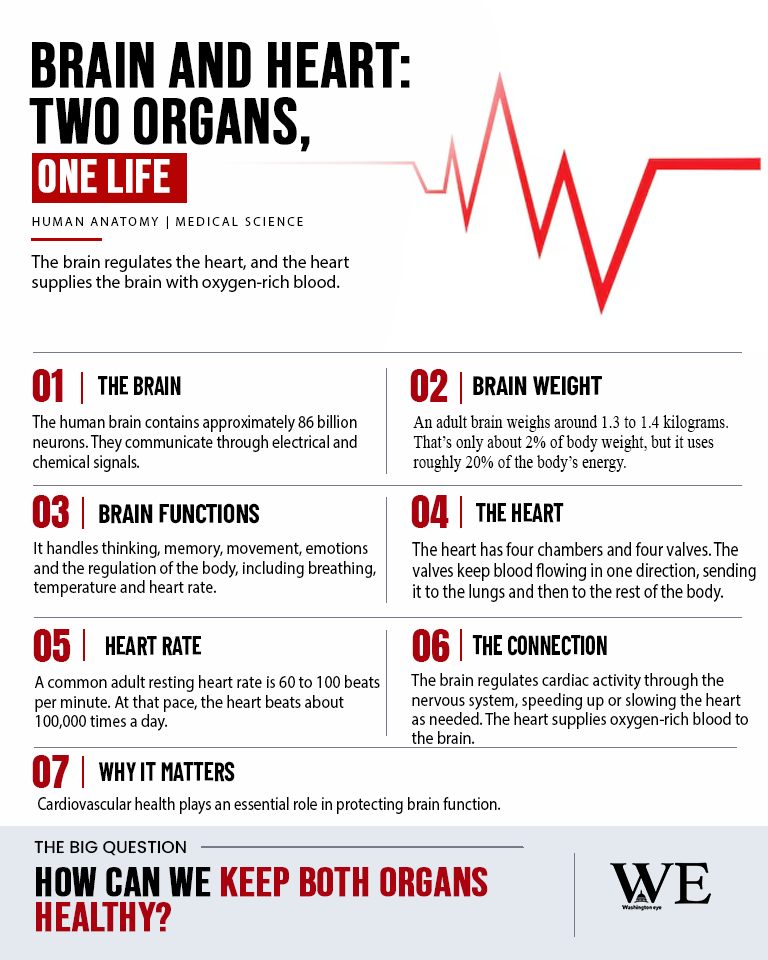
The adult human brain weighs approximately 1.3 to 1.4 kilograms and contains around 86 billion neurons, supported by numerous glial cells that help maintain and protect nervous tissue. Its largest structure, the cerebrum, consists of two hemispheres connected primarily by the corpus callosum, a thick bundle of nerve fibres enabling communication between the brain’s left and right sides.

The cerebral cortex, the brain’s outer layer, plays an essential role in higher cognitive functions, including reasoning, language, sensory interpretation and voluntary movement. Each cerebral hemisphere contains four major lobes. The frontal lobe contributes to planning, decision-making, personality and voluntary motor control. The parietal lobe processes sensory information and spatial awareness, while the temporal lobe supports hearing, language comprehension and memory. The occipital lobe primarily processes visual information.
Beneath the cerebrum, the cerebellum coordinates movement, balance and motor learning. The brainstem, comprising the midbrain, pons and medulla oblongata, regulates essential functions such as breathing, consciousness and cardiovascular reflexes. Other important structures include the thalamus, which relays much of the brain’s sensory information, and the hypothalamus, which regulates temperature, hunger, hormonal signalling and aspects of the autonomic nervous system.
The hippocampus is crucial for forming new memories, while the amygdala contributes to emotional processing, particularly responses involving fear and threat. Despite decades of research, scientists continue investigating how interactions among these structures produce consciousness, complex emotions and human behaviour.

The Human Heart: An Extraordinary Biological Pump
The human heart is a muscular organ approximately the size of a person’s fist, positioned within the thoracic cavity between the lungs and slightly to the left of the body’s midline. It consists of four chambers: the right atrium, right ventricle, left atrium and left ventricle. These chambers work together to maintain pulmonary and systemic circulation.
The right side receives oxygen-poor blood from the body and pumps it towards the lungs through the pulmonary arteries, where carbon dioxide is exchanged for oxygen. Oxygen-rich blood then returns through the pulmonary veins into the left atrium before entering the left ventricle, which pumps it into the aorta for distribution throughout the body.
Four valves, the tricuspid, pulmonary, mitral and aortic valves, ensure blood moves in the correct direction and prevent significant backward flow. The heart’s muscular wall, known as the myocardium, generates the force required for circulation. The left ventricular wall is particularly thick because it must pump blood against the higher resistance of systemic circulation.
Electrical impulses originating in the sinoatrial node coordinate the heartbeat. These signals travel through the atrioventricular node, bundle of His, bundle branches and Purkinje fibres, producing organised contractions. At rest, a healthy adult heart commonly beats between 60 and 100 times per minute, although rates vary with fitness, medication and health conditions. The coronary arteries supply the myocardium with oxygenated blood, making their uninterrupted function essential for preventing cardiac muscle injury.
The Brain–Heart Connection: Two Organs, One Integrated System
The relationship between the brain and heart extends far beyond the circulation of oxygenated blood. The brain continuously influences cardiac function through the autonomic nervous system, while the heart supplies the oxygen and nutrients required for normal neurological activity. The sympathetic nervous system increases heart rate and contractility during physical activity or stress, while parasympathetic signals, particularly through the vagus nerve, help slow the heartbeat during rest.
A 2024 scientific statement from the American Heart Association highlighted evidence connecting heart failure, atrial fibrillation and coronary artery disease with cognitive impairment and poorer brain health. Researchers have identified several potential mechanisms, including reduced cerebral blood flow, blood clots travelling from the heart to the brain, inflammation and changes in the brain’s small blood vessels. These findings reinforce the importance of managing cardiovascular risk factors to protect neurological function.
Medical Innovation and the Future of Brain and Heart Research
Modern medical technologies are enabling scientists to examine both organs in unprecedented detail. Magnetic resonance imaging, functional MRI and advanced brain-mapping techniques allow researchers to investigate neural structures, connectivity and activity. In April 2025, researchers reported an exceptionally detailed map of neural connections in a small section of the mouse brain, demonstrating progress towards understanding complex neural networks.
Cardiovascular imaging has similarly advanced through three-dimensional echocardiography, cardiac MRI and computed tomography, improving the assessment of heart chambers, valves and blood vessels. Meanwhile, artificial intelligence is increasingly being investigated for its potential to assist with medical-image interpretation, disease detection and personalised treatment planning. An April 2026 American Heart Association scientific statement also emphasised that brain health is influenced by physical health, psychological well-being, environmental conditions and lifestyle factors throughout life.
Ultimately, understanding the brain and heart as interconnected organs may help clinicians develop more comprehensive approaches to preventing cardiovascular and neurological diseases. Their anatomy illustrates not only the extraordinary complexity of the human body but also the importance of cooperation between its vital systems.