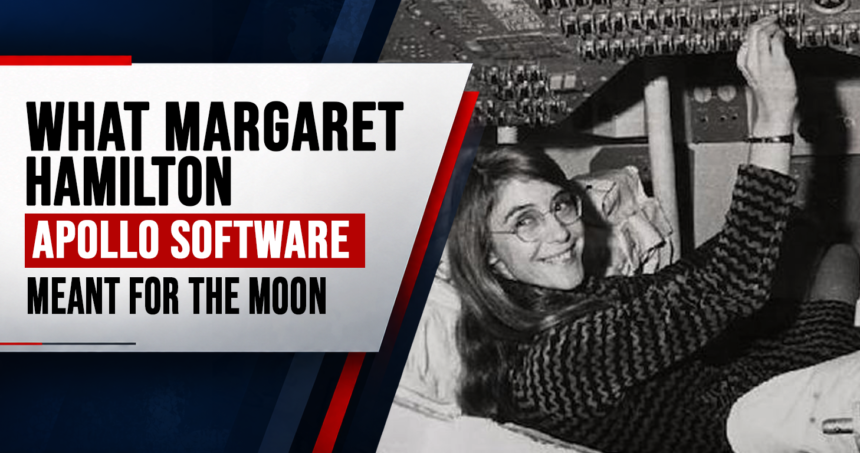
Margaret Hamilton, the pioneering American computer scientist whose groundbreaking software helped NASA successfully land humans on the Moon during the historic Apollo 11 mission, died on September 30, 2026, at the age of 90. Her death was announced on October 7 by the Massachusetts Institute of Technology (MIT), where she spent nearly two decades developing revolutionary computing systems that transformed space exploration and modern software engineering.
Hamilton died at a hospital in Cambridge, Massachusetts, with reports identifying multiple organ failure as the cause of death. Her daughter, Lauren Hamilton, confirmed her passing. Her death marked the loss of one of the most influential figures in computing history, whose contributions helped shape the digital technologies used worldwide today.
Who Was Margaret Hamilton? Early Life and Historic NASA Career

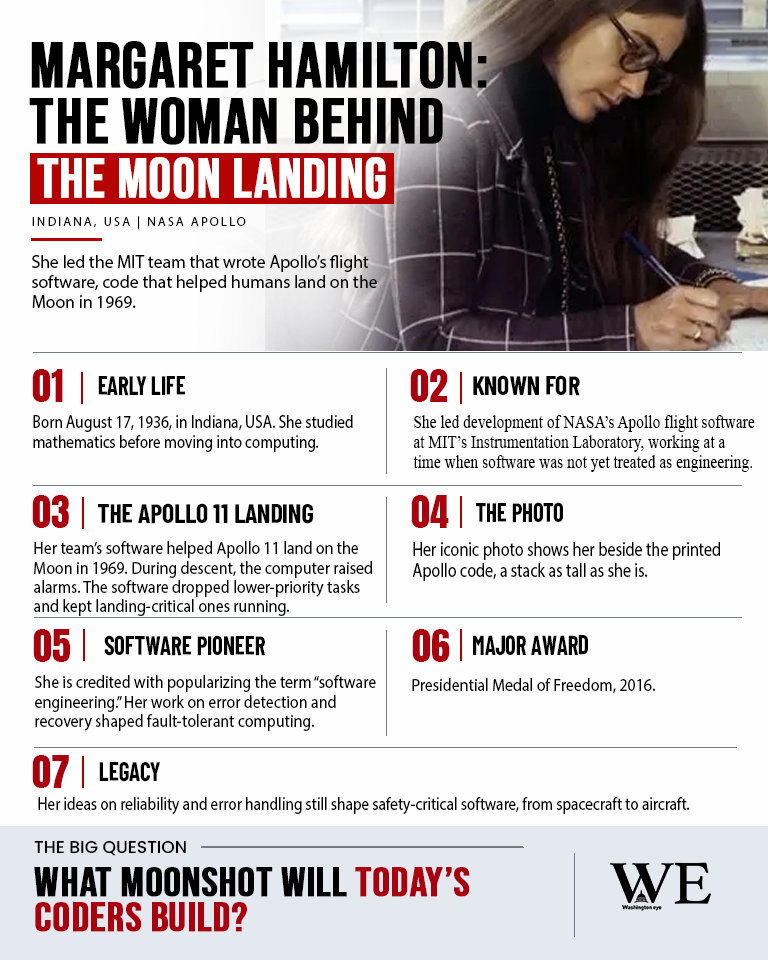
Born on August 17, 1936, in Paoli, Indiana, Hamilton developed an early interest in mathematics and scientific problem-solving. She initially attended the University of Michigan before transferring to Earlham College, where she graduated in 1958 with a bachelor’s degree in mathematics and a minor in philosophy.
In 1959, she moved to Massachusetts and began working at MIT, initially developing weather prediction software alongside meteorologist Edward Lorenz, whose research later contributed to chaos theory. She subsequently joined MIT Lincoln Laboratory, working on the United States’ Semi-Automatic Ground Environment (SAGE) air defence system.

Her career took a historic turn during the 1960s when she joined MIT’s Instrumentation Laboratory to develop onboard flight software for NASA’s Apollo programme. Hamilton became the project’s first female programmer and eventually led teams responsible for developing the guidance and navigation software used in crewed lunar missions.
By 1968, she had risen to assistant director, overseeing major elements of Apollo’s software development. Her leadership proved instrumental in the success of the American space programme during the intense technological competition of the Cold War.
How Her Software Helped Save Apollo 11

Hamilton’s most celebrated achievement occurred on July 20, 1969, when astronauts Neil Armstrong and Buzz Aldrin approached the lunar surface aboard Apollo 11’s Eagle lunar module. Just minutes before landing, the spacecraft’s computer began displaying alarming error codes, including 1201 and 1202, indicating that its processing capacity was overloaded. The unexpected warnings threatened to interrupt one of humanity’s most ambitious scientific missions.
However, Hamilton and her engineering team had designed sophisticated priority-based software capable of identifying essential operations while suspending less important tasks. This allowed the computer to continue processing critical landing instructions despite the overload. NASA’s Mission Control determined that the spacecraft could safely continue its descent. Armstrong and Aldrin subsequently completed humanity’s first crewed lunar landing, demonstrating the importance of Hamilton’s innovative approach to reliable computing.
Beyond Apollo 11, Hamilton’s work helped establish the principles of fault tolerance, error detection and defensive programming, which remain fundamental to modern aviation, healthcare technology, spacecraft and other safety-critical systems.
Awards, Achievements and Global Recognition
Hamilton received numerous prestigious honours throughout her career. In 2003, NASA presented her with the Exceptional Space Act Award for her scientific and technical contributions. In November 2016, President Barack Obama awarded her the Presidential Medal of Freedom, the highest civilian honour in the United States, recognising her extraordinary contributions to the Apollo missions and the development of software engineering.
She was subsequently named a Computer History Museum Fellow in 2017, received the Intrepid Lifetime Achievement Award in 2019 and was inducted into the National Aviation Hall of Fame in 2022. Hamilton also authored more than 130 publications and founded two technology companies: Higher Order Software in 1976 and Hamilton Technologies approximately a decade later. Her influence extended into popular culture. In 2017, LEGO included her in its Women of NASA collection, celebrating her achievements alongside other pioneering women in space science.
Tributes, Family and Lasting Legacy
Following her death, scientists, engineers and space exploration organisations paid tribute to Hamilton’s extraordinary career. NASA Administrator Jared Isaacman acknowledged her pioneering contributions to humanity’s first journeys to the Moon.
Olivier de Weck, interim head of MIT’s Department of Aeronautics and Astronautics, described Hamilton as a visionary whose contributions went far beyond developing advanced computer code. He emphasised that her leadership helped establish software engineering as a respected scientific discipline. Hamilton is survived by her daughter Lauren, son-in-law Richard Selesnick, two grandsons, four great-grandchildren and three siblings. A memorial service is planned for spring 2027 in Cambridge, Massachusetts.
Her death represents the passing of a remarkable scientific pioneer whose determination challenged gender barriers in a predominantly male technological industry. More than five decades after Apollo 11, Hamilton’s legacy continues to influence modern computing, inspire women in science and demonstrate how innovation can change the course of human history.