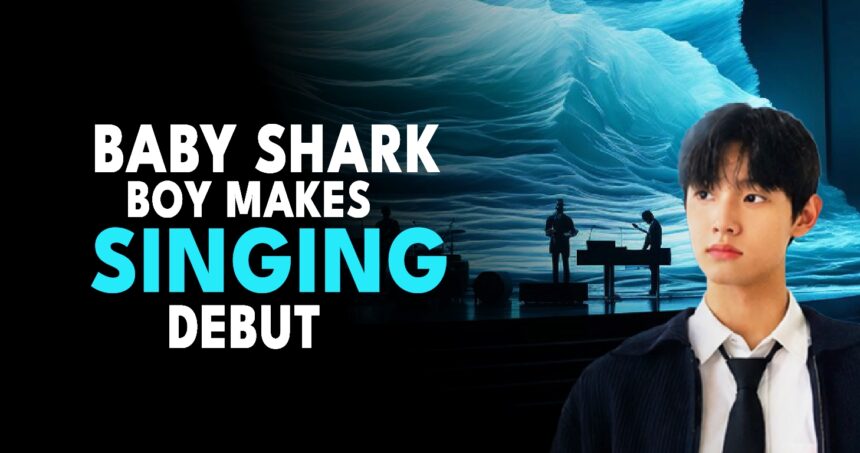
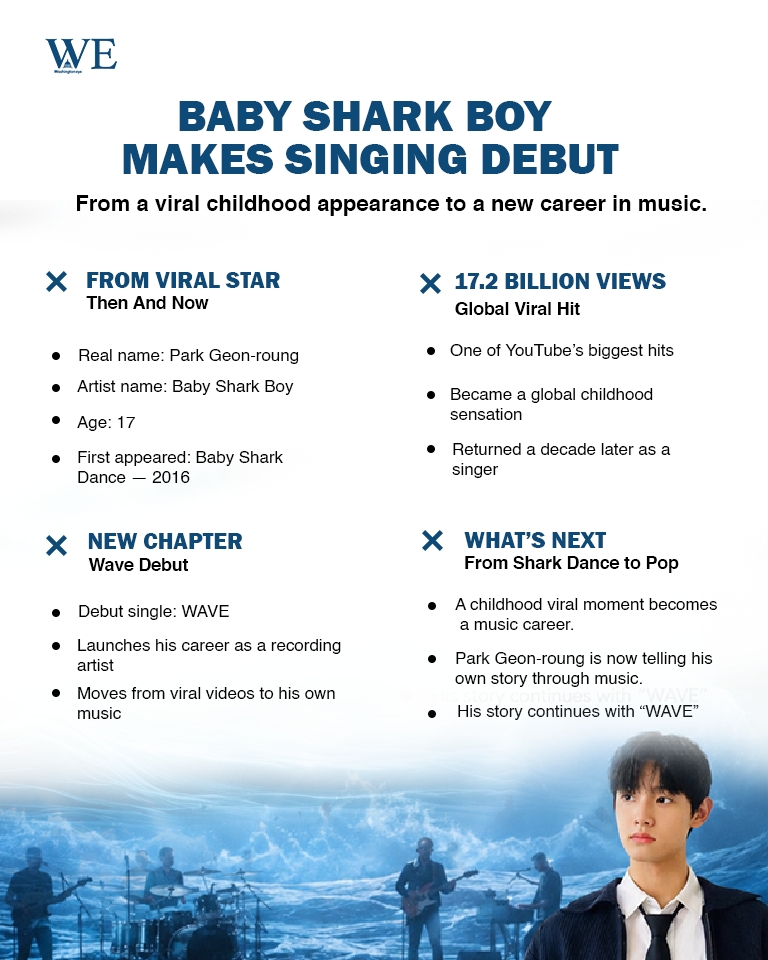
Ten years after dancing his way into internet history through the viral “Baby Shark Dance” video, South Korean teenager Park Geonroung has returned to music, this time not as a child performer, but as a K-pop singer hoping to establish his own artistic identity.
Park, now 17, released his first digital single, “WAVE,” on August 20, 2026, performing under the stage name “Baby Shark Boy.” The song features Joohoney of K-pop group MONSTA X and marks an unusual transformation from one of the internet’s most recognizable child stars into an aspiring professional musician.
The debut comes almost exactly a decade after Park appeared in the 2016 Pinkfong video that helped turn “Baby Shark” into a global cultural phenomenon. The video has since accumulated more than 17 billion YouTube views, making it the most-watched video in the platform’s history.

From ‘Doo-Doo-Doo’ to K-Pop
Park was only a young child when he appeared dancing beside the animated shark family in the colourful video produced by South Korean children’s entertainment company The Pinkfong Company. An important distinction is that Park was primarily the boy seen dancing in the famous video, not the child who provided its main recorded vocals. A decade later, his new project gives audiences an opportunity to hear his own singing voice.
“Baby Shark Dance” was uploaded in June 2016 and became increasingly popular the following year. Its simple choreography and relentlessly catchy “doo-doo-doo” refrain helped it spread among children, parents and eventually mainstream popular culture. Its reach went far beyond children’s entertainment. “Baby Shark” entered the Billboard Hot 100 in 2019, peaking at No. 32, while the dance was performed by major K-pop artists and copied across social media.
By November 2020, the video had overtaken “Despacito” to become YouTube’s most-viewed video. It later became the first YouTube video to reach 10 billion views. Despite being the face of such an enormous internet phenomenon, Park has said that his childhood remained surprisingly normal. His school friends knew about his appearance in the video, but largely treated him like any other student.
‘WAVE’ Connects His Past With His Future

Rather than attempting to distance himself completely from Baby Shark, Park has deliberately incorporated the phenomenon into his new musical identity. His debut single “WAVE” opens with elements recalling the familiar Baby Shark melody before transitioning into a contemporary electropop track. Park also participated in writing the lyrics, giving the project a more personal dimension. The title itself has symbolic significance. Park has described the original Baby Shark phenomenon as the first “wave” that began 10 years ago and grew far beyond anything he could have imagined. His new single represents another wave, this time one that he hopes to create through his own music.
The collaboration with Joohoney also gives the debut an established K-pop connection. MONSTA X was among the Korean acts that performed Baby Shark choreography during the song’s viral years, making his involvement a link between Park’s childhood fame and his new career. Pinkfong is backing the project and has also planned a behind-the-scenes documentary, “WAVE: A Boy’s Record,” exploring Park’s journey from the 2016 video to his emergence as a teenage performer.
Can ‘Baby Shark Boy’ Become a Serious Artist?
Park’s greatest advantage is also potentially his biggest challenge. Few debuting teenage singers begin with his level of worldwide recognition. Billions of people have encountered the video in which he appeared, giving the “Baby Shark Boy” name extraordinary marketing power. But viral childhood fame does not automatically translate into a sustainable music career.
K-pop is an intensely competitive industry filled with highly trained singers, dancers and performers backed by major entertainment agencies. Park will eventually have to convince audiences to listen because of his own music rather than simply because they remember Baby Shark. Pinkfong itself appears to be taking a cautious approach. The company has indicated that Baby Shark Boy could initially be a one-off project, with future decisions depending partly on the reception to the debut. Park, however, has suggested that he sees it as a beginning rather than merely an anniversary stunt.
Embracing Viral Fame Instead of Escaping It
The most interesting element of Park’s debut may be his decision not to reject the identity that made him famous. Former child stars often struggle to separate their adult careers from the characters or viral moments associated with their childhood. Park is attempting something different: using Baby Shark as the foundation of his new identity while gradually developing his own style. That strategy carries risks. The stage name “Baby Shark Boy” could make it difficult for audiences to take an older Park seriously if he eventually wants to pursue more mature music.
On the other hand, abandoning one of the world’s most recognizable internet associations would mean giving up an extraordinary advantage. Park appears comfortable with that contradiction. He told the Guardian that being the Baby Shark boy is not a past he wants to leave behind. Instead, he wants to build upon it while allowing audiences to discover his own voice.
His story also illustrates just how dramatically internet culture has changed childhood fame. A two-minute children’s video recorded when Park was seven has remained globally visible for a decade and can now serve as the launching pad for an entirely different career. Ten years ago, Park Geonroung stood beside an animated shark and performed a simple dance. Now, at 17, Baby Shark Boy is stepping back into the spotlight—this time with a microphone, his own lyrics and ambitions of his own.