
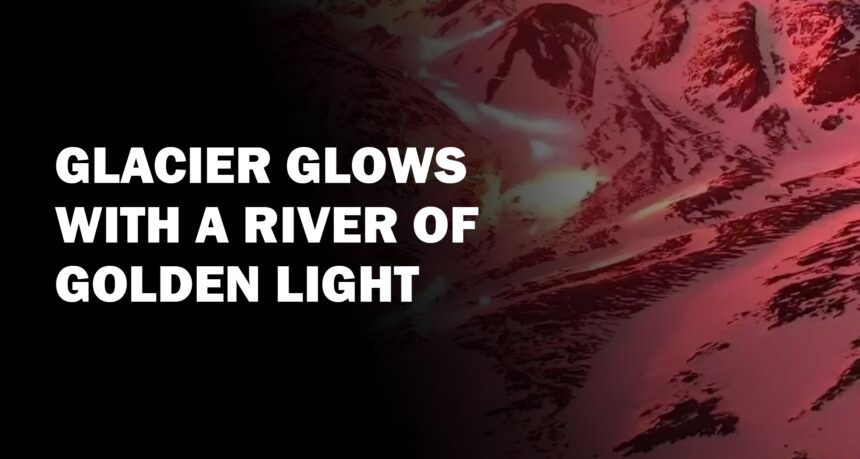
High above the colourful houses and icy waters of Ushuaia, glaciers and snow-covered mountains can appear to glow in brilliant shades of blue, white, pink and gold as the low southern sun strikes the frozen landscape. The spectacle has once again drawn attention to the extraordinary natural environment surrounding the Argentine city widely promoted as the “End of the World.”
Located on the island of Tierra del Fuego, between the Martial Mountains and the Beagle Channel, Ushuaia is commonly described as the world’s southernmost city. Its position close to Antarctica gives it dramatic seasonal changes in daylight, snow-covered winters and landscapes dominated by mountains, forests and ice.
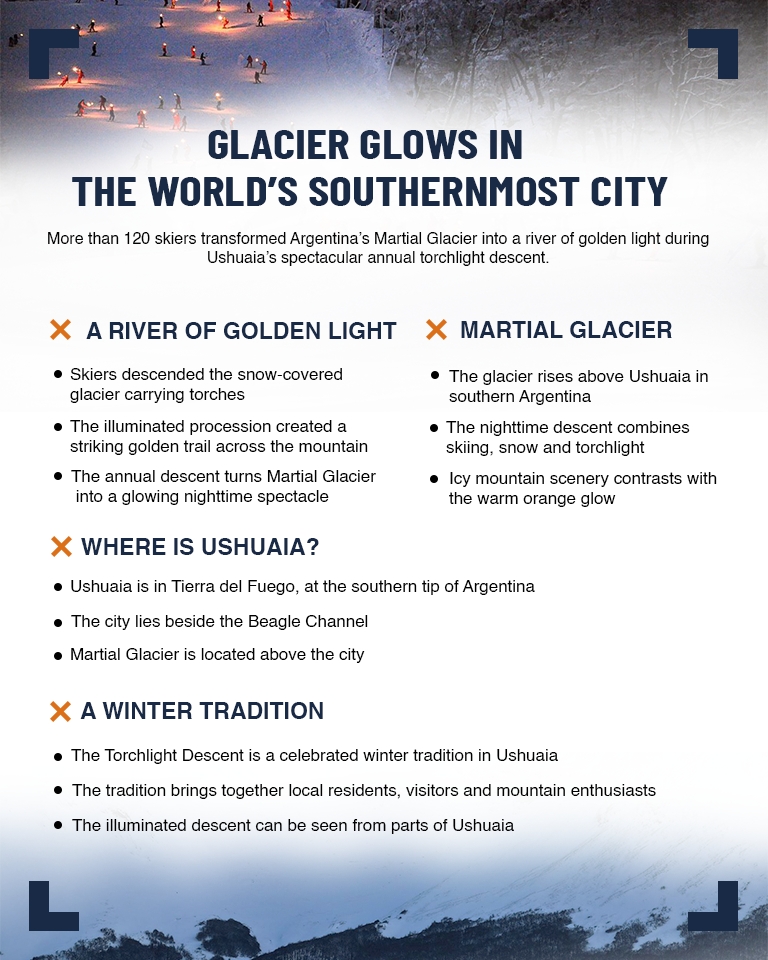
One of its best-known natural landmarks is the Martial Glacier, situated in the mountains immediately behind the city. From central Ushuaia, visitors can reach the surrounding area within a relatively short journey before following trails towards viewpoints overlooking the glacier, Beagle Channel and Tierra del Fuego.

Why Does the Glacier Appear to Glow?
The spectacular colour is produced by light interacting with ice, rather than by the glacier generating its own light. Glacial ice can appear intensely blue because dense, compressed ice absorbs more of the longer red wavelengths of visible light while allowing more blue light to be scattered or transmitted back towards an observer. Older and more compact sections of glacier ice can therefore display particularly striking blue tones.

Sunrise and sunset create another effect. When the Sun sits low on the horizon, its light travels through more of Earth’s atmosphere. Shorter blue wavelengths are scattered more strongly, leaving warmer reds, oranges and pinks to illuminate clouds, mountains and snow.
In Ushuaia’s high-latitude environment, the low angle of the Sun can produce dramatic lighting across frozen mountain landscapes. Depending on cloud cover, atmospheric conditions and the position of the observer, the glacier and surrounding snow can appear almost illuminated against the darker mountains. The phenomenon is especially striking because Ushuaia’s landscape combines glaciers, snow, forests, mountains and ocean within a remarkably compact area.
Life at the ‘End of the World’

Ushuaia lies at approximately 54.8 degrees south latitude, around 1,000 kilometres from Antarctica. Its extreme location has transformed what was once a remote settlement into one of Argentina’s most recognizable tourism destinations.
The city is also one of the world’s most important gateways for Antarctic tourism, with expedition ships departing from its port across the Drake Passage towards the Antarctic Peninsula. Its position has given Ushuaia a powerful international identity. Signs and souvenirs across the city use the phrase Fin del Mundo, “End of the World”, while visitors frequently travel there specifically to experience its remote geography.
The title “world’s southernmost city,” however, requires some qualification. Puerto Williams in Chile lies farther south and has increasingly been classified as a city following its administrative development. Ushuaia remains much larger and is still widely marketed and described in tourism as the world’s southernmost city.
Beyond the Martial Glacier, the surrounding region includes Tierra del Fuego National Park, the Beagle Channel and numerous mountains, lakes and forests. The combination makes tourism an important component of the local economy.
Glaciers Are Also Climate Indicators
The beauty of a glowing glacier carries a more serious environmental message. Mountain glaciers are highly sensitive to changes in temperature and precipitation. Across many regions of the world, scientists have documented substantial glacier retreat as global temperatures have risen. Glacier loss can alter freshwater supplies, ecosystems and landscapes. Globally, melting glaciers also contribute to rising sea levels.
The frozen landscapes surrounding Patagonia and Tierra del Fuego therefore provide scientists with important evidence about how southern environments are responding to climatic changes. The brilliant colours visible in glacial ice should consequently not disguise the vulnerability of these environments. A glacier that attracts tourists because of its beauty can simultaneously serve as a long-term record of changing climatic conditions.
Tourism Brings Opportunity, and Pressure
Images of luminous glaciers and snow-covered mountains have helped make Patagonia one of the world’s most recognizable adventure-tourism regions. Ushuaia benefits from visitors arriving for hiking, skiing, wildlife watching, cruises and journeys to Antarctica. But increased tourism also presents environmental challenges. More visitors mean greater demand for transportation, accommodation, energy and waste management in an ecosystem where environmental recovery can be slow.
Antarctic tourism departing from Ushuaia creates an additional debate over how rapidly tourism should expand in some of Earth’s most fragile environments. Responsible tourism therefore plays an increasingly important role. Authorities, conservation organizations and tour operators face the challenge of allowing people to experience the region without damaging the landscapes that attract them.
More Than a Beautiful Photograph
The sight of a glacier seemingly glowing above Ushuaia captures several extraordinary features of the far south in a single image. There is the physics of sunlight passing through ancient ice, the unusual geography of a city squeezed between mountains and sea, and the environmental importance of glaciers in a warming world. The phenomenon also demonstrates why glacial landscapes can appear almost unreal. Under the right conditions, ice is not simply white.
It can become deep blue, turquoise, pink, orange or golden, depending on its structure and the light falling upon it. At the so-called End of the World, that combination can transform an already dramatic landscape. As sunlight moves across Tierra del Fuego’s mountains, the glacier above Ushuaia becomes more than frozen water. For a few moments, it can look like a vast natural lantern suspended above one of the southernmost communities on Earth.