

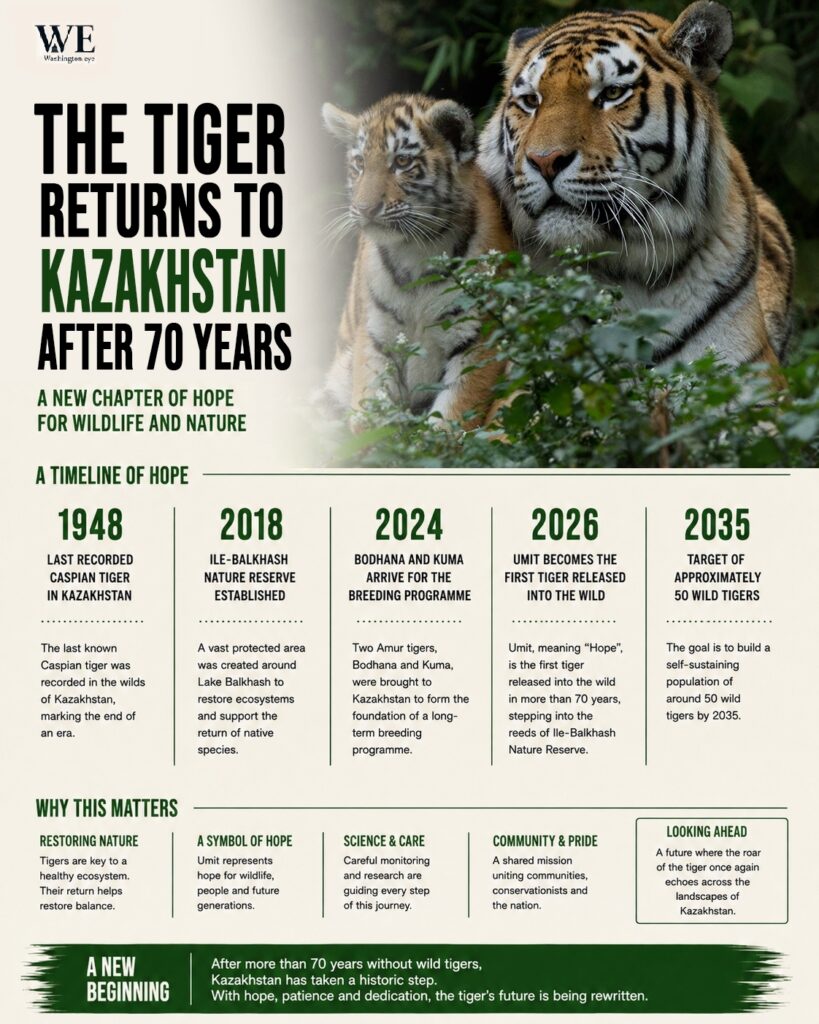
A tiger has returned to the wild in Kazakhstan for the first time in more than seven decades, marking a historic milestone in one of Central Asia’s most ambitious wildlife restoration projects. On July 31, 2026, a female Amur tiger named Ümit was released into the Ile-Balkhash State Nature Reserve, an area where tigers once roamed before disappearing during the 20th century.
The release is particularly significant because Kazakhstan’s native Turan, or Caspian, tiger disappeared from the country more than 70 years ago. Habitat destruction, declining prey populations and deliberate hunting contributed to its disappearance. Kazakhstan says the last tigers vanished from its territory around the middle of the 20th century. Ümit’s release is not simply the arrival of another endangered animal. It represents years of work to restore an entire ecosystem capable of supporting one of the world’s largest predators.
From Extinction to a Historic Return

Turan tigers once inhabited river valleys, reed beds and floodplain forests across Central Asia, including the Ili River delta, southern Lake Balkhash and Syr Darya regions. But expansion of agriculture, destruction of natural habitats, hunting and the disappearance of prey eventually pushed the predator to extinction in the region.
Kazakhstan formally announced its ambition to restore tigers at the first international tiger conservation forum in St Petersburg in 2010. Scientists from Kazakhstan, Russia and other countries subsequently studied whether the country still contained enough suitable habitat to support a viable population.

Their attention turned to the Ili River delta and southern Balkhash region, a vast landscape of wetlands, reed beds and floodplain forests. Kazakhstan later established the Ile-Balkhash reserve and began restoring habitats and prey populations. Because the Caspian tiger itself is extinct, conservationists faced an obvious question: which tiger could replace it? Genetic research provided the answer. Caspian and Amur — or Siberian — tigers are extremely closely related genetically, making the surviving Amur population the most appropriate source for restoring tigers to Central Asia.
Ümit Becomes the First Tiger Released
The breakthrough came in May 2026, when four wild-caught Amur tigers were transported from Russia’s Khabarovsk region to Kazakhstan. They included two adults and two cubs. The animals were placed in specially constructed adaptation enclosures at Ile-Balkhash. Before Ümit was allowed into the wild, specialists assessed her health, behaviour, hunting ability and response to humans. After approximately two months of observation, experts determined that she could survive independently.

On July 31, the enclosure was opened and Ümit entered the Kazakh wilderness, becoming the first tiger released into its historic range in Kazakhstan in more than 70 years. Kazakhstan’s Environment Minister Yerlan Nyssanbayev described the release as a historic event but stressed that it represented only the beginning of the effort to establish a sustainable population.
The adult male remains under specialist observation and will be released only after passing behavioural assessments. The two younger tigers, which arrived at around six to seven months old, are also being kept in controlled conditions while they mature.
Restoring More Than Just Tigers
The project highlights an important principle of conservation: bringing back a predator requires rebuilding the ecosystem beneath it. Kazakhstan has spent years restoring habitat and strengthening populations of animals that could form the tiger’s prey base. These efforts include the recovery or reintroduction of Bukhara deer and kulan, alongside measures to improve water systems and protect natural vegetation.
The region could eventually support a significant tiger population. Earlier Kazakh government assessments suggested that the southern Balkhash landscape might have the ecological capacity for up to around 100 tigers, although building a genuinely self-sustaining population would take decades.
The programme itself is expected to be a long-term undertaking lasting 40 to 50 years. Tigers will be monitored using satellite GPS collars, allowing scientists to follow their movements and respond if they approach settlements or experience difficulties.
Impact and Critical View
The return of tigers could have effects far beyond saving one species. As apex predators, tigers can influence prey populations and help restore ecological relationships that disappeared when the original predator vanished. The project could also strengthen Kazakhstan’s international reputation for biodiversity conservation and eventually support carefully managed ecotourism, potentially generating economic opportunities for communities surrounding the reserve.
But the programme carries substantial risks. Releasing a tiger is much easier than establishing a breeding, self-sustaining population. The animals need sufficient prey, protected habitat and reliable water resources. Authorities must also prevent poaching and manage the possibility of conflict between tigers, livestock and nearby communities.
Climate change and water pressures in the Ili-Balkhash ecosystem add another challenge. Long-term success will require sustained financing, scientific monitoring, anti-poaching enforcement and cooperation with local residents.
There is also a scientific distinction worth maintaining: Kazakhstan is not literally bringing an extinct Caspian tiger back from extinction. Instead, it is using its closest surviving relative, the Amur tiger, to restore the ecological tiger population that once occupied Central Asia.
That makes the project an experiment in ecological restoration rather than resurrection. Still, Ümit walking into the Ile-Balkhash wilderness represents something Kazakhstan has not witnessed for generations. A landscape that lost its top predator more than 70 years ago once again contains a wild tiger.
If Ümit survives, other released animals successfully reproduce and Kazakhstan maintains the habitat they need, the country could eventually achieve something once considered almost impossible: returning a functioning tiger population to the heart of Central Asia.