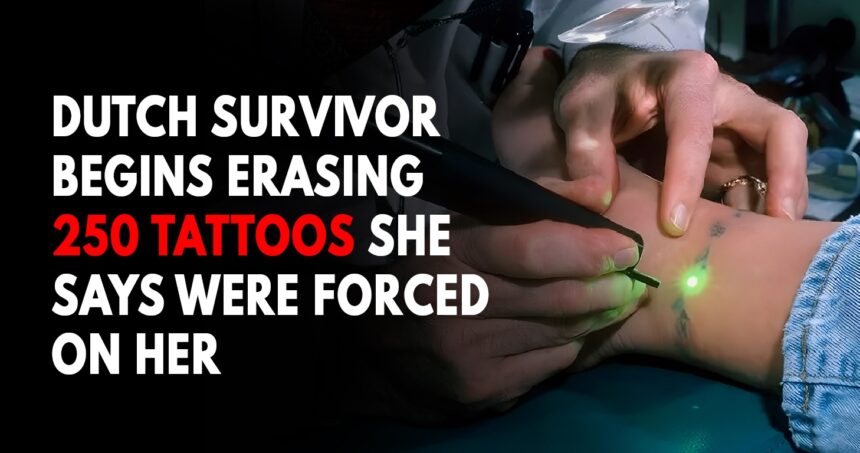
A Dutch woman who endured years of domestic abuse and was forcibly tattooed around 250 times by her former partner is undergoing an extraordinary physical and emotional transformation, as specialists work to erase the marks that once covered much of her face and body. The 53-year-old woman, identified publicly only as Joke, has become the face of a campaign highlighting an often overlooked form of coercive control: forced tattooing.
Her former partner repeatedly tattooed his name, initials and possessive messages across her body, including areas where he believed other men had previously touched her. Joke’s case gained renewed international attention in July after AFP documented her treatment at a specialist clinic in Rotterdam. She is being helped by Stichting Spijt van Tattoo, or the Tattoo Regret Foundation, which provides free laser removal to survivors of domestic violence, trafficking and other forms of coercion.
Years of Abuse and 250 Tattoos

According to Joke and the foundation helping her, the tattoos were not expressions of love or voluntary body art. They were used as instruments of control, humiliation and ownership. Her former partner obtained a tattoo machine online and tattooed her repeatedly at home. His name appeared more than a dozen times on her face alone, including her forehead, nose, cheeks, chin and even eyelids. Other markings covered large areas of her body.
Some tattoos included possessive wording such as “property of,” according to the foundation. He reportedly targeted places on her body where he suspected another man had touched her, effectively using permanent ink to demonstrate what he regarded as ownership over her. The tattooing was only one element of the abuse. Joke told AFP that she had also been confined in caravans and sheds during the abusive relationship. She described living under severe psychological pressure and fear.
Her story demonstrates how domestic violence can extend beyond physical assault. Experts increasingly recognize coercive control as a pattern in which an abuser seeks to dominate another person through intimidation, isolation, humiliation, threats and restrictions on personal freedom. For Joke, even escaping the relationship did not remove the visible evidence of that control. The tattoos remained on her skin.
Painful Road to Removing the Past
Joke was eventually referred to the Rotterdam-based Tattoo Regret Foundation. Its founders, Andy and Dex Han, have worked in tattoo removal for decades and began dedicating part of their work to helping abuse survivors free of charge in 2018. Even experienced specialists were shocked by the extent of Joke’s case. Andy Han told AFP that her face, chest and other parts of her body were covered with her former partner’s name, leaving the team unsure where to begin.

Removing the tattoos is far more complicated than creating them. Laser treatment works by breaking tattoo pigment into tiny particles that can gradually be cleared by the body. Multiple sessions are normally necessary, with the difficulty depending on factors including the tattoo’s size, depth, colour and location.
Joke has undergone 12 laser sessions over roughly two and a half years, according to reports. Treatment on her face was so painful that anaesthetic administered with medical support was required. The total cost of removing all her tattoos has been estimated at around €100,000. Despite the long process, the results are increasingly visible. Many of the markings on her face have faded substantially and can now be concealed with makeup. Photographs taken in Rotterdam in July showed Joke during the continuing removal process.
A Problem Bigger Than One Survivor
Joke’s experience may be extreme, but the foundation says she is not alone. Spijt van Tattoo has helped hundreds of people dealing with unwanted tattoos associated with abuse or coercion. Cases can range from an initial forced onto someone’s finger by a controlling partner to trafficking victims marked with the names of their exploiters.
Another survivor interviewed by AFP, identified as Bonnie, described being forced at age 22 to carry a possessive tattoo bearing her abuser’s name. For survivors such as Bonnie and Joke, removing the ink can become part of psychologically reclaiming ownership of their bodies. The foundation has therefore launched the campaign “Uit je Hart uit je Huid,” roughly translated as “Out of Your Heart, Off Your Skin,” to raise money for free tattoo removal for women subjected to coercive tattooing.
Critical View: When a Tattoo Becomes Evidence of Control
Joke’s story raises difficult questions about how legal and social systems recognize abuse that does not always fit traditional definitions of physical violence. A tattoo can appear voluntary to an outsider, while the decision behind it may have resulted from threats, intimidation, dependency or prolonged psychological manipulation. Proving that coercion retrospectively can therefore be extremely difficult.
The case also demonstrates why tattoo removal can mean far more than cosmetic treatment. For survivors whose bodies have been permanently marked by their abusers, removing those markings may represent a restoration of identity, autonomy and dignity. Joke has now chosen to tell her story publicly partly to draw attention to other women experiencing similar abuse. Her message is that coercive tattooing should not automatically be interpreted as a voluntary decision and that victims living under psychological control may struggle to resist their abusers.
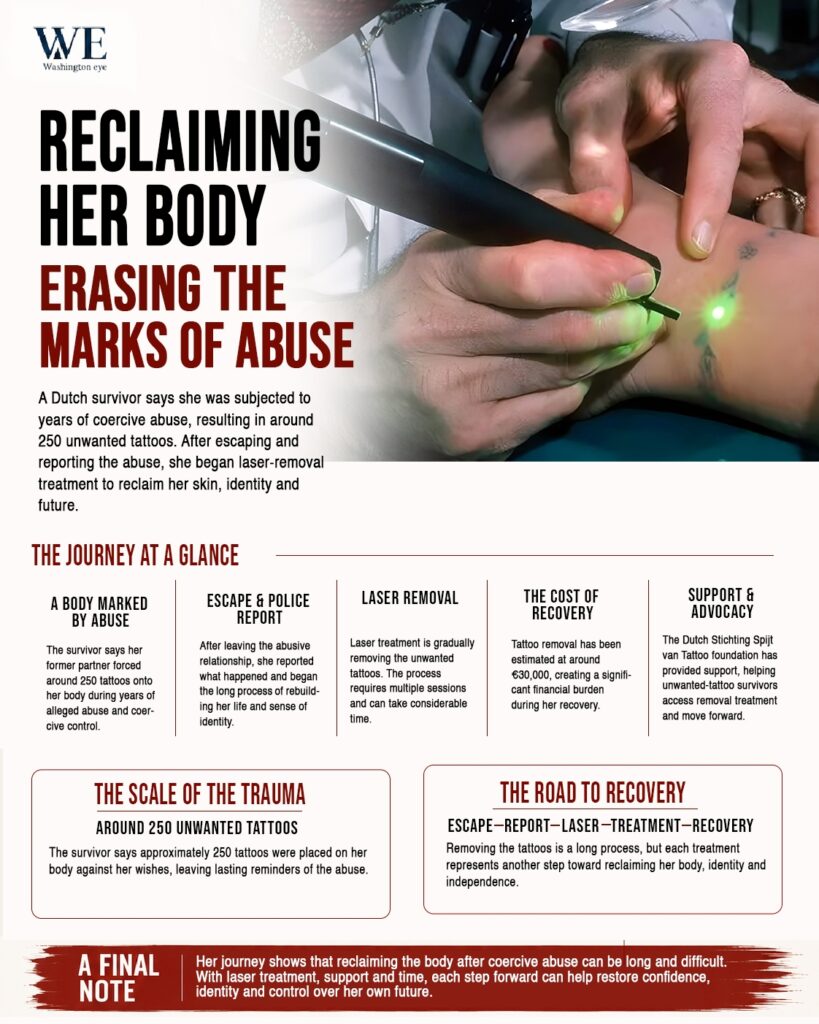
What began as an attempt by an abusive partner to permanently claim ownership of her body is gradually being reversed, one laser session at a time. For Joke, removing 250 tattoos is therefore about something much larger than clearing ink from skin: it is about taking ownership of her life back.