The world is commonly divided into seven continents: Africa, Asia, Europe, North America, South America, Oceania and Antarctica. Under the widely used seven-continent model, 195 countries are generally recognised worldwide, 193 members of the United Nations and two non-member observer states, the Holy See and the State of Palestine. However, totals can vary because some geographical classifications treat disputed or transcontinental states differently.
Continents are large geographical divisions rather than political organisations, and their boundaries are influenced by history, culture and physical geography. The United Nations uses its M49 geographical classification to organise countries and territories for statistical purposes. Some countries, including Russia, Türkiye and Kazakhstan, extend across continental boundaries but are usually placed in one region for statistical counting. The UN Statistics Division also lists dependent territories separately from sovereign countries.
Africa has 54 internationally recognised countries, the highest number of any continent. They are Algeria, Angola, Benin, Botswana, Burkina Faso, Burundi, Cabo Verde, Cameroon, the Central African Republic, Chad, Comoros, the Republic of the Congo, Côte d’Ivoire, the Democratic Republic of the Congo, Djibouti, Egypt, Equatorial Guinea, Eritrea, Eswatini, Ethiopia, Gabon, The Gambia, Ghana, Guinea, Guinea-Bissau, Kenya, Lesotho, Liberia, Libya, Madagascar, Malawi, Mali, Mauritania, Mauritius, Morocco, Mozambique, Namibia, Niger, Nigeria, Rwanda, São Tomé and Príncipe, Senegal, Seychelles, Sierra Leone, Somalia, South Africa, South Sudan, Sudan, Tanzania, Togo, Tunisia, Uganda, Zambia and Zimbabwe.

Asia, the world’s largest and most populous continent, has 48 countries under the commonly used classification. They are Afghanistan, Armenia, Azerbaijan, Bahrain, Bangladesh, Bhutan, Brunei, Cambodia, China, Cyprus, Georgia, India, Indonesia, Iran, Iraq, Israel, Japan, Jordan, Kazakhstan, Kuwait, Kyrgyzstan, Laos, Lebanon, Malaysia, the Maldives, Mongolia, Myanmar, Nepal, North Korea, Oman, Pakistan, Palestine, the Philippines, Qatar, Saudi Arabia, Singapore, South Korea, Sri Lanka, Syria, Tajikistan, Thailand, Timor-Leste, Türkiye, Turkmenistan, the United Arab Emirates, Uzbekistan, Vietnam and Yemen. Palestine is included as one of the UN’s two non-member observer states.

Europe is generally counted as having 44 countries. They are Albania, Andorra, Austria, Belarus, Belgium, Bosnia and Herzegovina, Bulgaria, Croatia, Czechia, Denmark, Estonia, Finland, France, Germany, Greece, the Holy See, Hungary, Iceland, Ireland, Italy, Latvia, Liechtenstein, Lithuania, Luxembourg, Malta, Moldova, Monaco, Montenegro, the Netherlands, North Macedonia, Norway, Poland, Portugal, Romania, Russia, San Marino, Serbia, Slovakia, Slovenia, Spain, Sweden, Switzerland, Ukraine and the United Kingdom. Russia stretches across Europe and Asia but is commonly counted in Europe. Kosovo is often shown separately because its independence is not universally recognised and it is not a UN member.
North America has 23 sovereign countries when Central America and the Caribbean are included. They are Antigua and Barbuda, The Bahamas, Barbados, Belize, Canada, Costa Rica, Cuba, Dominica, the Dominican Republic, El Salvador, Grenada, Guatemala, Haiti, Honduras, Jamaica, Mexico, Nicaragua, Panama, Saint Kitts and Nevis, Saint Lucia, Saint Vincent and the Grenadines, Trinidad and Tobago, and the United States. Greenland, Bermuda and several Caribbean islands are not counted as independent countries because they remain territories or dependencies of other states.
South America contains 12 sovereign countries: Argentina, Bolivia, Brazil, Chile, Colombia, Ecuador, Guyana, Paraguay, Peru, Suriname, Uruguay and Venezuela. French Guiana is located on the continent but is not an independent country; it is an overseas department of France. The continent is dominated geographically and economically by Brazil, which covers nearly half of South America’s land area.

Oceania has 14 sovereign countries spread across the Pacific Ocean. They are Australia, Fiji, Kiribati, the Marshall Islands, the Federated States of Micronesia, Nauru, New Zealand, Palau, Papua New Guinea, Samoa, the Solomon Islands, Tonga, Tuvalu and Vanuatu. The region also contains several territories administered by countries including France, the United States, New Zealand and the United Kingdom.
Antarctica is the only continent without any sovereign countries or permanent native population. Several governments have made territorial claims there, but international activities are governed by the Antarctic Treaty System, which reserves the continent primarily for peaceful and scientific purposes. National Geographic confirms that no country owns Antarctica, although seven states maintain historical territorial claims.
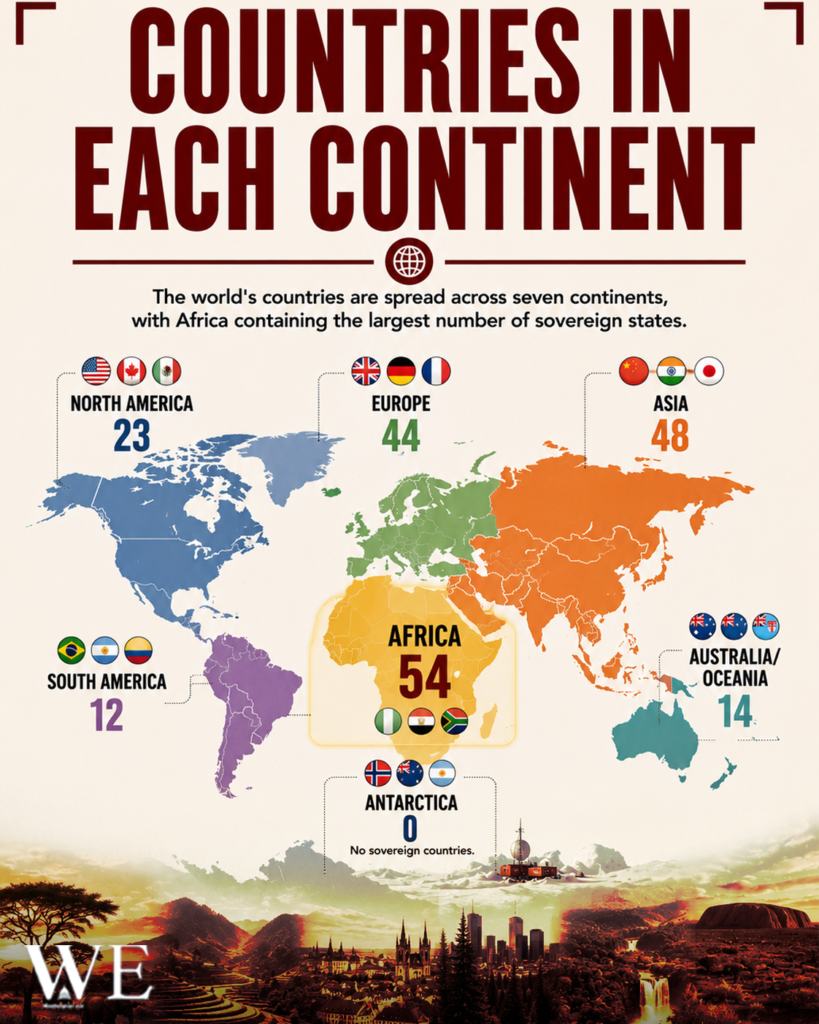
These figures produce a commonly accepted total of 195 countries: 54 in Africa, 48 in Asia, 44 in Europe, 23 in North America, 12 in South America and 14 in Oceania, with none in Antarctica. The total combines the 193 UN member states with the Holy See and Palestine, the world body’s two non-member observer states.