
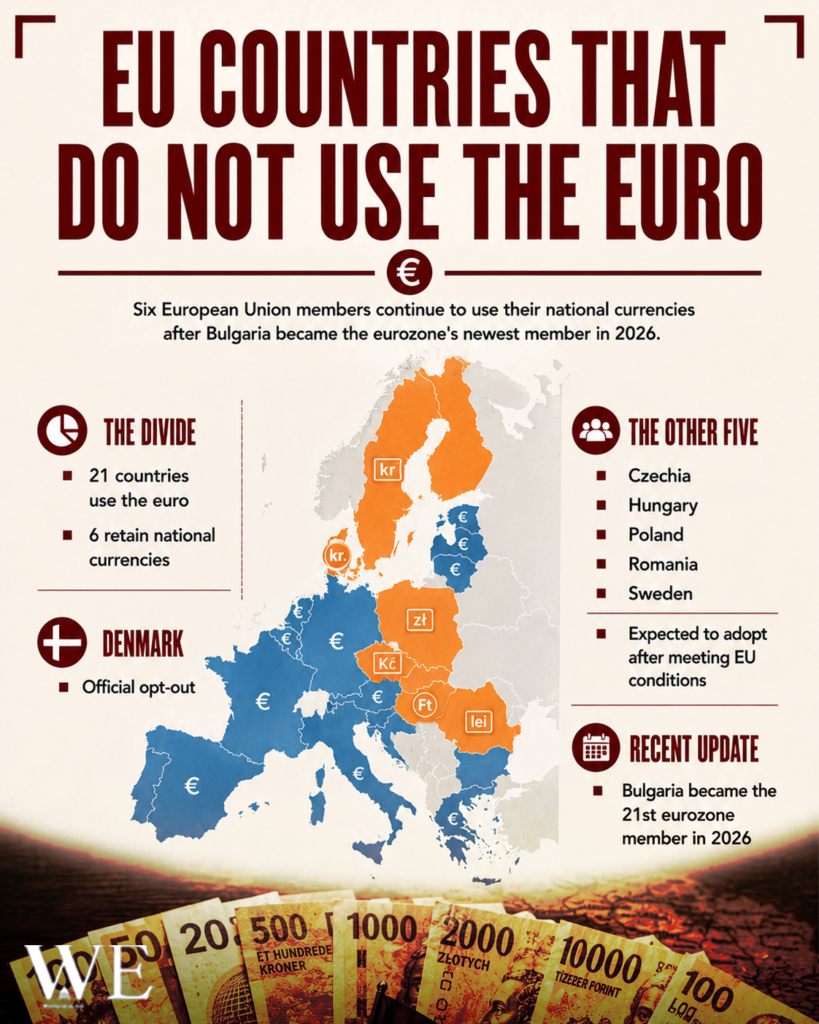
Six European Union countries continue to use their national currencies instead of the euro following Bulgaria’s entry into the euro area at the beginning of 2026. As of August 2026, Czechia, Denmark, Hungary, Poland, Romania and Sweden are the only EU members outside the currency bloc.
The euro is now the official currency of 21 of the EU’s 27 member states and is used daily by more than 350 million people. The latest expansion occurred on January 1, 2026, when Bulgaria replaced the lev and became the euro area’s 21st member. Its admission reduced the number of non-euro EU countries from seven to six. Bulgaria entered at a fixed conversion rate of 1 euro to 1.95583 lev, according to the European Central Bank.
The six countries remaining outside the euro area use the Czech koruna, Danish krone, Hungarian forint, Polish złoty, Romanian leu and Swedish krona. Although they are all members of the EU, their obligations concerning the single currency are not identical.

Denmark is the only EU member with a formal exemption from adopting the euro. The country secured an opt-out under EU agreements and may retain the krone permanently unless its government and voters decide to change course. Danish voters rejected euro membership in a referendum in 2000, although the krone remains closely linked to the euro through Europe’s exchange-rate system.

The other five countries are legally expected to adopt the euro once they satisfy the required economic and legal conditions. However, the EU does not impose a fixed deadline, allowing national governments to determine when they are politically and economically ready. The European Union’s official information portal identifies Czechia, Hungary, Poland, Romania and Sweden as countries that have not yet met all the conditions for membership.
Countries seeking to enter the euro area must meet the Maastricht convergence criteria. These include stable inflation, sustainable government finances, manageable public debt, stable long-term interest rates and participation in the Exchange Rate Mechanism II for at least two years without severe currency pressure. National laws, particularly those governing central-bank independence, must also be compatible with EU treaties.
The ECB’s latest Convergence Report, released on June 24, 2026, found that progress among the five candidate countries had been limited. The report said external shocks, including geopolitical conflicts, energy-market instability and global trade tensions, had complicated their efforts to bring their economies closer to euro-area standards.

Inflation in Romania was considerably above the reference rate of 2.7 per cent, while Hungary and Poland also exceeded the limit. Czechia and Sweden recorded inflation below the reference value. Government finances presented another obstacle: Hungary, Poland and Romania posted budget deficits above the EU reference level of 3 per cent of gross domestic product in 2025.
Long-term interest rates in Hungary, Poland and Romania also remained above the qualifying reference level. None of the currencies of Czechia, Hungary, Poland, Romania or Sweden was participating in ERM II, an essential stage before euro adoption. The ECB also found that legislation in all five countries was not yet fully compatible with euro-area requirements. These findings mean none is ready for immediate admission, according to the ECB’s 2026 assessment.
Economic requirements are only part of the explanation. Public opinion and national politics also influence the pace of adoption. Some citizens fear that replacing their national currency could increase prices or reduce national control over interest rates and economic policy. Governments may also be reluctant to surrender monetary authority during periods of inflation, weak growth or political uncertainty.
Supporters of the euro argue that membership eliminates currency-conversion costs, simplifies travel and trade, makes prices easier to compare and may attract investment. Businesses that trade extensively with euro-area countries can particularly benefit from greater exchange-rate certainty. Opponents argue that a common monetary policy may not always suit the needs of every national economy.
Bulgaria’s successful changeover demonstrated that the euro area remains open to further expansion. However, the six remaining countries are likely to follow different paths. Denmark can remain outside indefinitely because of its opt-out, while Czechia, Hungary, Poland, Romania and Sweden remain formally committed to joining when they meet the conditions. For now, Europe’s single market continues to operate with one dominant currency and six national alternatives.