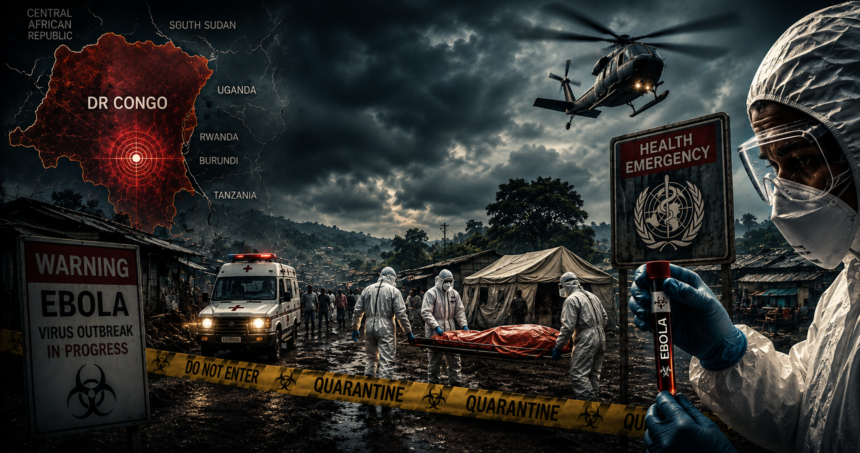
The World Health Organization has declared the ongoing Ebola outbreak in the Democratic Republic of the Congo a Public Health Emergency of International Concern (PHEIC), raising fears of wider regional spread as cases continue to rise across parts of Central Africa. The declaration, announced on Saturday, comes after health authorities confirmed that the outbreak involving the rare Bundibugyo strain of Ebola had spread within eastern DR Congo and into neighboring Uganda.
According to WHO and Africa CDC officials, the outbreak has so far resulted in more than 240 suspected cases and at least 80 deaths, with most infections concentrated in DR Congo’s conflict-affected Ituri province. Authorities said only a limited number of cases have been laboratory confirmed so far, but the rapid spread, high fatality rate, and movement of people across borders prompted urgent international action.
The outbreak was first identified earlier this month after several unexplained deaths were reported among healthcare workers and local residents in mining communities near Bunia and Mongbwalu in eastern Congo. Investigators later traced one of the early suspected cases to a deceased nurse, highlighting the severe risks faced by frontline medical staff. Health experts fear underreporting may mean the actual number of infections is significantly higher than official estimates.

WHO Director-General Tedros Adhanom Ghebreyesus said the emergency declaration was necessary because the outbreak meets international criteria for a global health threat requiring coordinated action and funding support. However, WHO clarified that the situation does not yet qualify as a pandemic emergency under international regulations.

The Bundibugyo strain responsible for the outbreak is considered especially dangerous because there are currently no approved vaccines or targeted treatments specifically designed for it. Existing Ebola vaccines and therapies, including those developed after previous outbreaks in West Africa and Congo, primarily target the more common Zaire strain of the virus. This has complicated response efforts and increased concern among international health agencies.
Ebola is a severe and often fatal viral disease transmitted through direct contact with infected bodily fluids, contaminated surfaces, or infected wild animals such as bats and primates. Symptoms usually include fever, vomiting, bleeding, weakness, muscle pain, and severe dehydration. Without rapid isolation and treatment, outbreaks can spread quickly through families, healthcare facilities, and densely populated areas.
Health authorities warned that the situation in eastern Congo is particularly difficult because the affected region has long suffered from armed conflict, mass displacement, weak healthcare systems, and poor sanitation infrastructure. Aid organizations say insecurity has limited access to several communities where suspected infections continue to emerge. Population movement between DR Congo, Uganda, and South Sudan has also raised fears of cross-border transmission.

The outbreak has already triggered emergency responses across neighboring countries. Uganda has intensified border screening and surveillance measures after confirming unrelated Ebola infections in Kampala. Regional governments have been advised not to impose blanket border closures but instead strengthen testing, contact tracing, and public awareness campaigns. WHO officials warned that unofficial crossings could make containment harder if travel restrictions are handled improperly.
The Africa Centres for Disease Control and Prevention has also activated emergency operations and appealed for increased international support, including diagnostic equipment, laboratory capacity, protective gear, and medical personnel. WHO has begun deploying emergency supplies and technical teams to affected areas while mobilizing funding for treatment centers and outbreak monitoring.
This is not the first Ebola outbreak in Congo. The disease was first identified near the Ebola River in 1976 in what is now DR Congo, and the country has experienced multiple outbreaks since then. However, experts say the latest emergency is especially concerning because of the rare virus strain involved and the rapid spread into urban and cross-border settings.

Global health experts are urging countries and humanitarian organizations to respond quickly to prevent a repeat of past Ebola crises, including the devastating West African outbreak between 2013 and 2016 that killed more than 11,000 people. While officials stress that the current outbreak remains geographically concentrated, they warn that delayed action could allow the virus to spread further across the region.