Racism continues to shape societies across the globe in 2026, remaining one of the most persistent and complex social issues despite decades of activism, policy reforms, and global awareness campaigns. From systemic discrimination in employment and policing to cultural exclusion and online hate speech, racism manifests in both overt and subtle forms across continents, affecting millions of people regardless of geography. Recent reports by organizations such as the United Nations and various human rights groups indicate that while some regions have made legislative progress, racial inequalities remain deeply embedded in social, political, and economic structures worldwide.
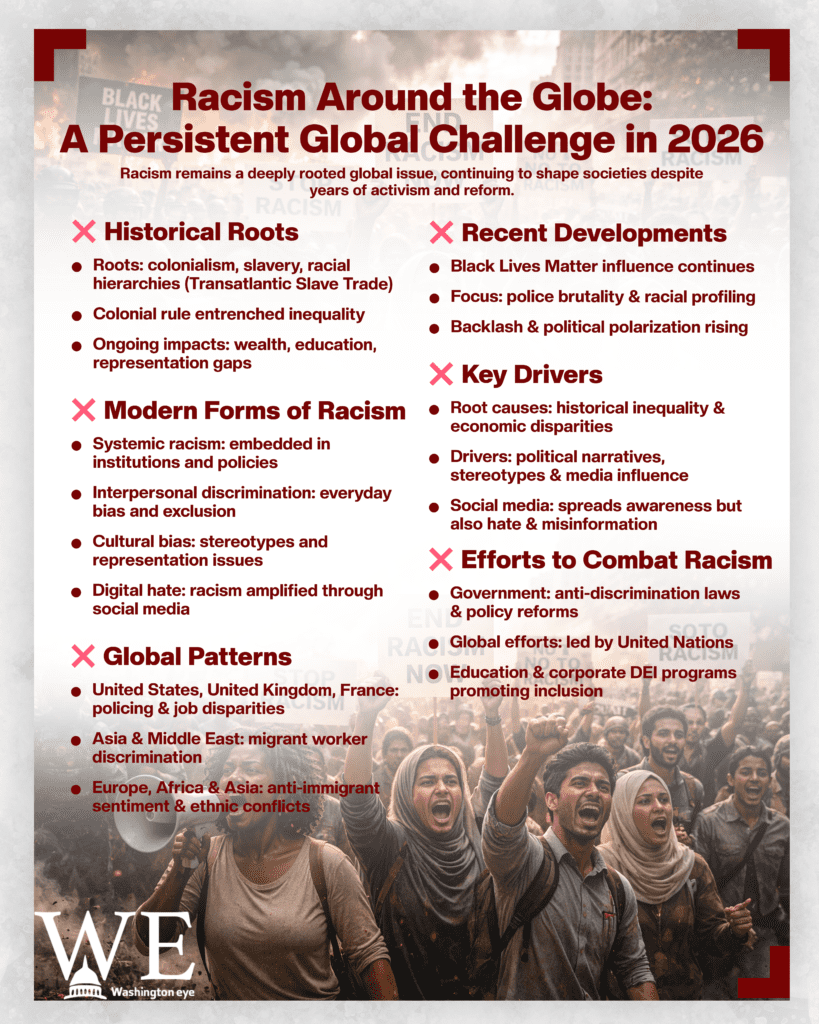
Historically, racism dates back centuries, rooted in colonial expansion, slavery, and pseudo-scientific theories that attempted to justify racial hierarchies. The transatlantic slave trade between the 16th and 19th centuries institutionalized racial discrimination, particularly against people of African descent. Colonial systems in Asia, Africa, and the Americas further entrenched racial divisions by privileging certain groups over others. Although the formal structures of colonialism and slavery have long been dismantled, their legacies persist in modern inequalities, particularly in wealth distribution, access to education, and political representation.
In the present day, racism takes multiple forms, including systemic racism, interpersonal discrimination, cultural bias, and digital hate. Systemic racism is often reflected in policies or institutional practices that disproportionately disadvantage certain racial or ethnic groups. For example, studies in countries like the United States, the United Kingdom, and France have highlighted disparities in policing, incarceration rates, and employment opportunities for minority communities. Meanwhile, in parts of Asia and the Middle East, migrant workers and ethnic minorities frequently report discrimination in wages, housing, and legal protections.

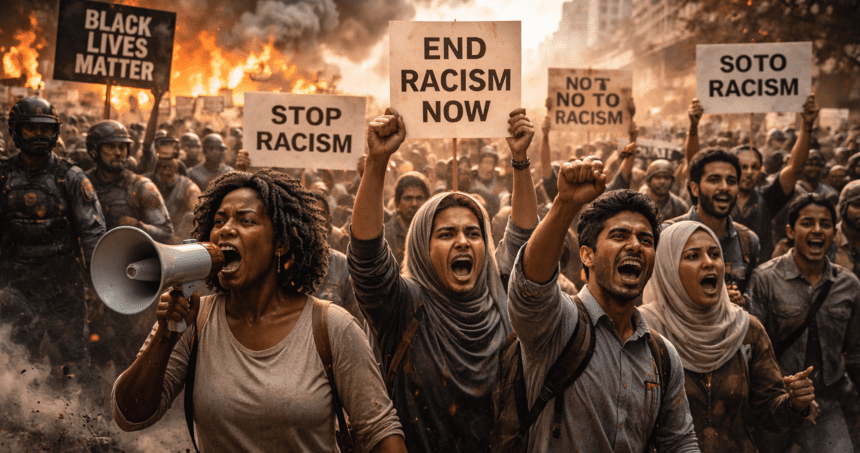
Recent global events have further exposed racial tensions. The aftermath of movements such as Black Lives Matter, which gained renewed momentum in the early 2020s, continues to influence public discourse and policy debates. Protests and advocacy campaigns have pushed governments to confront issues such as police brutality and racial profiling. However, backlash and political polarization have also intensified in some regions, revealing deep divisions within societies. In Europe, rising anti-immigrant sentiment has been linked to economic uncertainty and political rhetoric, while in parts of Africa and Asia, ethnic conflicts and minority persecution remain pressing concerns.

Experts attribute the persistence of racism to a combination of historical legacy, economic inequality, political manipulation, and social conditioning. Deep-seated stereotypes, often reinforced by media representation and lack of diversity in leadership positions, continue to shape perceptions and behaviors. Additionally, the rapid expansion of social media has created new platforms for both awareness and abuse. While digital spaces have enabled marginalized voices to be heard, they have also facilitated the spread of racist narratives and misinformation at an unprecedented scale.
Efforts to combat racism are ongoing at both national and international levels. Governments have introduced anti-discrimination laws, diversity initiatives, and educational reforms aimed at promoting inclusion. International bodies, including the United Nations, have emphasized the need for structural change and accountability. Education is increasingly seen as a key tool in addressing prejudice, with schools and universities incorporating diversity and inclusion into their curricula. Corporate sectors have also begun to adopt diversity, equity, and inclusion (DEI) policies, though critics argue that many of these measures remain superficial or inadequately enforced.
Despite these initiatives, activists warn that progress is uneven and often slow. In many cases, marginalized communities continue to experience discrimination in everyday life, from hiring practices to healthcare access. Moreover, intersectionality, where race intersects with gender, class, and other identities, adds layers of complexity to the issue, making solutions more challenging to implement.

Looking ahead, analysts suggest that addressing racism requires sustained global cooperation, stronger enforcement of anti-discrimination laws, and a shift in societal attitudes. Grassroots movements, policy reforms, and technological accountability are likely to play critical roles in shaping future progress. As the world becomes increasingly interconnected, the fight against racism is no longer confined to individual nations but is recognized as a global responsibility requiring collective action.