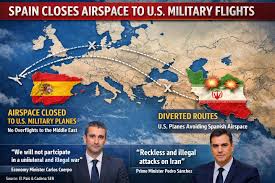
Spain has formally closed its airspace to United States military aircraft involved in the ongoing Iran war, marking one of the most significant diplomatic ruptures between NATO allies in recent years. The decision was confirmed on March 30, 2026, in Madrid by Defence Minister Margarita Robles, who stated that Spain would not permit “the use of military bases or airspace for actions related to the war in Iran.” The move follows an earlier refusal by Spain to allow U.S. forces to operate from jointly used military bases such as Rota and Morón, escalating tensions between the two countries.
The closure comes amid the widening conflict involving the United States, Israel, and Iran, which began in late February 2026. Spain has consistently positioned itself as one of Europe’s most vocal critics of the war, with Prime Minister Pedro Sánchez describing the military campaign as “illegal,” “reckless,” and contrary to international law. Spanish officials argue that allowing U.S. aircraft to use their airspace would amount to indirect participation in a war they fundamentally oppose. Economy Minister Carlos Cuerpo reinforced this stance, emphasizing that Spain refuses to support what it considers a unilateral military action lacking legal justification.
The restriction specifically targets U.S. military flights linked to combat operations, forcing them to reroute around Spanish territory, although exceptions remain for emergencies or humanitarian cases. Analysts note that this decision complicates U.S. logistics across Europe and the Middle East, as Spain’s geographic position makes it a key transit corridor for military aircraft. The ban also underscores Spain’s broader refusal to be drawn into offensive operations, even as it maintains its commitments to NATO in defensive contexts.
Washington has reacted sharply. U.S. officials, including Secretary of State Marco Rubio, criticized Spain’s move, questioning the value of alliance cooperation if member states refuse support during military operations. Former U.S. President Donald Trump has gone further, threatening trade retaliation against Madrid and warning of broader economic consequences if Spain continues to deny support. Despite these threats, Spanish leadership has remained firm, insisting that foreign policy decisions must align with international law and national values rather than alliance pressure.
The dispute has exposed rare divisions within NATO, an alliance traditionally built on collective defense and strategic coordination. While some European countries have offered limited support to U.S. operations, Spain has taken a distinctly independent line, aligning itself with calls for de-escalation and diplomacy. Observers note that similar disagreements have occurred in past conflicts, but Spain’s outright closure of airspace represents an unusually strong form of dissent.
Beyond military implications, the decision carries broader geopolitical consequences. It signals a shift in European dynamics, with Spain emerging as a leading critic of Western intervention in the Middle East. It also reflects growing public and political resistance within Europe to prolonged military engagements abroad. At the same time, the move risks economic fallout if U.S. trade threats materialize, though no concrete sanctions have yet been implemented.
The development comes against the backdrop of escalating regional instability. The Iran war has already disrupted global oil markets, increased military activity across the Middle East, and heightened fears of a wider conflict. In this context, Spain’s decision is being interpreted not only as a bilateral dispute with Washington but also as part of a broader debate over the legality, legitimacy, and long-term consequences of the war.

Ultimately, Spain’s closure of its airspace to U.S. military flights represents a defining moment in transatlantic relations. It underscores Madrid’s commitment to a foreign policy grounded in international law and non-participation in what it views as an unjust war, even at the cost of straining ties with a key ally. As the conflict continues, the standoff between Spain and the United States may shape both NATO dynamics and Europe’s strategic posture in the months ahead.