
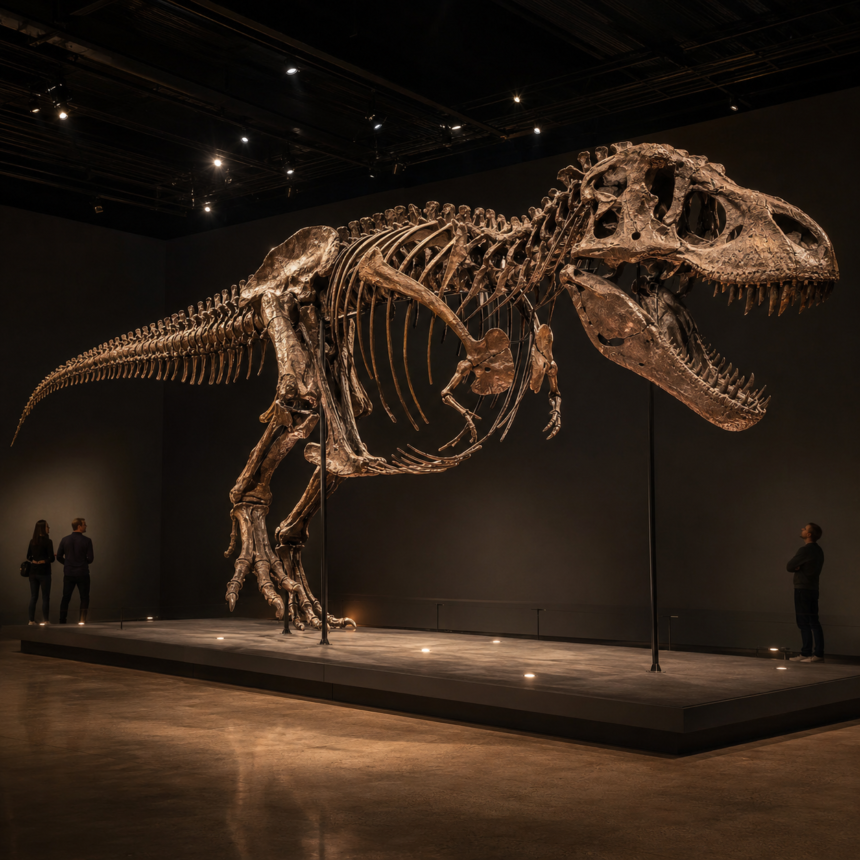
A remarkably preserved Tyrannosaurus rex skeleton nicknamed “Gus” has sold for $50.13 million at Sotheby’s in New York, setting a new auction record for any dinosaur fossil. The 67-million-year-old skeleton was purchased by an unidentified telephone bidder on July 14, 2026, following a tense 10-minute contest involving seven bidders. Its final price far exceeded Sotheby’s pre-sale estimate of between $20 million and $30 million.
Measuring approximately 38 feet (11.6 metres) from head to tail and standing 12.5 feet (3.8 metres) tall, Gus ranks among the largest T. rex specimens ever unearthed. Its original skull measures 54 inches long, while its femur is more than 50 inches in length. The enormous skull was displayed separately at Sotheby’s because it was too heavy to place safely on the mounted skeleton, which instead carried a reproduction head.
Gus is composed of 183 fossilised bone elements and is approximately 61 percent complete by bone count. Because many of the missing pieces are smaller bones, it represents an estimated 75 to 80 percent of the dinosaur’s original bone mass. Its skull is particularly well preserved, with around 82 percent of its bones represented and all six groups of teeth present. The specimen also includes 30 of the 32 rarely recovered gastralia, commonly known as belly ribs. Sotheby’s described Gus as an exhibition-ready specimen.
Despite some reports describing Gus as the most complete T. rex ever found, that title is generally associated with “Sue,” the famous specimen housed at Chicago’s Field Museum. Sue is approximately 90 percent complete by bone mass, measures around 40 feet long and stands about 13 feet tall. Gus should therefore be described as one of the largest and most complete T. rex skeletons discovered—and the largest and most complete example ever offered at auction.

The fossil was discovered in 2021 on private ranchland in Harding County, South Dakota, within the fossil-rich Hell Creek Formation. The region, which stretches across parts of South Dakota, North Dakota, Montana and Wyoming, has yielded several important dinosaur discoveries. Gus was named after Gary “Gus” Licking, the rancher who owned the land with his wife, Dana. Licking died in February 2022, before the full importance of the discovery became known.
Commercial palaeontology company Theropoda Expeditions excavated the skeleton between 2021 and 2023. Its team reportedly camped on the ranch for several months each year, carefully examining an area extending up to 70 feet around the original discovery site. Three years were spent extracting the remains, followed by approximately two years of preparation, documentation and mounting. Nearly 1,000 fossil fragments and other objects were recovered during the project. South Dakota News Watch documented the five-year recovery process.
Gus’s bones also provide clues about its violent life. The skull, lower jaw and other skeletal elements carry possible tyrannosaur bite marks, which may have resulted from combat with another predator or scavenging after death. Several ribs and belly ribs show fractures that later healed, indicating that the animal survived serious injuries during its lifetime. These signs of trauma, together with the skeleton’s unusual completeness, size and well-preserved skull, contributed to its scientific and commercial value.

The sale broke the previous dinosaur auction record held by “Apex,” a Stegosaurus skeleton that sold at Sotheby’s for $44.6 million in 2024. It also surpassed “Stan,” another T. rex that fetched $31.8 million in 2020. Gus’s record price demonstrates the rapidly increasing demand for rare fossils among wealthy collectors and institutions. The auction result made Gus the most expensive dinosaur fossil ever sold.
However, the identity of the buyer and the skeleton’s future destination remain unknown, renewing concerns among palaeontologists. Scientists warn that fossils bought privately can become unavailable for research, verification and public education. Museums are also increasingly unable to compete with multimillion-dollar bids. Although fossils discovered on private American land can legally be sold, researchers have urged Gus’s new owner to place the skeleton in a recognised museum or provide reliable scientific access. Gus may now be the world’s most valuable dinosaur, but its greatest worth will depend on whether the public and scientific community are allowed to study it.