
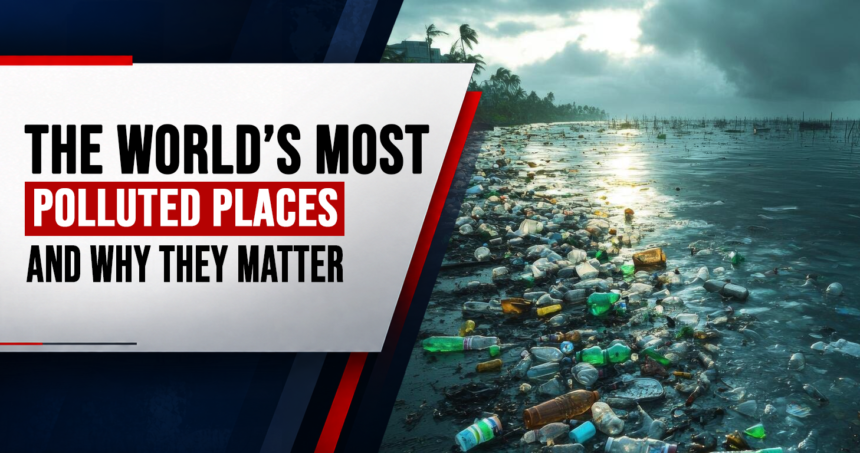
From towering mountains of garbage in Indonesia to toxic electronic waste in Ghana and overflowing landfills in India, some of the world’s most severely contaminated locations are confronting an escalating waste-management crisis. Unlike conventional air-pollution rankings, which measure harmful particles in the atmosphere, these environmental hotspots are defined by accumulated rubbish, industrial chemicals, contaminated soil, hazardous materials and polluted water.
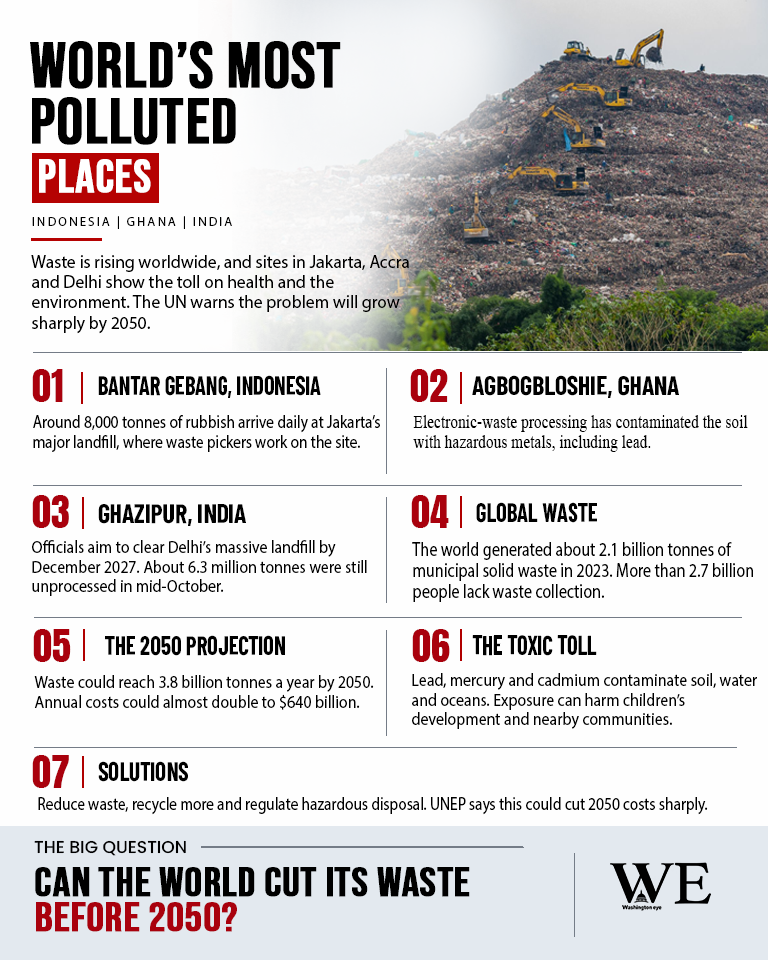
The crisis is growing as urban populations expand, consumption increases and waste-disposal infrastructure struggles to keep pace. According to the United Nations Environment Programme (UNEP), global municipal solid waste generation could increase from approximately 2.1 billion tonnes in 2023 to 3.8 billion tonnes annually by 2050 unless governments adopt stronger waste-reduction and management policies.
One of the most striking examples is Bantar Gebang, a vast landfill on the outskirts of Jakarta, Indonesia. Covering more than 100 hectares, the site receives approximately 8,000 tonnes of rubbish every day, transported by around 1,400 trucks. Mountains of decomposing household waste tower over surrounding communities, while contaminated liquid runoff, known as leachate, poses risks to nearby land and water.

Thousands of people depend on the landfill for their livelihoods, sorting through discarded materials to recover plastics, metals and other recyclable items. However, working among unstable waste heaps carries serious risks. In 2026, seven people died after a rubbish mound collapsed, burying people beneath the debris. The tragedy highlighted the dangers faced by informal waste workers who earn their living in hazardous conditions.

In Ghana, the Agbogbloshie area of Accra has become internationally recognised for its history of electronic-waste contamination. Discarded computers, electrical cables, batteries and other electronic equipment have been dismantled and burned to recover valuable metals, exposing workers and nearby communities to hazardous substances.
Although authorities cleared the original electronic-waste site in 2021, reports in 2026 indicate that scrap-processing activities and pollution concerns have re-emerged. Ghanaian officials have also announced plans to remove a massive waste heap in the area, which one government minister estimated to be approximately ten storeys high.
Electronic waste is particularly dangerous because discarded devices may contain lead, mercury, cadmium and other toxic substances. When cables and electrical components are burned or dismantled without appropriate safeguards, contaminants can spread into surrounding soil, water and dust. Research conducted at Agbogbloshie has identified elevated concentrations of potentially toxic metals in soil samples collected from former burning and dismantling areas. The World Health Organization warns that informal electronic-waste recycling can release hundreds of hazardous substances, creating serious health concerns, especially for children.

India faces similar challenges at Ghazipur, one of Delhi’s most notorious landfill sites. Decades of accumulated municipal waste have created a towering rubbish mound associated with fires, odours and concerns about groundwater contamination. In September 2026, India’s National Green Tribunal reviewed progress on remediation at Ghazipur and directed authorities to undertake groundwater testing around the landfill.
The Municipal Corporation of Delhi indicated that remediation of the site’s legacy waste was scheduled for completion by December 2027. The tribunal’s directions underline the continuing environmental risks associated with large, long-established disposal sites. Beyond individual landfills, the global waste problem extends to abandoned industrial facilities, mining areas, contaminated rivers and communities exposed to hazardous chemical residues. These locations may not contain the largest visible piles of rubbish, but they can pose significant risks because of the toxicity of the substances involved.
Industrial waste containing heavy metals can persist in the environment for decades. Lead exposure, for example, can damage children’s developing brains and nervous systems, while other pollutants may affect kidney function, respiratory health and local ecosystems. The risks depend on the chemical involved, the level of exposure and the effectiveness of environmental safeguards.
Plastic waste presents another challenge. Poorly managed plastics can accumulate in waterways, coastal ecosystems and urban drainage systems, where they obstruct water flow, harm wildlife and gradually fragment into smaller particles. Open burning of plastic and mixed rubbish can also release hazardous pollutants.
The economic consequences are substantial. UNEP estimates that the direct global cost of municipal waste management was approximately $252 billion in 2020. When broader costs associated with pollution, health and climate change were included, the figure increased to around $361 billion. Without significant reforms, the combined annual cost could reach approximately $640 billion by 2050.
Governments and environmental organisations are increasingly promoting recycling, waste separation, safer disposal facilities and circular-economy approaches designed to reduce the volume of materials discarded after use. However, experts emphasise that recycling alone cannot resolve the problem. Reducing unnecessary packaging, extending product lifespans, controlling industrial dumping and improving waste collection are equally important.
The situation also raises questions about environmental inequality. In many cities, low-income communities live closest to landfill sites and industrial disposal areas, while informal waste workers face hazardous exposure with limited protective equipment or access to healthcare. As global waste volumes continue to rise, the world’s contaminated dumping grounds reveal the consequences of inadequate infrastructure and unsustainable consumption. The challenge is no longer simply where to dispose of unwanted products, but how to prevent discarded materials from becoming long-term threats to human health and the environment.