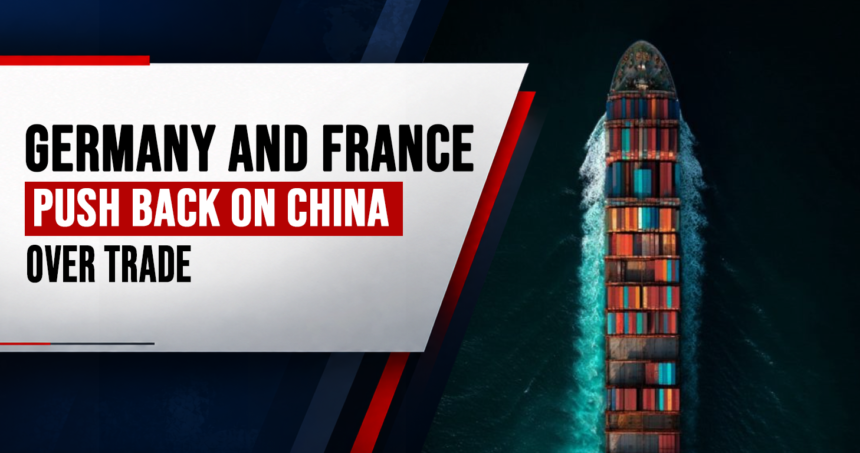
Trade tensions between Germany and China have intensified as Berlin joins France in demanding stronger European Union measures against what it considers unfair Chinese trade practices, marking a significant shift in Germany’s traditionally cautious economic relationship with Beijing. The dispute, driven by growing trade imbalances, competition in the automotive industry and restrictions on critical raw materials, has raised concerns about the future of Europe’s largest industrial economy and its dependence on Chinese supply chains.
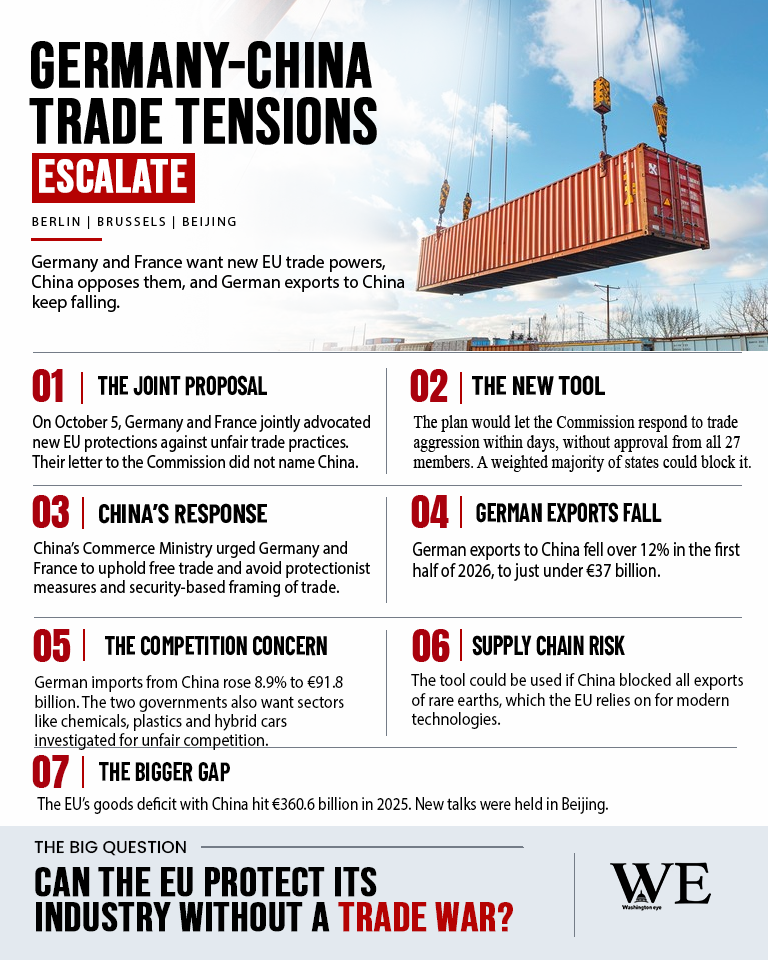
The latest escalation followed a joint proposal submitted by German Chancellor Friedrich Merz and French President Emmanuel Macron to European Commission President Ursula von der Leyen on October 5. The two leaders called for a new rapid-response trade mechanism that would allow the European Union to act more quickly against countries accused of distorting international competition through subsidies, dumping and restrictions on essential exports. Although the proposal did not explicitly identify China as its target, the measures address practices that European officials have repeatedly associated with Beijing.
Germany’s changing position represents a departure from its longstanding approach to China, which has prioritised economic engagement and commercial cooperation. For decades, German manufacturers, particularly automotive companies such as Volkswagen, BMW and Mercedes-Benz, benefited from expanding Chinese demand. However, the relationship has become increasingly strained as Chinese manufacturers strengthen their presence in European markets while German exports to China decline.
According to preliminary figures released by Germany Trade & Invest in August, German exports to China fell by more than 12% during the first six months of 2026, reaching just under €37 billion. China, once Germany’s second-largest export market in 2021, had fallen to ninth place by the first half of 2026. Meanwhile, Germany’s trade deficit with China continued to widen, reflecting the growing imbalance between imports and exports.

The automotive industry has emerged as one of the most important areas of competition. Chinese electric vehicle manufacturers, including BYD, have expanded their international operations, offering increasingly competitive vehicles in markets traditionally dominated by European brands. German manufacturers are simultaneously confronting weaker demand, high production costs and the challenge of adapting to electric mobility.
Another major source of tension involves China’s control over the processing and supply of rare earth minerals, which are essential for electric vehicles, wind turbines, electronics and advanced manufacturing. Export restrictions introduced by Beijing have created uncertainty for German companies dependent on these materials, prompting warnings from industrial associations about possible production disruptions.
The semiconductor sector has also experienced difficulties. Restrictions affecting Chinese-made electronic components, including those associated with chipmaker Nexperia, have exposed vulnerabilities in European automotive supply chains. German officials have repeatedly called for greater predictability in the supply of semiconductors and critical minerals, arguing that unexpected restrictions can disrupt production and threaten industrial competitiveness.

The dispute intensified further in October when Germany and France proposed strengthening the EU’s ability to restrict access to its single market in response to persistent unfair trading practices. The proposed mechanism, described in some reports as a trade “kill switch”, would give European authorities additional powers to respond to economic pressure from external trading partners.
China reacted critically to the initiative, warning that Europe could face economic consequences if it adopted the proposed restrictions. Beijing has consistently defended its industrial policies and opposed measures it considers discriminatory or protectionist. Chinese officials have also expressed concerns about European restrictions on high-technology exports and the increasing treatment of economic relations as national security matters.
Despite the growing disagreements, diplomatic engagement has continued. European Trade Commissioner Maroš Šefčovič travelled to Beijing for trade consultations on October 8 and 9, discussing issues including vehicle imports, market access and the supply of rare earth materials. The discussions produced preliminary understandings on Chinese hybrid vehicle exports, selected European products and export licensing procedures for critical materials.
However, analysts have questioned whether these limited agreements will be sufficient to address the deeper structural imbalances between the two economies. European policymakers remain concerned about China’s industrial subsidies, manufacturing overcapacity and restrictions affecting foreign companies operating in its domestic market.
The issue also featured prominently at the European Union summit in Brussels on October 15, where leaders discussed trade imbalances with China alongside rising energy costs, industrial competitiveness and broader economic security challenges. Germany’s support for stronger trade protections demonstrated growing concern that European manufacturers could face further pressure without coordinated action.
Nevertheless, Berlin faces a difficult balancing act. China remains a major trading partner and an important market for German businesses, while many German industries depend on Chinese materials, components and manufacturing networks. Aggressive trade restrictions could provoke retaliation and create additional difficulties for companies already struggling with economic uncertainty.
The dispute also reflects a wider transformation in global trade relations, as governments increasingly prioritise economic security, strategic independence and domestic industrial competitiveness. For Germany, reducing dependence on Chinese suppliers while preserving access to the Chinese market has become a central economic policy challenge.
As negotiations continue, the future of Germany-China trade relations will depend on whether both sides can address concerns over market access, industrial competition and supply chain security without triggering further retaliatory measures. The outcome could have significant implications not only for Europe’s largest economy but also for international trade and the global manufacturing industry.