Europe’s streets are becoming a testing ground for the relationship between economic expectations and political trust. From French classrooms to Iberian housing protests, demonstrators are challenging whether governments can still deliver affordable living and dependable public services. The unrest suggests a shared crisis of expectations, but calling it a European spring risks confusing parallel grievances with a unified political movement. The distinction matters: widespread dissatisfaction does not necessarily produce a common programme or political outcome.
Different Streets, Shared Pressures
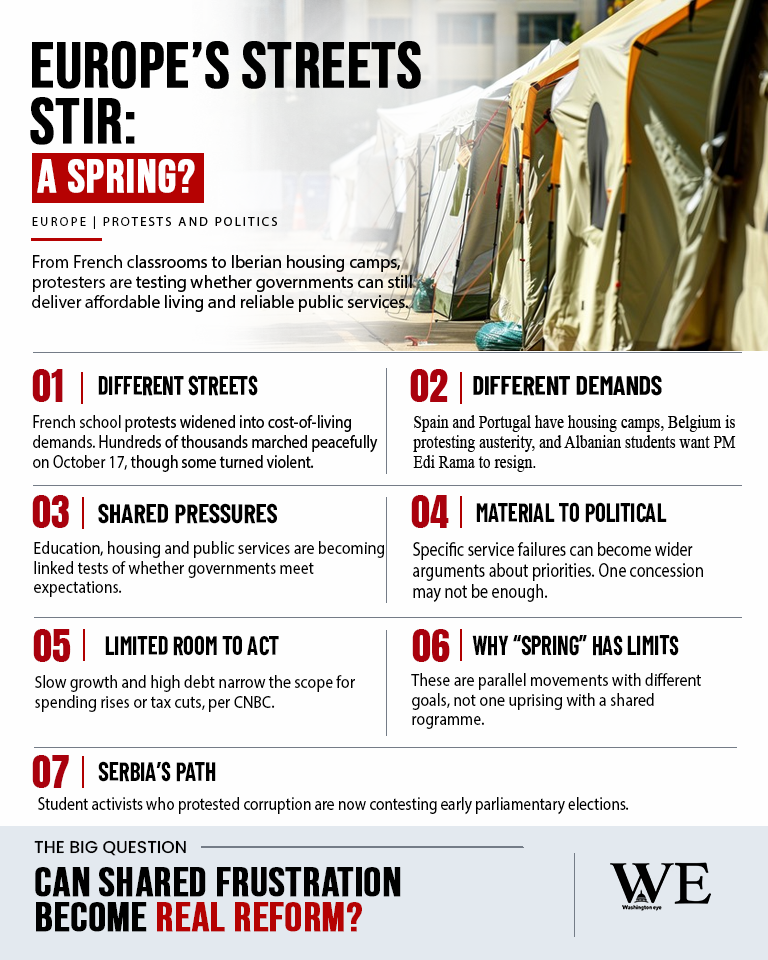
In France, protests that began over teacher shortages and deteriorating school facilities have widened into demands concerning living standards, inequality and public spending. Reuters reported that hundreds of thousands marched peacefully on October 17, although violent groups attacked property and police. Distinguishing these actions is essential to understanding both the movement’s breadth and the authorities’ response.
Elsewhere, the immediate demands differ. Housing affordability has prompted protest camps in Spain and Portugal, while Belgian demonstrations have challenged austerity measures. In Albania, students have joined a movement demanding Prime Minister Edi Rama’s resignation. These are not interchangeable struggles. Nevertheless, their convergence suggests that education, housing and public services increasingly function as connected measures of whether governments meet citizens’ expectations.
When Material Grievances Become Political
The significance of these protests lies less in their simultaneous appearance than in their potential to broaden. France illustrates how dissatisfaction with a specific service can become a wider argument about distribution and government priorities. When students, workers and established protest networks mobilise around overlapping concerns, authorities face demands that cannot necessarily be resolved through a single concession.
Yet governments also confront constraints. CNBC’s reporting identifies slow economic growth and substantial public debt as factors limiting the scope for spending increases or tax reductions. This creates a difficult political tradeoff: fiscal restraint may deepen dissatisfaction, while additional commitments require credible financing. The implications therefore extend beyond protest management to the legitimacy of budget choices and the distribution of adjustment costs.
Why the Spring Analogy Has Limits
A European spring would imply more than demonstrations occurring across several countries. The available reporting instead describes movements with different demands, participants and institutional settings. Housing campaigns, opposition to spending cuts and demands for a government’s resignation may reinforce one another symbolically without producing a shared organisation or agreed destination. Treating them as one uprising would obscure those differences.
Serbia offers a distinct pathway: student activists who sustained protests against corruption are now contesting early parliamentary elections. Their experience highlights a central question for the wider unrest: can mobilisation translate into durable political influence? Electoral participation, negotiated reforms and continued demonstrations represent different possible trajectories, rather than stages in an inevitable continental transformation.
The Test Ahead
The immediate challenge is whether institutions can respond without either dismissing grievances or treating every demand as equally achievable. Violence complicates that task by shifting attention towards security, even where most participants demonstrate peacefully. France’s experience already illustrates the importance of keeping public order concerns separate from assessments of protesters’ substantive demands.

Europe is witnessing a consequential protest wave, but not yet a demonstrably unified spring. Its lasting significance will depend on whether shared frustration produces workable reforms, sustained political organisation or deeper estrangement between citizens and governments. The streets have exposed the pressure; institutional responses will determine its direction.