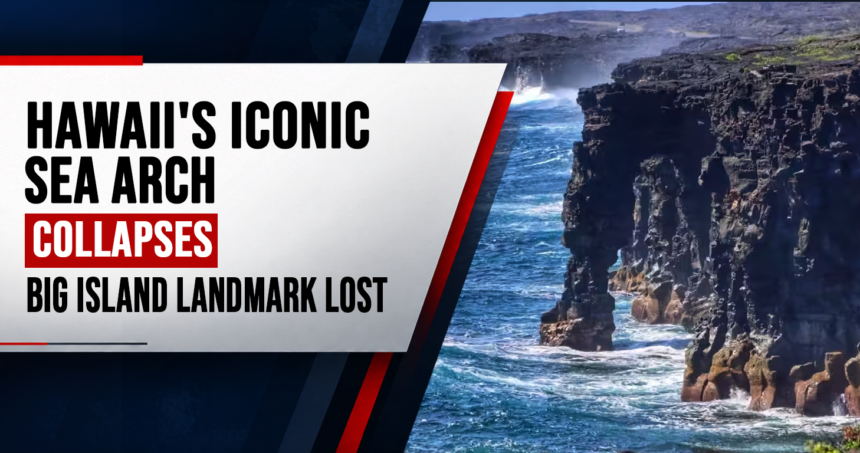
One of Hawaii’s most recognisable natural landmarks, the Hōlei Sea Arch, has collapsed into the Pacific Ocean after centuries of exposure to powerful waves, volcanic activity and coastal erosion. The approximately 90-foot-high (27.4-metre) rock formation, located within Hawaiʻi Volcanoes National Park on the Big Island, disappeared sometime between September 23 and September 27, 2026, during a period of severe weather associated with Tropical Storm Nolo. The United States National Park Service (NPS) officially confirmed the collapse on October 1, describing it as another transformation of Hawaii’s constantly changing volcanic coastline. The disappearance has attracted international attention, prompting renewed warnings about unstable cliffs and the dangers of approaching restricted coastal areas.
According to the National Park Service, the natural arch was still standing on Wednesday, September 23, but had completely collapsed by the evening of Sunday, September 27. Although the precise moment remains unknown, authorities believe the collapse may have occurred while parts of the national park were temporarily closed because of Tropical Storm Nolo. However, officials have not established whether the storm directly triggered the incident. The collapse was confirmed after photographs showed that the distinctive rock formation, which once extended dramatically from the cliffs over the ocean, had disappeared.
A 550-Year-Old Geological Landmark Disappears
The Hōlei Sea Arch was among the most photographed natural attractions along Hawaii’s southern coastline. Situated near the end of the approximately 19-mile Chain of Craters Road, the formation attracted tourists, photographers and geology enthusiasts seeking to experience the island’s dramatic volcanic landscape.
The arch was carved into an ancient lava flow dating back approximately 550 years. Over centuries, relentless ocean waves gradually eroded softer sections of volcanic rock, leaving behind a natural bridge-like structure extending over the Pacific Ocean. The process, known as differential erosion, occurs when rocks of varying resistance wear away at different rates. Although the lava flow’s approximate age is established, the precise age of the arch itself is not known.

The landmark had already experienced considerable structural damage before its collapse. During the 2018 eruption of Kīlauea volcano and the accompanying summit collapse, earthquakes weakened nearby coastal cliffs. Additional cracks and signs of instability were identified in January 2020, forcing park authorities to close the original viewing area.
A safer observation point was subsequently established in March 2020, allowing visitors to admire the formation from a greater distance. Later that year, powerful surf associated with Tropical Storm Darby broke away a substantial section of rock from the arch’s lower structure, increasing concerns about its long-term survival.
The recent collapse occurred against the backdrop of another period of extreme weather affecting the Hawaiian Islands. Tropical Storm Nolo brought dangerous conditions that prompted temporary park closures. Nevertheless, geologists and park officials have long recognised that sea arches are naturally temporary formations, eventually collapsing as erosion, weathering and geological instability weaken their foundations.

Safety Warnings, Tourism Impact and the Changing Hawaiian Coastline
Following the collapse, the National Park Service issued warnings urging tourists to remain away from unstable coastal cliffs and strictly observe restricted-area signs. Officials expressed concern after photographs circulating on social media showed individuals entering closed sections near the former arch, potentially exposing themselves and emergency responders to serious danger.
The cliffs surrounding the site descend almost vertically into rough ocean waters, creating significant risks of falling, drowning and further rockslides. Authorities emphasised that coastal formations can collapse without warning, particularly in areas affected by previous earthquakes, volcanic activity and prolonged erosion.
The disappearance also represents a loss for Hawaii’s tourism landscape. Visitors travelling along Chain of Craters Road had long regarded the arch as a major attraction, offering panoramic views of the Pacific Ocean and an opportunity to observe the effects of volcanic activity and coastal erosion.
Speaking to Hawaiʻi Public Radio following the collapse, visitors Fahad Shaon and Samira Farhin said they were unaware that the formation had disappeared before reaching the viewpoint. Nevertheless, they expressed appreciation for the surrounding cliffs and coastal scenery, suggesting that the area continues to offer a memorable experience despite the landmark’s disappearance.
The incident has also renewed public interest in the geological processes shaping the Hawaiian Islands. Unlike human-made monuments, natural coastal formations continuously evolve through the interaction of volcanic rock, ocean waves, seismic activity and weather conditions. As cliffs retreat inland, existing formations disappear while new geological features may gradually emerge.
The National Park Service had previously acknowledged the temporary nature of the Hōlei Sea Arch, explaining that erosion would eventually destroy the formation and that other arches could develop as the coastline continued changing.
Although the collapse has been widely associated with Tropical Storm Nolo, authorities have not identified a definitive immediate cause. The available evidence indicates that years of structural weakening preceded the incident, making it difficult to attribute the destruction to a single weather event.
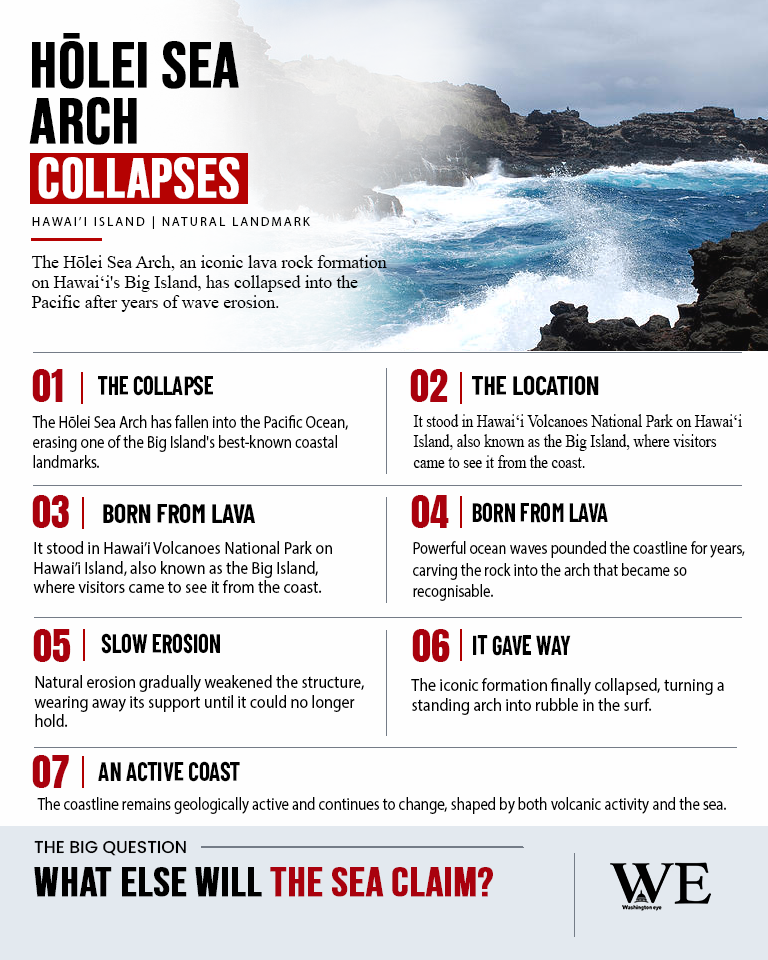
For Hawaii, the loss of the Hōlei Sea Arch marks the end of a distinctive geological landmark and highlights the powerful natural forces that continue reshaping the islands. While the arch can no longer be admired by future visitors, its collapse serves as a reminder of the temporary nature of even the most impressive natural formations and the importance of respecting safety restrictions along unstable coastlines.