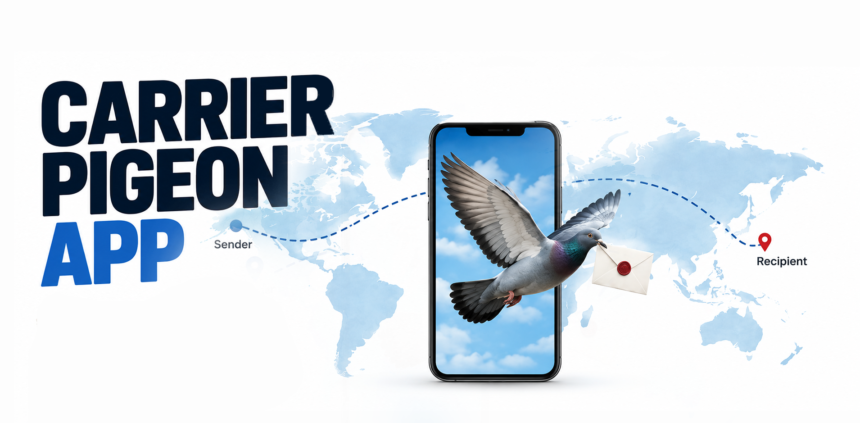
At a time when a WhatsApp message can cross the world almost instantly, a new social networking app is attracting attention by doing almost the exact opposite. Carrier Pidge, a messaging app created by software engineer Noah Iarrobino, deliberately makes users wait for their messages to travel at roughly the speed of a real carrier pigeon.
Released on Apple’s App Store in April 2026, Carrier Pidge has emerged as part of a small but growing “slow social” movement that challenges the culture of instant notifications, read receipts and pressure to respond immediately. Instead of simply tapping “send” and seeing a message arrive seconds later, users attach their digital note to a virtual pigeon and watch it travel toward its destination.
How Does Carrier Pidge Work?

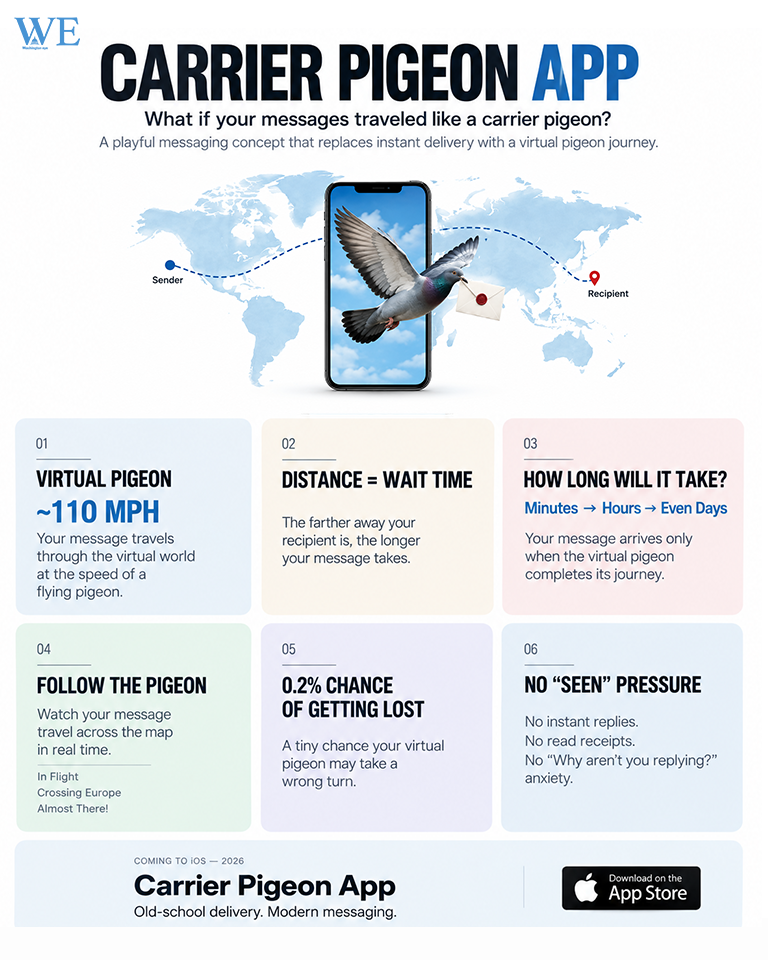
The idea is deliberately simple. Carrier Pidge calculates the distance between the sender and recipient and makes the virtual bird travel at about 110 miles per hour, with a speed variation of approximately 25%. A nearby message may therefore arrive relatively quickly, while one sent across a country could take hours. International communication can take days.
The experience becomes even stranger because delivery is not completely guaranteed. According to the app’s listing, every pigeon has a 0.2% chance of becoming lost during its journey. Virtual birds can also become distracted, adding an element of unpredictability that imitates the limitations of historical pigeon communication.

Users can follow the pigeon’s journey on a real-time map, add friends to their “flock” and manage their virtual aviary. The design uses parchment and old-fashioned correspondence imagery to reinforce the historical theme. Crucially, the app does away with read receipts and instant delivery.
Why Make Messaging Slower?
Carrier Pidge arrives during growing debate about the psychological and social effects of always-on digital communication. Mainstream messaging platforms have spent years reducing delays, but Carrier Pidge deliberately introduces friction. Iarrobino told The National that the waiting itself is central to the concept: users are not expected to respond instantly, and there is no read-receipt pressure.

The app’s official website similarly describes itself as a slower messaging experience designed for personal notes that deserve a journey and a moment of arrival. The unconventional idea appears to have found an audience. Iarrobino told The National in August that Carrier Pidge had reached around 140,000 iOS downloads. The app has also accumulated hundreds of ratings on Apple’s US App Store, where it currently carries a rating above four stars.
From Ancient Pigeons to Smartphones
The concept may seem absurd, but carrier pigeons once played an important role in long-distance communication. Before radio, smartphones and modern telecommunications, specially trained homing pigeons were used to transport written messages, including during military operations. Carrier Pidge effectively turns that history into a digital game. The pigeon is virtual and the message travels through modern internet infrastructure, but the user experiences an artificial delay calculated according to geographical distance.
The app is not alone in experimenting with this idea. Roost, another independently developed “slow-cial” platform released around the same period, also makes digital messages travel at the speeds of birds and other creatures. The two applications are not affiliated, but their emergence suggests that deliberately inconvenient technology may itself be becoming a niche trend.
Privacy, Cost and the Bigger Question
Because location determines delivery time, privacy is an obvious concern. Carrier Pidge says friends see only a broad geographical region rather than a home address, street or live precise location. Its privacy policy says the service collects information required for accounts, messaging, delivery estimates and security, while its newer messages use end-to-end encryption. The application is free to download but includes in-app purchases. Users can purchase additional virtual pigeons, with reports noting an option costing 99 cents.
Carrier Pidge is unlikely to replace conventional messaging services, and its creator has openly acknowledged its limited practical usefulness. But practicality may be missing the point. In an online economy built around speed, engagement and constant notifications, an application that intentionally makes communication slower offers an unusual experiment: perhaps anticipation can make a digital message feel more meaningful.
Whether Carrier Pidge becomes a lasting social platform or remains a viral novelty is uncertain. Its popularity, however, highlights an interesting shift in digital culture. After decades of technology trying to eliminate waiting, some users appear willing to bring it back—one virtual pigeon at a time.