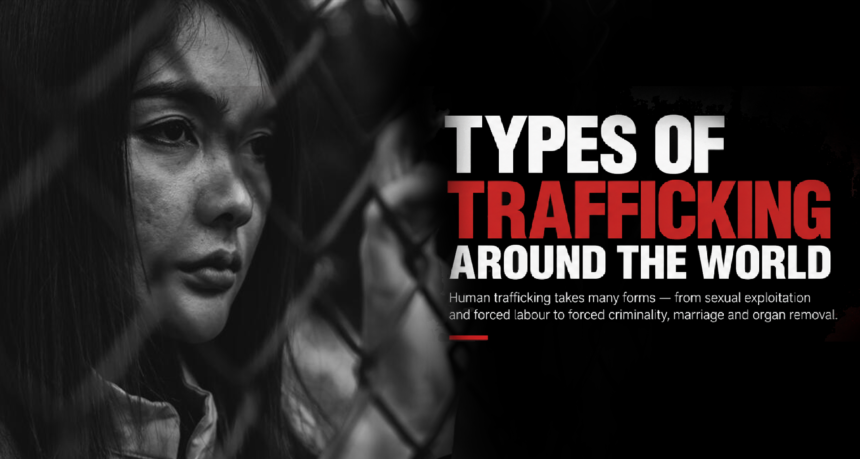
Human trafficking remains one of the world’s most widespread and difficult-to-detect crimes, affecting men, women and children across virtually every region. While trafficking is often associated with sexual exploitation, international reports show that victims are also exploited through forced labour, forced criminal activity, begging, domestic servitude, forced marriage, child exploitation and organ removal. Increasingly, technology is giving criminal networks new ways to recruit and control victims.
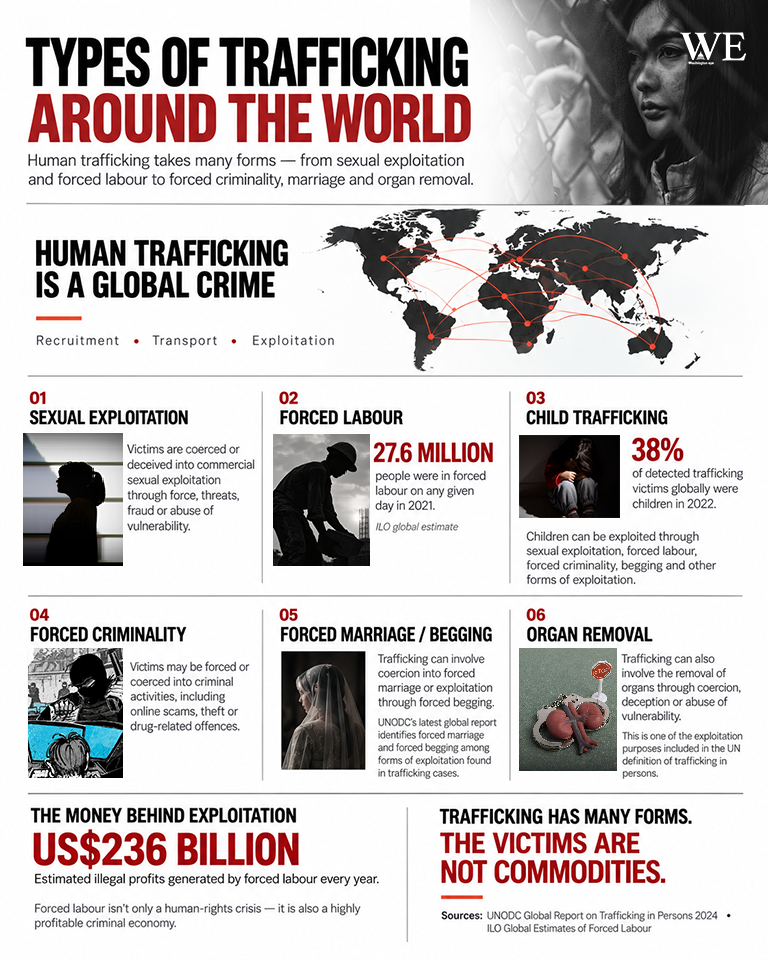
According to the United Nations Office on Drugs and Crime’s latest major global assessment, the number of detected trafficking victims in 2022 was 25% higher than in 2019, before the COVID-19 pandemic. Children accounted for 38% of detected victims, while the number of detected child victims had increased by 31%.
From Sexual Exploitation to Forced Labour: The Major Types

Forced labour is one of the largest forms of exploitation linked to trafficking. Victims may be forced to work in agriculture, construction, factories, fishing, domestic service, restaurants or other industries while traffickers confiscate passports, withhold wages, impose debts or threaten violence. The International Labour Organization estimates that 27.6 million people were in forced labour in 2021. Criminal exploitation of forced labour in the private economy generates an estimated $236 billion in illegal profits every year.
Sex trafficking and sexual exploitation particularly affect women and girls, although men and boys can also be victims. UNODC data show that 60% of detected girl trafficking victims were exploited sexually. Criminals commonly use false employment offers, romantic relationships, debt, threats or promises of migration to recruit victims.

Another growing concern is forced criminality. Victims can be compelled to steal, transport drugs, commit fraud or operate online scams. Southeast Asia has become particularly associated with trafficking into so-called scam compounds, where people recruited through apparently legitimate jobs can be confined and forced to conduct cryptocurrency, investment and romance scams.
Other forms include forced begging, domestic servitude, forced marriage and trafficking for organ removal. Organ trafficking particularly targets people facing poverty, displacement or insecure immigration status. Reports have identified cases and networks affecting parts of Africa, the Middle East and Asia.
Why and Where Does Trafficking Happen?

There is no single trafficking capital. Cases are recorded across Europe, Asia, Africa, the Americas and the Middle East, and trafficking can happen entirely within one country, it does not require crossing an international border. Poverty, unemployment, war, displacement, gender inequality, unsafe migration, corruption and weak law enforcement all increase vulnerability. Conflicts can create particularly dangerous conditions because displaced families may lose income, documentation and community protection.
Traffickers exploit these circumstances by offering jobs, transportation, accommodation or supposed opportunities abroad. Technology has further changed the crime. Recruitment can now begin through social media, dating applications, messaging services and fake online job advertisements. At the same time, digital evidence, artificial intelligence and data analysis can help authorities identify suspicious networks and locate victims.
Laws, Major Cases and the Fight Against Traffickers
The principal international legal framework is the UN Palermo Protocol, adopted in 2000 and in force since December 2003. It defines trafficking around recruitment, transportation, transfer, harbouring or receipt of people through coercion, fraud, deception or abuse of vulnerability for exploitation. It specifically covers sexual exploitation, forced labour, slavery-like practices, servitude and organ removal.
Countries have subsequently introduced their own anti-trafficking legislation, but enforcement remains uneven. The U.S. State Department’s 2024 global figures recorded 18,774 prosecutions, 7,115 convictions and 133,943 identified victims in 2023. The gap between identified victims and convictions demonstrates how difficult these cases can be to investigate and prosecute.
Some important cases have nevertheless demonstrated that sophisticated trafficking operations can be dismantled. In Britain, for example, a landmark 2023 prosecution resulted in convictions involving a plot to bring a young Nigerian man to the UK for removal of his kidney, demonstrating that trafficking laws extend well beyond conventional labour and sexual exploitation cases.
A Crime That Requires More Than Border Control
The critical challenge is that trafficking is primarily about exploitation rather than movement. A person does not have to cross a border to become a trafficking victim. Policies focused solely on immigration controls therefore risk overlooking domestic trafficking and victims who entered a country legally before being exploited.
Governments need stronger labour inspections, specialist police units, international intelligence sharing, financial investigations and tougher action against corrupt officials and businesses benefiting from exploitation. Safe migration channels, worker protections, shelters, legal assistance and compensation are equally important. Technology companies and recruitment platforms also have a growing responsibility to detect fraudulent advertisements and trafficking-related activity.
Ultimately, trafficking survives because exploitation remains highly profitable while victims are frequently too frightened, isolated or economically dependent to report it. The global response has produced stronger laws and more prosecutions, but the continuing rise in detected victims, particularly children, shows that legislation alone is insufficient. Tackling poverty and conflict, protecting migrants and workers, disrupting criminal finances and ensuring survivors can safely cooperate with authorities will be essential if governments are to turn anti-trafficking commitments into measurable results.