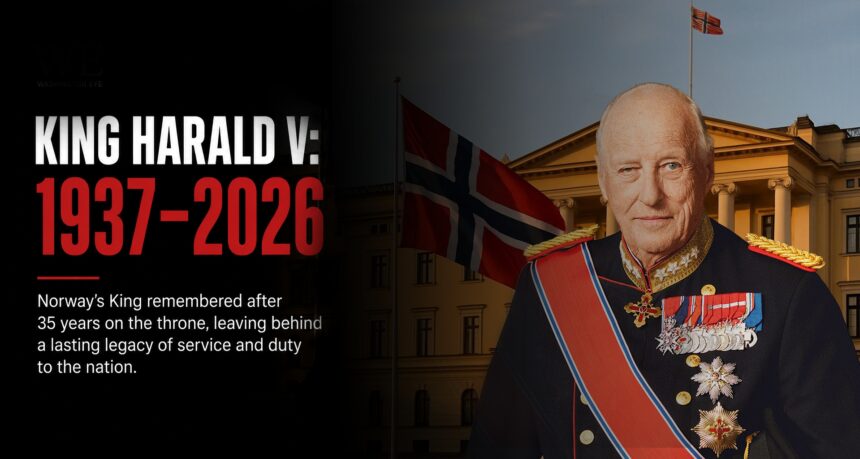
Norway is mourning the death of King Harald V, the country’s long-serving monarch who helped modernise the Norwegian royal family and became known for his messages of tolerance, national unity and social inclusion. Harald died peacefully on August 28 at Oslo University Hospital Rikshospitalet, aged 89, bringing his 35-year reign to an end.
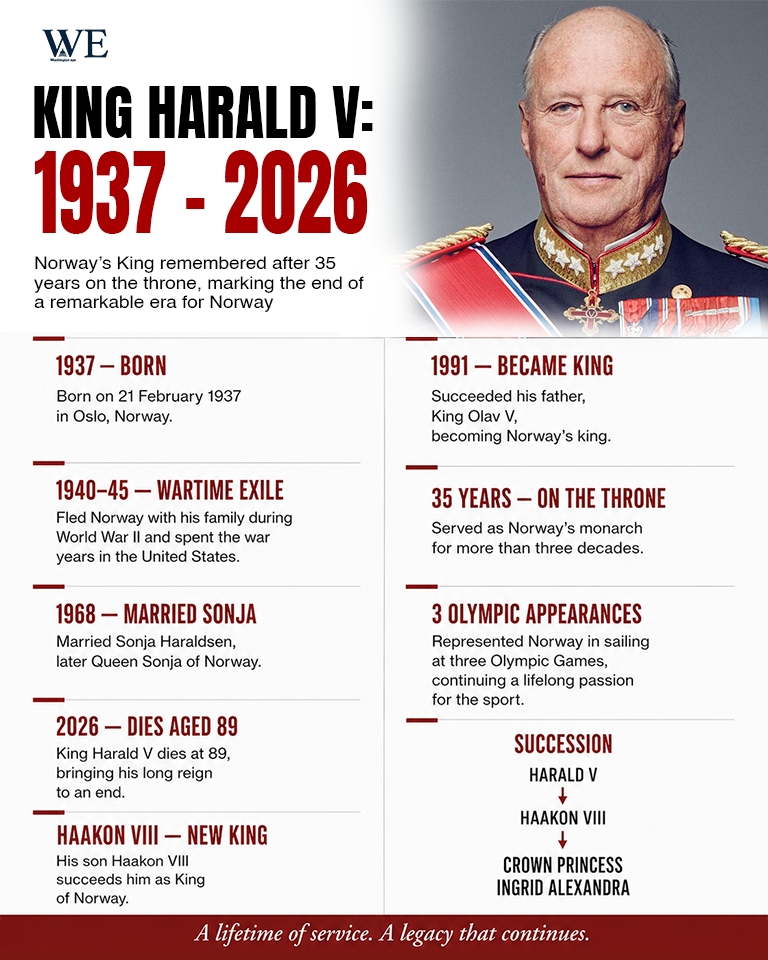
His death immediately triggered a constitutional succession. His only son, Crown Prince Haakon, became King Haakon VIII, while Haakon’s daughter, Ingrid Alexandra, became crown princess and first in line to the throne. On September 1, the new king took his constitutional oath before Norway’s parliament, the Storting, pledging to uphold the country’s constitution and laws.
Tens of thousands of Norwegians have gathered outside the Royal Palace in Oslo, leaving flowers, candles, drawings and Norwegian flags in tribute to a monarch who remained remarkably popular throughout much of his reign. Harald’s coffin is lying in state in the Royal Palace chapel ahead of a state funeral scheduled for September 9.

From Wartime Prince to King of Norway
Harald was born on February 21, 1937, at Skaugum near Oslo, the only son of Crown Prince Olav and Crown Princess Märtha. His birth carried historic significance: he was the first Norwegian-born royal heir in almost six centuries. His childhood was dramatically disrupted by the Second World War. When Nazi Germany invaded Norway in 1940, the young prince, his mother and sisters fled the country and eventually spent much of the war in the United States. His father and grandfather, King Haakon VII, meanwhile supported Norway’s government-in-exile from Britain.

Harald later studied at the University of Oslo and Balliol College, Oxford, and developed a lifelong passion for sailing. He represented Norway in three Olympic Games—1964, 1968 and 1972—and carried the Norwegian flag at the opening ceremony of the 1964 Tokyo Olympics. His private life also challenged royal convention.
Harald fell in love with Sonja Haraldsen, a commoner, but their relationship faced years of resistance because she was not of royal or aristocratic background. After a courtship lasting around a decade, they married in 1968. Sonja eventually became queen when Harald inherited the throne. The couple had two children: Princess Märtha Louise and Haakon, who has now succeeded his father.
A 35-Year Reign That Modernised the Monarchy

Harald became king on January 17, 1991, following the death of his father, King Olav V. Unlike monarchs of earlier generations, Harald operated in a wealthy, highly democratic Scandinavian society where the monarchy’s political authority was limited but its symbolic importance remained substantial. His role therefore focused heavily on representing Norway, supporting national institutions and providing a sense of continuity during moments of celebration and crisis.
Perhaps the most difficult moment of his reign came after the July 22, 2011 terrorist attacks, when 77 people were killed in Oslo and on the island of Utøya. Harald became an important symbol of national mourning and solidarity, speaking publicly about grief, unity and the need to protect an open society.
He also became associated with a more inclusive conception of Norwegian identity. His speeches acknowledged immigrants, religious diversity, and people with different backgrounds as equally belonging to the country. That approach helped Harald maintain substantial popularity even as monarchies elsewhere in Europe faced growing questions about their relevance.
Years of Health Problems Before His Death
The king’s health had become an increasing concern during the final years of his reign. He underwent several periods of hospital treatment and had experienced infections and heart-related problems. Crown Prince Haakon periodically acted as regent when his father was unable to perform official duties. In 2024, Harald became ill while on holiday in Malaysia and was temporarily fitted with a pacemaker before returning to Norway. A permanent pacemaker was subsequently implanted.
Health problems continued in 2026. In February, while holidaying in Tenerife, Spain, the king was hospitalised with an infection and dehydration. Harald ultimately died peacefully at Oslo University Hospital on August 28. His death ended a reign lasting more than three and a half decades and removed the man who, at the time, had been Europe’s oldest reigning monarch.
Norway Gets a New King
Under Norway’s constitutional system, there was no period without a monarch. At the moment Harald died, his son automatically became King Haakon VIII, aged 53. The transition became formally visible when Haakon appeared before parliament on September 1 to swear the oath required by Norway’s constitution. His daughter Ingrid Alexandra accompanied him and is now heir to the throne.
Haakon inherits a monarchy that remains broadly supported but is entering a challenging period. Recent controversies involving members of the extended royal family have placed unprecedented pressure on the institution. Harald’s personal popularity and reputation for stability often helped insulate the monarchy from those disputes. Haakon must now establish his own style while preserving public confidence.
Funeral and National Mourning
Norway has entered a period of national mourning, with people travelling to Oslo to pay their respects. Harald’s coffin was moved through the Royal Palace to the palace chapel, where members of the public have been given an opportunity to honour the late king. Queen Sonja and other members of the royal family have participated in memorial events. The state funeral is scheduled for September 9, after which Harald is expected to be buried in the royal mausoleum at Akershus Fortress in Oslo, alongside previous Norwegian monarchs. International condolences have arrived from monarchs, presidents and governments around the world, reflecting Harald’s decades as Norway’s head of state.
The End of an Era for Norway
King Harald possessed little direct political power, but his influence came from something more difficult to measure: continuity. During his reign, Norway experienced enormous economic and social change, became one of the world’s wealthiest countries and developed into an increasingly diverse society. Harald adapted the monarchy to those changes rather than attempting to resist them.
His death also demonstrates the challenge facing modern European monarchies. Their survival increasingly depends not on constitutional authority but on public trust, restraint and an ability to represent societies that are far more diverse than those in which royal institutions originated.
Haakon VIII now inherits that responsibility. Harald leaves behind Queen Sonja, two children, grandchildren and a monarchy profoundly shaped by his 35 years as king. His reputation will likely rest less on political events, over which he had limited authority, and more on his ability to serve as a unifying national figure during both prosperity and tragedy. For Norway, August 28, 2026 marks more than the death of a king. It marks the end of a generation of Scandinavian monarchy and the beginning of the reign of King Haakon VIII.