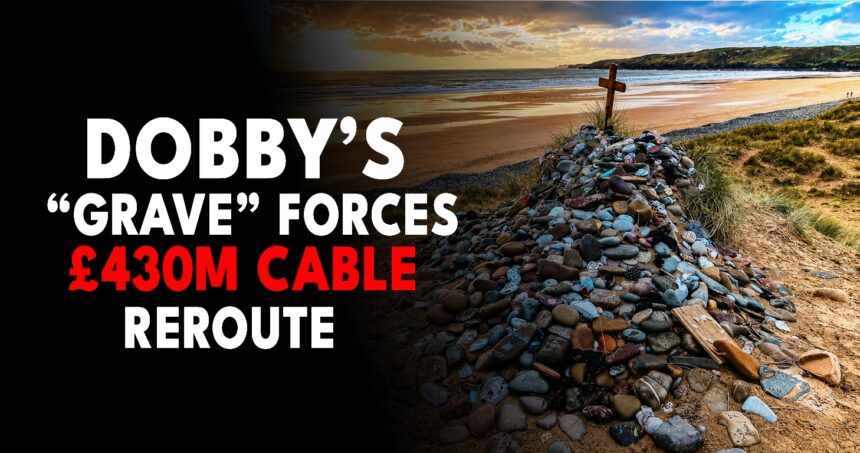
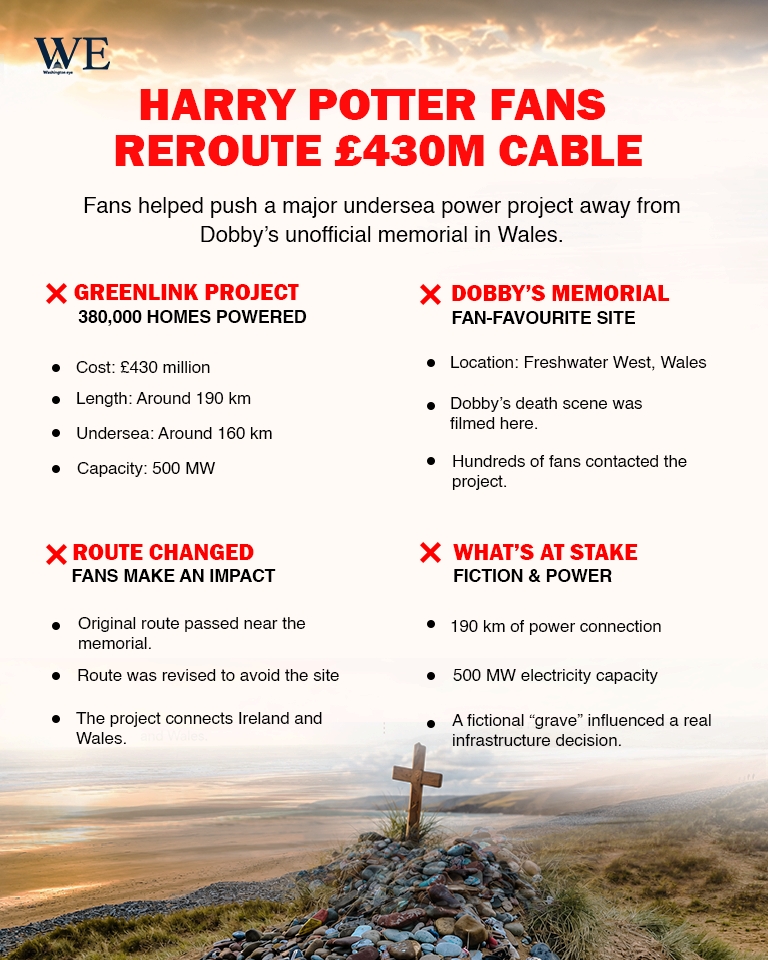
The power of Harry Potter fandom has produced an unusual real-world consequence after developers of a £430 million electricity link between Britain and Ireland changed its planned route to avoid the unofficial “grave” of Dobby, the fictional house-elf whose death became one of the film series’ most emotional moments.
The story emerged publicly in August after former Greenlink project director Simon Ludlam discussed the episode on The Energy Revolution podcast. The Greenlink electricity interconnector runs for about 200 kilometres (125 miles) between County Wexford in Ireland and Pembrokeshire in Wales, linking the Irish electricity system with Britain’s National Grid.
The original plans would have taken the cable through an area of Freshwater West beach, the spectacular Welsh coastline used to film scenes from Harry Potter and the Deathly Hallows – Part 1. It was there that Harry buried Dobby after the house-elf died while helping him and his friends escape. Although Dobby is entirely fictional and no character is actually buried there, fans subsequently created an unofficial memorial on the beach.

How Dobby’s ‘Grave’ Changed a £430m Project
Freshwater West has become a pilgrimage site for Harry Potter fans. Visitors leave stones carrying messages such as “Here Lies Dobby,” as well as socks, a reference to the moment in the series when Harry tricks Lucius Malfoy into giving Dobby his freedom. The controversy began after Ludlam appeared in a BBC interview and pointed out where the Greenlink cable was expected to come ashore and travel underground. When the interview was broadcast several weeks later, the project suddenly began receiving complaints.
Ludlam said developers received hundreds of calls from people concerned that construction would disturb Dobby’s memorial. He initially did not understand the controversy because he was unfamiliar with the character. Once the scale of the reaction became clear, planners were brought in to identify an alternative route. The cable was eventually redirected so that it would avoid the unofficial Dobby memorial, satisfying many of the fans who had contacted the project.
The result demonstrates an extraordinary collision between fictional popular culture and major real-world infrastructure: a character created by J.K. Rowling ended up influencing planning surrounding a project worth hundreds of millions of pounds.
What Is the Greenlink Interconnector?

Despite the amusing circumstances surrounding the rerouting, Greenlink itself is a major piece of energy infrastructure. The high-voltage electricity interconnector connects the grids of Ireland and Great Britain, allowing electricity to flow between the two markets. Such connections can improve energy security by allowing countries to import electricity when domestic supplies are under pressure and export surplus power when more is available.
The project is valued at approximately £430 million, or more than €500 million, and its roughly 200km route includes a major subsea section across the Irish Sea. Interconnectors are becoming increasingly important as European electricity systems incorporate larger quantities of renewable energy. Wind and solar generation fluctuate according to weather conditions, so connections between national electricity networks can help balance supply and demand. That makes Greenlink far more consequential than the unusual Dobby controversy might suggest.
The Strange Twist: Real Bronze Age Remains
The story became even more unusual when Ludlam revealed that, after avoiding the fictional grave, the project’s alternative route passed relatively close to real Bronze Age archaeological remains. These included urns associated with human burials. The contrast immediately attracted attention: planners had changed the route because of public pressure surrounding the imaginary burial place of a fictional house-elf, only to encounter genuine archaeological heritage elsewhere.
That does not mean archaeological remains were simply destroyed. Major infrastructure projects in Britain are subject to planning, environmental and archaeological requirements, with specialists assessing sites and determining how heritage should be protected. Nevertheless, the episode provided an almost unbelievable conclusion to an already unusual planning story.
Why the Dobby Memorial Is Controversial
Ironically, the National Trust, which owns Freshwater West, has itself expressed concerns about the unofficial memorial. The organization decided in 2022 that the tribute could remain but asked visitors not to leave socks, painted stones or other objects, because Freshwater West is an environmentally sensitive protected landscape. Large numbers of physical tributes can disturb the environment, while painted materials and other objects may introduce pollution.
That creates an interesting contradiction. Fans successfully helped ensure that major infrastructure avoided the memorial, yet the continuing expansion of the memorial itself can place pressure on the beach that inspired their campaign. The National Trust has encouraged visitors to enjoy the location while following “leave no trace” principles.
Should Fiction Influence Real Infrastructure?
The episode raises a surprisingly serious planning question: how much weight should cultural attachment carry when governments and companies design major infrastructure? From a purely practical perspective, Dobby’s grave does not exist. It was a film location that later became a fan-created memorial. Yet places can acquire cultural significance regardless of whether the events associated with them were real. Film and television locations increasingly attract international tourism, creating economic and emotional value for communities.
Freshwater West illustrates that phenomenon particularly clearly. For Harry Potter fans, the location represents one of the franchise’s most memorable scenes. For planners, however, it remains a physical landscape where environmental protection, public access, archaeology and infrastructure must all be balanced. The episode is also a remarkable example of fan activism influencing a multimillion-pound development.
A fictional house-elf could never have appeared on an official planning application as a resident requiring protection. But hundreds of real people cared enough about the place associated with him to make their objections heard. And they succeeded. Years after Dobby famously became “a free elf,” his unofficial resting place has achieved something even more unexpected: making a £430 million energy project move out of the way.